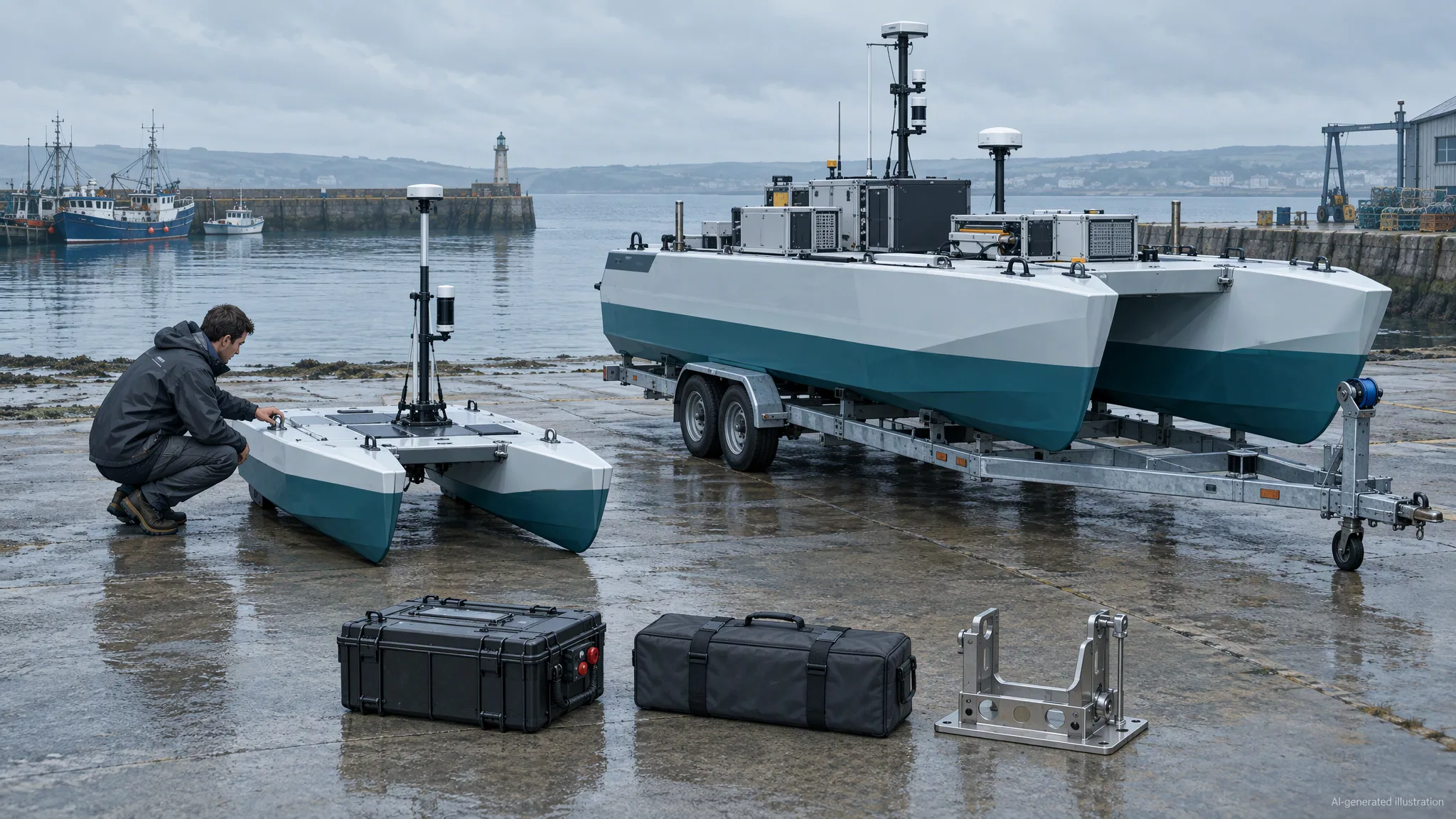
An unmanned surface vehicle is the part of a survey or monitoring system that floats, and almost everything that decides whether the project works is arranged around it: the instrument, its mount, its power, the link to the bank, the way the boat goes into the water. That is why comparing two models by their largest number goes wrong so often. Across the eight Aqua Helpers platforms we supply — KOI, KOI TURBO, HUNTER, HUNTER-X, Orcalink, ORCALINK-X, Seeker and MANTA — the same quantity is written to different definitions, and the first job is to establish which definition is in front of you.
What is an unmanned surface vehicle being bought for?
It is bought as a configuration that carries instruments over water, not as a hull type. The vehicle holds the sounder, the probe, the ADCP or the sampling line; the operator stays on the bank or on a support boat; what the project gets is a data set or a set of samples. Everything else in the comparison — load, hours, sea state, link, handling — is a constraint on that job.
The span inside one family shows how little the model name settles. Our platforms run from the 0.99 m KOI to the 6.6 m MANTA, and from a 12 kg hull to an 1,800 kg lightship vessel. A 12 kg boat and an 1,800 kg boat are not really compared with each other; each is checked against the same few questions, in a different order. If the sensing has to happen below the surface instead of on it, the question changes altogether: our comparison of surface, tethered and autonomous vehicles follows where the measurement happens rather than the vehicle name.
Which figure is the payload?
The one that tells you whether the battery is inside it. Three of our models publish both an equipment-only load and a battery-plus-equipment load, and the pair only helps if the quotation says which basis it uses:
| Model | Vehicle mass, as published | Load, as published | What the two rows give |
|---|---|---|---|
| HUNTER-X | 50 kg with battery; 35 kg without | 20 kg equipment; 35 kg battery + equipment | The same 15 kg battery from either row |
| ORCALINK-X | 230 kg with battery; 170 kg without | 100 kg equipment; 150 kg battery + equipment | 60 kg by mass, 50 kg by load |
| KOI TURBO | 11 kg hull weight | 20 kg equipment; 50 kg battery + equipment | The hull figure is published without a battery note, so there is no third number to test |
Two rows of that table say different things. On the HUNTER-X the four figures close on each other: strip the battery out of the vehicle mass and 35 kg remains; strip the equipment out of the combined load and the same 15 kg remains. On the ORCALINK-X they do not close: the mass pair implies a 60 kg battery, the load pair implies 50 kg. So the combined figure has to be read as an allowance for a configuration, not as a sum you can recompute, and which reading a quoted boat uses belongs in writing, in the quotation.
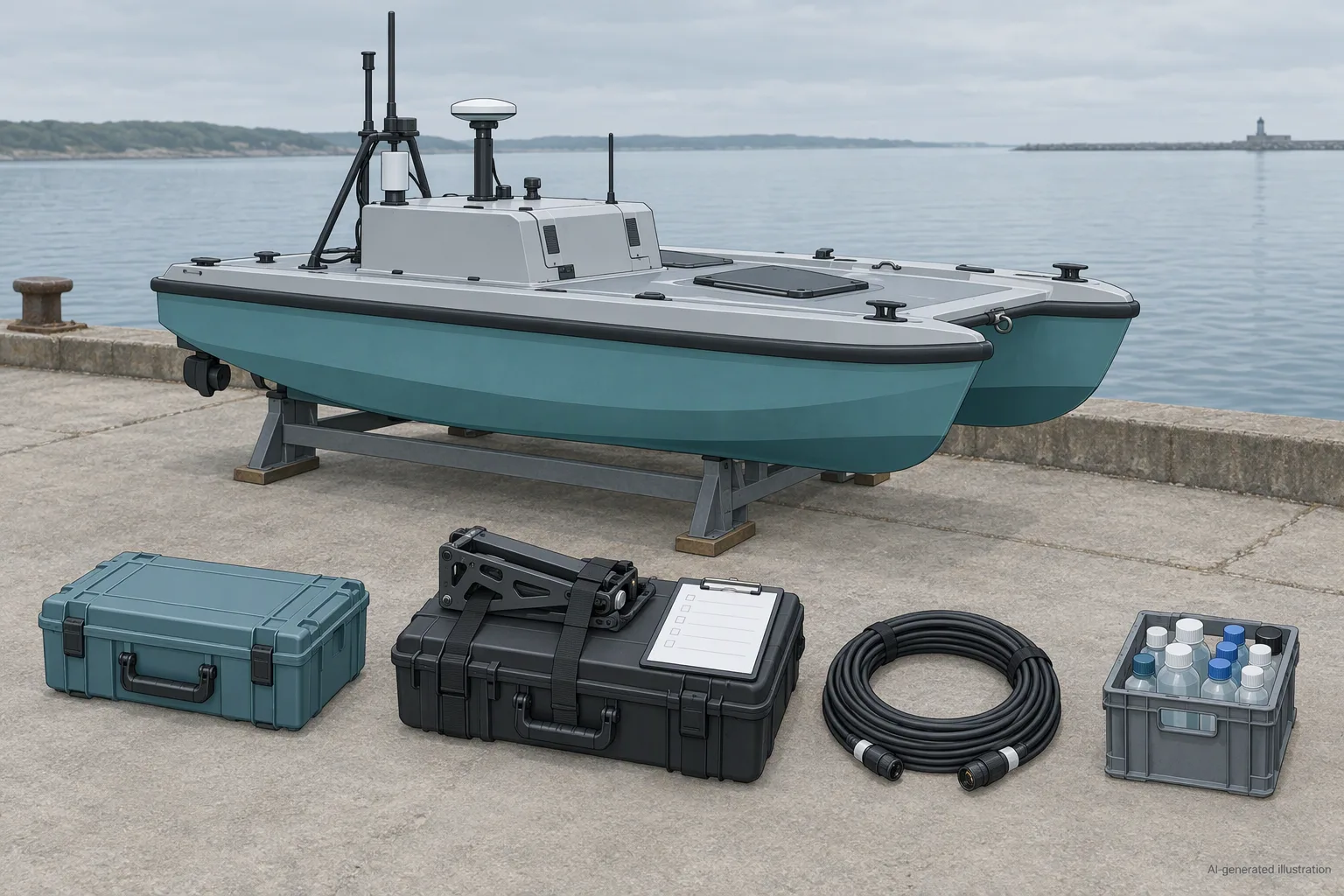
What sits inside that allowance is usually more than buyers expect: the sounder head and its fairing, the mounting bracket, the cable run, the sampler and its bottles, the antenna. A payload figure is a budget for all of it. Our surface platform comparison puts the published bases side by side, and draught follows the load too — a 0.15 m reference on the KOI against 0.48 m on the MANTA, and a 1,800 kg lightship against 1,970 kg full load on the MANTA alone. Ask for the instrument list in kilograms, on the configuration you are being quoted.
How many hours does a day actually give you?
An endurance figure without a speed is not a day. The HUNTER publishes 5 hours at 1.5 m/s and 1–2 hours at its 6 m/s maximum: one hull, hours differing by a factor of three, and the difference is the throttle, not the battery. The MANTA publishes 20 hours of operational endurance, a 230 nmi maximum range, a 40 kn maximum speed and a 5–30 kn operating speed — and its own configuration note says these are not one simultaneous operating point.
That is not a marketing flourish; it is the arithmetic of a survey day. Distance covered is speed times hours, area covered is that distance times the swath you set, and the transit out and back comes off the top. Our article on matching an area to one vehicle's day runs that calculation on the same pair of figures, and the survey time calculator will do it with your area and your line spacing. What the calculator will not do is supply an endurance number for a model that has not published one against a speed.
What sea can it be launched into?
Sea state is the first thing a skipper asks and the last thing a specification table answers cleanly. The Seeker and the MANTA carry an operational Sea State 3 and a survival Sea State 4 — a working limit and a limit for coming through weather, which are not two grades of the same permission. The smaller models publish a wind figure beside a wave height instead, and the two scales do not convert into each other at your site. How to read each of those ratings, and why 0.5 m and 1 m can sit beside the same Beaufort label, is set out in our article on how to read operational and survival ratings.
How far does the link reach?
Usually further than the video does. The KOI publishes a 5 km data range and a 3 km image range; the KOI TURBO publishes 2 km for both. The Seeker and the MANTA publish a 15 nmi private-network range and, separately, a 30 km nominal coverage distance described as ground-to-air line of sight — which is not the same promise across water. Satellite communication is an option on the larger models, not a standard fit. If the day depends on watching video, size the day on the image figure; why the two limits separate is the subject of its own article.
Who lifts it into the water?
Whoever the configured mass allows. Hull weights across the range start at 11 kg on the KOI TURBO and 12 kg including battery on the KOI, sit at 50 kg with battery on the HUNTER-X and 230 kg with battery on the ORCALINK-X, and end at 1,800 kg lightship on the MANTA. The KOI TURBO carries a four-point lifting design that its manufacturer describes as supporting single-person handling and deployment — and that description sits beside a 50 kg battery-plus-equipment allowance, so the mass in one person's hands is the bare hull, not the boat with a sounder, a bracket and a battery aboard. At the other end, the MANTA's configuration notes ask the buyer to check launch and recovery for a 1,800 kg lightweight platform, with a 270 L fuel tank, a trailer or a crane, and the people to run them.
The handling plan follows the configured mass. That is the sentence to settle before the model is fixed, because it decides the vehicle, the slipway and how many people stand on it.
What is mounted through the hull, and what is only a listed option?
A through-hull fitting is a commitment; an option list is not. The KOI TURBO has a 250 mm through-hull moon pool and two interchangeable rear hatches — a full-coverage hatch that seals both the moon pool and the rear compartment, and a simplified open hatch intended for sampling or a vertically mounted instrument, both on quick-release latches. Its single-beam echo sounder and dual RTK antennas are listed as part of the survey arrangement, which is a different statement from the same instruments appearing among the options. The Seeker offers dual moon pools and rail mounts; the HUNTER lists single-beam, multibeam and side-scan sonar, RTK, sampling and water-quality instruments as options, and an option is not a delivery item until the quotation says so.
A category in a list does not establish that a particular third-party instrument fits. The questions are dimensional: does it pass the opening, does the bracket put it at the right depth and orientation, what power and data does it need, and who supplies the interface. Ask for a drawing of the arrangement, not a category name.
Who answers for the numbers?
The manufacturer's sheet states the ratings; we supply the platform, coordinate the configuration and quote it. Every figure here is a published rating for a named model under a stated condition, and none of it is a measurement taken on your site. Where the sheet gives two readings of one quantity, the quotation has to say which one applies to the boat being offered — that is what a written quotation is for, and it is why the scope note beneath the table matters more than the table.
The other half of that answer is what sits inside the price: which controller, which battery arrangement, which instruments, which accessories. Our guide to choosing a USV sets out the order we work in — task and data first, payload and installation second, launch access last.
What do we need before we can compare platforms?
Four things, and none of them is a model name: the task and the data it has to produce; the instruments with their mass, dimensions, power and data interface; the site's sea, current, depth and access; and the handling available — bank, slipway, trailer, crane, people. Send those and we can set a configuration against the manufacturer's stated ratings and say where the two do not meet. What we cannot do is turn a manufacturer's rating into a safe working limit for your water; which rules apply to operating an uncrewed craft where you work is a question for your regulator.
When the answer needs a quotation rather than a reading, put the same four things into the project inquiry on our main site. The instrument list matters more than the shortlist.
Filed under USVs
Back to Blog