Marine robotics / Definition
ADCP
Acoustic Doppler current profiler
An ADCP uses the Doppler shift of sound reflected by particles in the water to measure water-current velocities at different depths.
At a glance
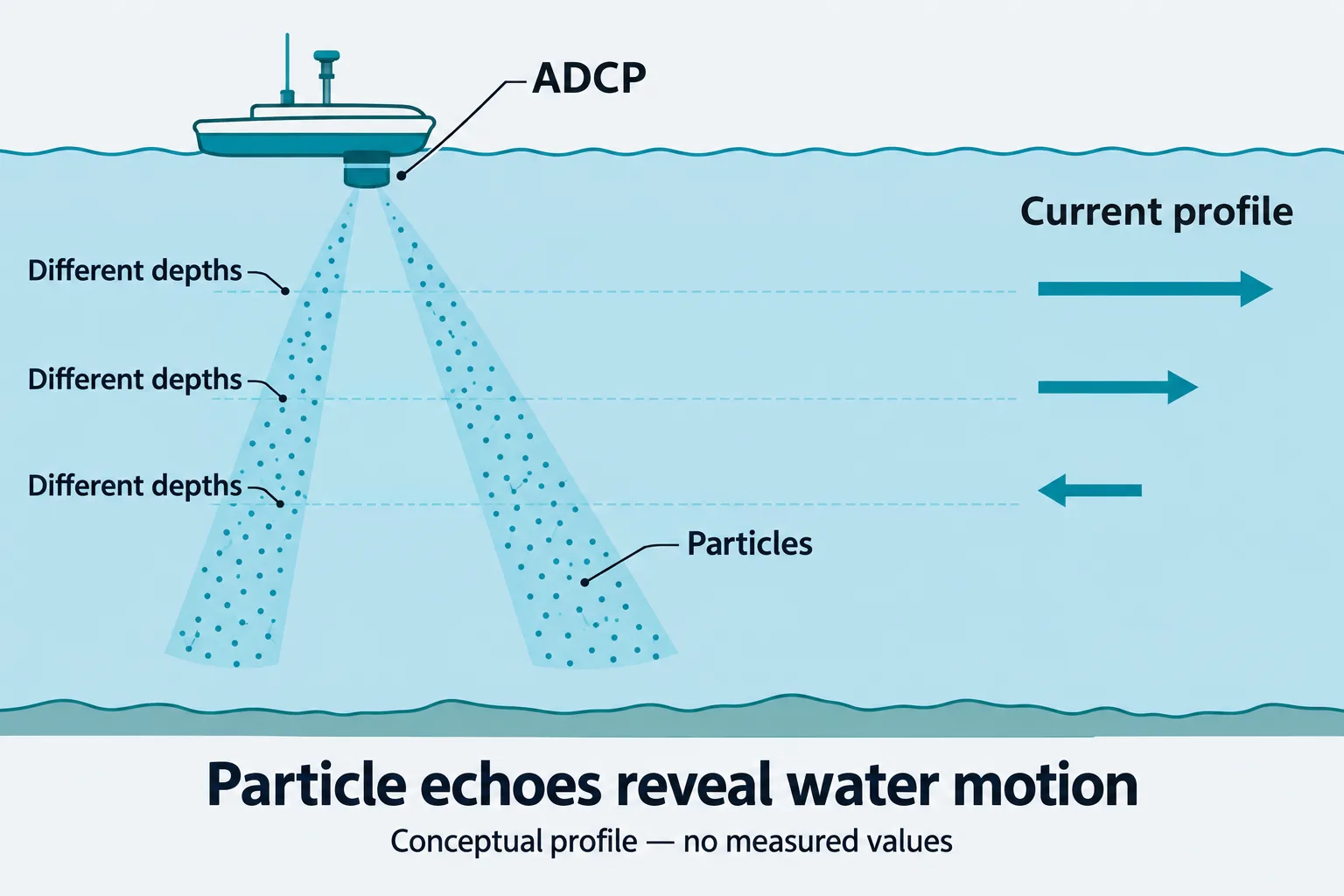
An ADCP uses echoes from particles within the water column to estimate water motion at different depths. The arrows illustrate a current profile, not sonar direction or measured values. AI-generated illustration; not an actual instrument, dataset or field result. Not to scale.
View full-size diagram (opens in a new tab)What the term means
An acoustic Doppler current profiler transmits sound into the water and analyzes echoes from suspended particles. Changes in the frequency of those echoes provide information about motion relative to the instrument. The USGS describes this Doppler principle as the basis for ADCP water-current measurements.
The word profiler matters: the instrument characterizes velocity through portions of the water column, rather than returning only one surface-speed value.
Mission context
ADCPs are used to study currents and, with an appropriate measurement method, determine river discharge. The USGS documents discharge measurements made from moving boats. In that context, water velocity is one part of a measurement that also has to account for the moving platform and the river cross-section.
For a USV project, specifying an ADCP is therefore more informative than asking for a generic water sensor. The intended output may be a current profile or a discharge result, and the instrument, installation and data workflow must suit that output.
A common confusion
An ADCP is not simply another name for a bathymetric echo sounder. Its primary purpose is to measure water velocity; an echo sounder is used to measure acoustic ranges to the bottom. Some instruments provide additional measurements, but neither instrument name alone establishes a complete mapping or discharge capability.