Marine robotics / Definition
USV
Uncrewed surface vessel · Unmanned surface vehicle
A USV is an uncrewed surface vessel that operates on the water surface, using remote control or programmed navigation to carry task-specific equipment.
At a glance
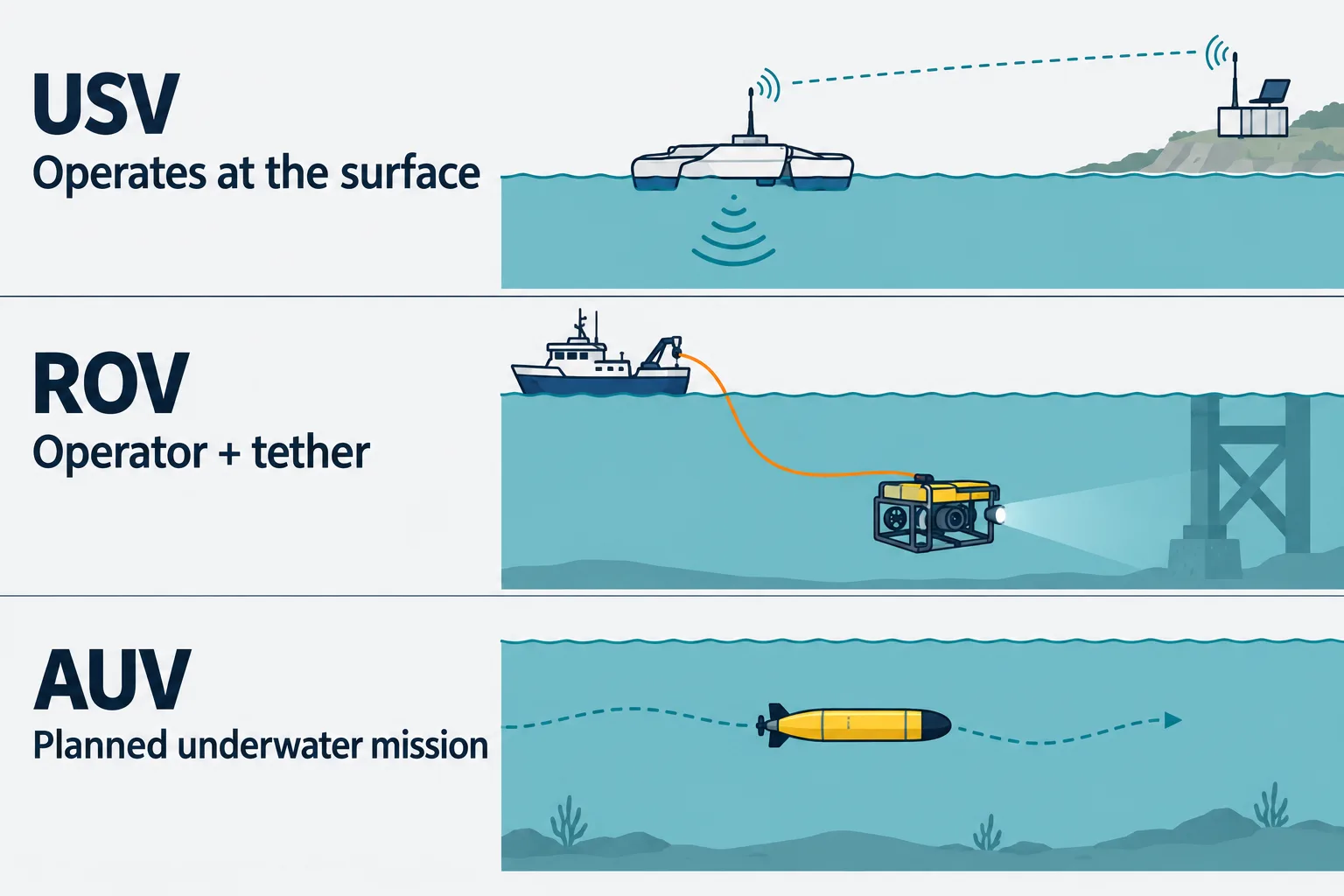
The USV stays at the surface even when its sensors observe below it. The ROV uses a tether; the AUV follows an untethered underwater mission. AI-generated illustration; generic vehicles, not actual products or field evidence. Not to scale.
View full-size diagram (opens in a new tab)What the term means
A USV is a boat or other surface platform with no crew aboard. The abbreviation is used for both uncrewed surface vessel and unmanned surface vehicle. NOAA describes USVs that are remotely controlled from shore or a ship, as well as platforms that follow pre-planned missions with limited real-time input.
The term identifies where the vehicle operates and the absence of an onboard crew. It does not, by itself, specify a level of autonomy, hull design, propulsion system or sensor package.
Mission context
A survey USV can carry an echo sounder to measure bottom depths. A monitoring configuration can carry water-quality sensors, while a sampling configuration needs a mechanism to collect physical water samples. These are different payloads: the name USV alone does not establish that all three are included or interchangeable.
NOAA also describes surface vessels that support underwater vehicles with navigation or communications. That is a configured system role, not a standard capability of every survey boat.
A common confusion
An autonomous boat remains a surface vehicle; an AUV operates underwater. A USV may measure features below the surface with a sonar or submerged sensor without the vessel itself diving. Vehicle type and measurement location are separate questions when reading a specification.
What this means for equipment selection
Selecting a USV keeps the vessel at the surface while its payload performs the task. The trade-off is whether the required measurements can be made from that position or need an instrument carried underwater by an ROV or AUV. Survey, monitoring and physical sampling each call for a different payload arrangement.
On Aqua Robot Supply's USV equipment page, compare the platform and task-specific instrument configuration together; remote control or programmed navigation does not identify the sensors included.