USV vs ROV vs AUV: what actually decides mission fit?
For a USV vs ROV vs AUV decision, start with where your instruments must operate and whether an operator needs to respond to observations while the vehicle is underwater. We supply these equipment families at Aqua Robot Supply and coordinate configurations with their manufacturers. Our comparison is for defining an equipment requirement, not an operating procedure.
A surface vessel can collect underwater measurements. An autonomous underwater vehicle can inspect structures. A remotely operated vehicle can collect survey data. The task label alone—“survey,” “monitoring” or “inspection”—does not settle the choice.
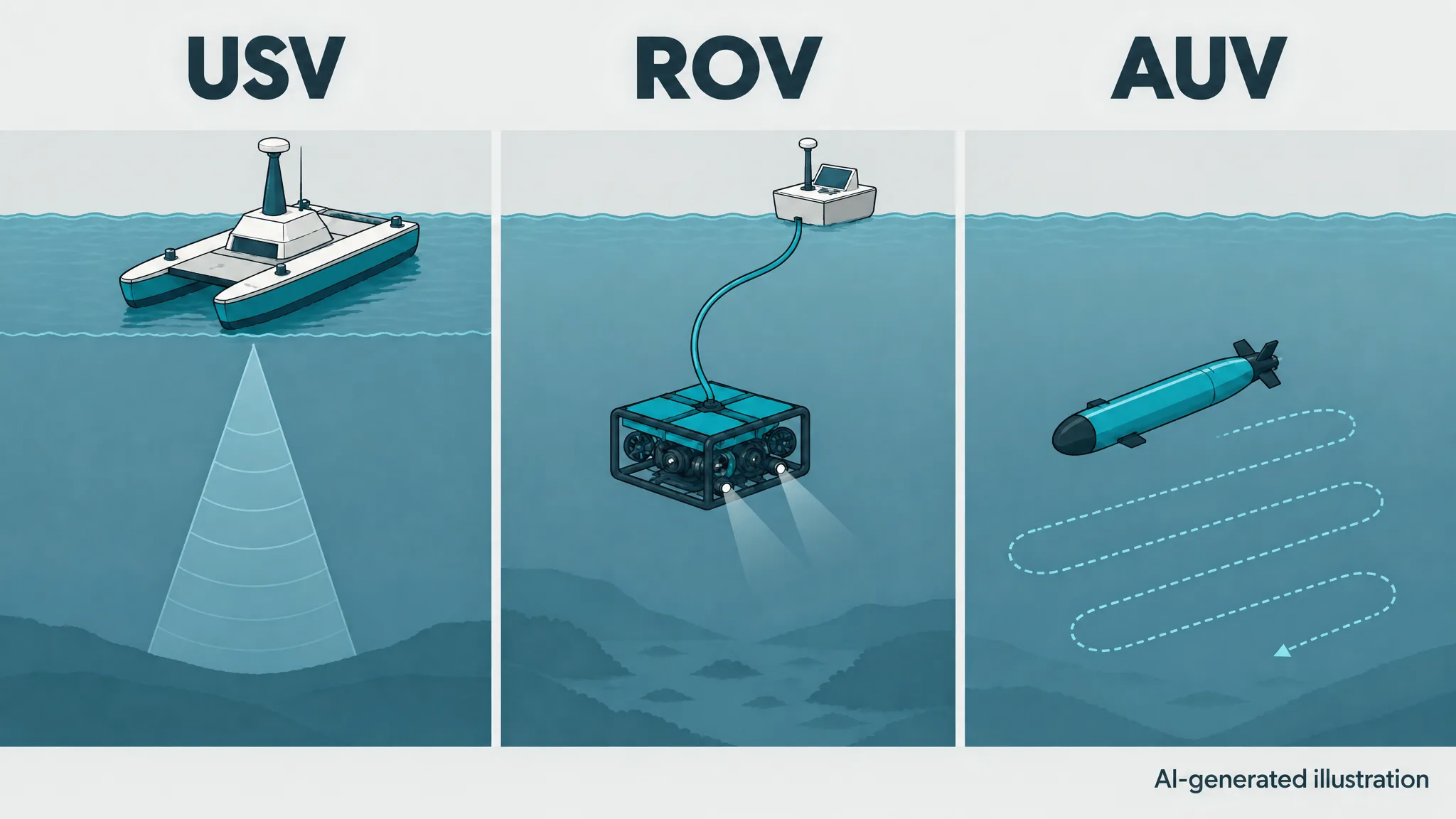
The more useful distinction is between carrying instruments from the surface, directing underwater work through a live connection, and sending an underwater platform on a planned mission. Choose that working arrangement first; compare models afterward.
| Vehicle family | Where the vehicle operates | Control arrangement | Start here when your task needs… |
|---|---|---|---|
| ROV: remotely operated vehicle | Underwater | An operator directs the vehicle through a tether | Live observation, immediate changes of viewpoint or operator-directed tool work |
| AUV: autonomous underwater vehicle | Underwater | Onboard systems execute the mission without continuous tethered piloting | Planned underwater coverage or repeatable sensor routes |
| USV: unmanned surface vehicle | On the water's surface | Remote control or automatic mission execution, depending on configuration | A surface carrier for survey, sampling or monitoring instruments |
These are starting points, not exclusive assignments. Sensor access, the required record and the available control arrangement can matter more than the category's usual application.
Can a surface vehicle do an underwater survey?
Yes. A USV stays at the surface, but its mission instruments can measure the water or seabed below it. Do not rule out a surface platform merely because the subject of the survey is underwater.
Our surface survey and monitoring platforms include configurations with optional sonar, sampling and water-quality instruments. The instrument package—not the hull by itself—determines what measurements the system can collect.
Start a USV configuration discussion when the required instruments can work from that surface platform. Describe the measurement, instrument placement and data output before choosing the vessel. If the sensor itself must travel underwater along a structure or through a particular water layer, that introduces a different requirement to evaluate.
For bathymetry, distinguish “the vessel can carry a sonar” from “this arrangement will produce the survey deliverable we need.” Mounting, positioning, power, data connections and processing belong in the equipment discussion. A payload mass figure does not answer those questions.
The control question remains separate. Automatic route following on the surface is not the same as underwater autonomy, and a surface radio link does not establish a live wireless connection to a submerged vehicle. Specify which measurements must be visible during the mission and which may be retrieved afterward.
When does live underwater control favor an ROV?
An ROV is the starting point when a person must look at the developing situation and decide where the underwater vehicle goes next. That might mean changing the camera angle, revisiting a suspicious area or directing an installed tool.
NOAA's explanation of tethered and autonomous vehicles distinguishes the ROV's cable-carried command and control from an AUV mission conducted without operator intervention. That distinction is more useful than assuming every inspection needs an ROV: ask whether the inspection requires continuous human decisions underwater.
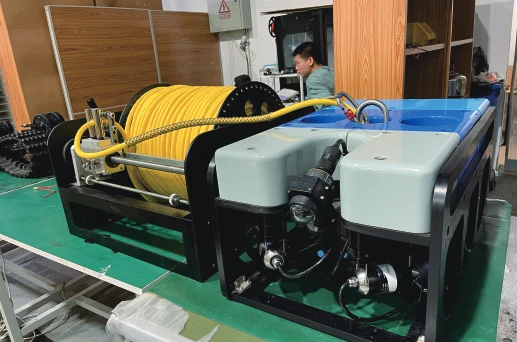
The live connection also creates a surface-side equipment requirement. Pengpai Ocean's cable-powered inspection systems describe deck controls, an umbilical, a winch and a guide arrangement. The vehicle is only part of that system; power, cable handling and access need their own place in the project brief.
Choose a different starting point if the deliverable is planned underwater coverage without a requirement for continuous live piloting. Conversely, keep an ROV in the discussion if the task depends on a person making close-up decisions as observations arrive. A planned route and an operator-directed examination answer different needs, even when both record sonar or camera data.
Are AUVs only for large-area seabed mapping?
No. An AUV can also collect data around structures when its mission, sensors and navigation are configured for that work. The important distinction is planned underwater acquisition versus continuous tethered piloting—not “mapping versus inspection.”
In its application materials, Pengpai Ocean describes using a PX-210 configured for underwater data acquisition with dual-frequency sonar to inspect piers in the eastern section of the Qingdao Jiaozhou Bay Cross-Sea Bridge. The manufacturer describes navigation around the piers and side-scan data supporting routine pier maintenance.
This is a manufacturer-reported example, not a project performed by us or an independently verified performance comparison. Its relevance is the combination of a defined group of structures, an underwater route and a sonar-data output. It shows why “bridge inspection” does not automatically mean “ROV.”
It does not establish that an AUV can replace every close-up examination of those structures. A sonar acquisition task is different from a live camera investigation or operator-directed manipulation. State which output your team needs before deciding that the vehicle in one example fits your project.
Also distinguish mission autonomy from data access. An AUV that follows its route independently does not thereby provide a continuous live video feed. Specify what must be recorded onboard, what information must reach the operator during the mission, and when the complete data set must be available.
Does a hybrid AUV/ROV remove the need to choose?
A hybrid adds operating modes; it does not eliminate mode-specific requirements. It is relevant when your project needs both autonomous underwater missions and tethered observation, but each mode still needs a defined configuration.
Pengpai Ocean's dual-mode PX-180ARV platform describes autonomous navigation in AUV mode and tethered control with online video observation in ROV mode. Navigation equipment, acoustic communication, control cables and surface controls need to be specified for the intended arrangement.
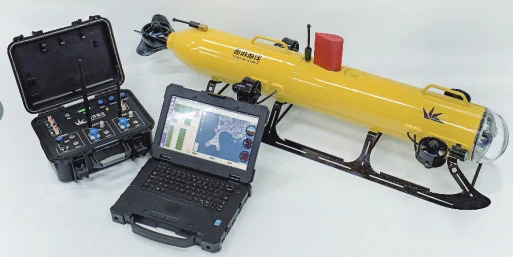
Ask what changes between modes: the mission software, navigation sensors, connection to the operator and surface equipment. Do not assume that a hybrid label means every autonomous function and tether option arrives in one standard kit.
If your task only requires live observation, a conventional ROV may be the more relevant family to evaluate. If it only requires planned underwater data collection, evaluate an AUV against that requirement. Specify a hybrid because both modes serve a defined task, not because two acronyms sound more capable than one.
What must the mission brief include before comparing models?
Write the brief around the required evidence and the decisions that must happen during the mission. We suggest recording the following requirements before requesting a configuration:
- The deliverable. Name the measurements, video, imagery, samples or tool action required. “Inspect the site” is not specific enough to distinguish a planned sonar survey from a live visual examination.
- The sensor's working position. State whether the instrument can work from the surface or must travel underwater, and identify the area, structures or water layers it must observe.
- The control and data needs. Separate automatic route execution, live piloting, onboard recording and information required during the mission. Do not treat them as one feature called “remote operation.”
- The site and complete equipment arrangement. Describe water conditions, obstacles, shore or vessel access, power, communications and handling facilities. Include instrument models and interfaces if they are already selected.
Have the manufacturer and your site's qualified technical personnel review operating limits and launch, recovery, power and cable arrangements for the selected system. A family comparison cannot determine those site-specific conditions.
We coordinate equipment selection and quotations with manufacturing partners; we do not perform the survey or inspection. Send the brief through our project equipment inquiry, including the decisions an operator must make while the mission is running. That gives the discussion a concrete starting point: surface-carried measurements, live underwater control, planned underwater acquisition—or a specifically defined combination.