Marine robotics / Definition
ROV
Remotely operated vehicle
An ROV is a remotely operated underwater vehicle linked to an operator by a tether that carries control signals and data.
At a glance
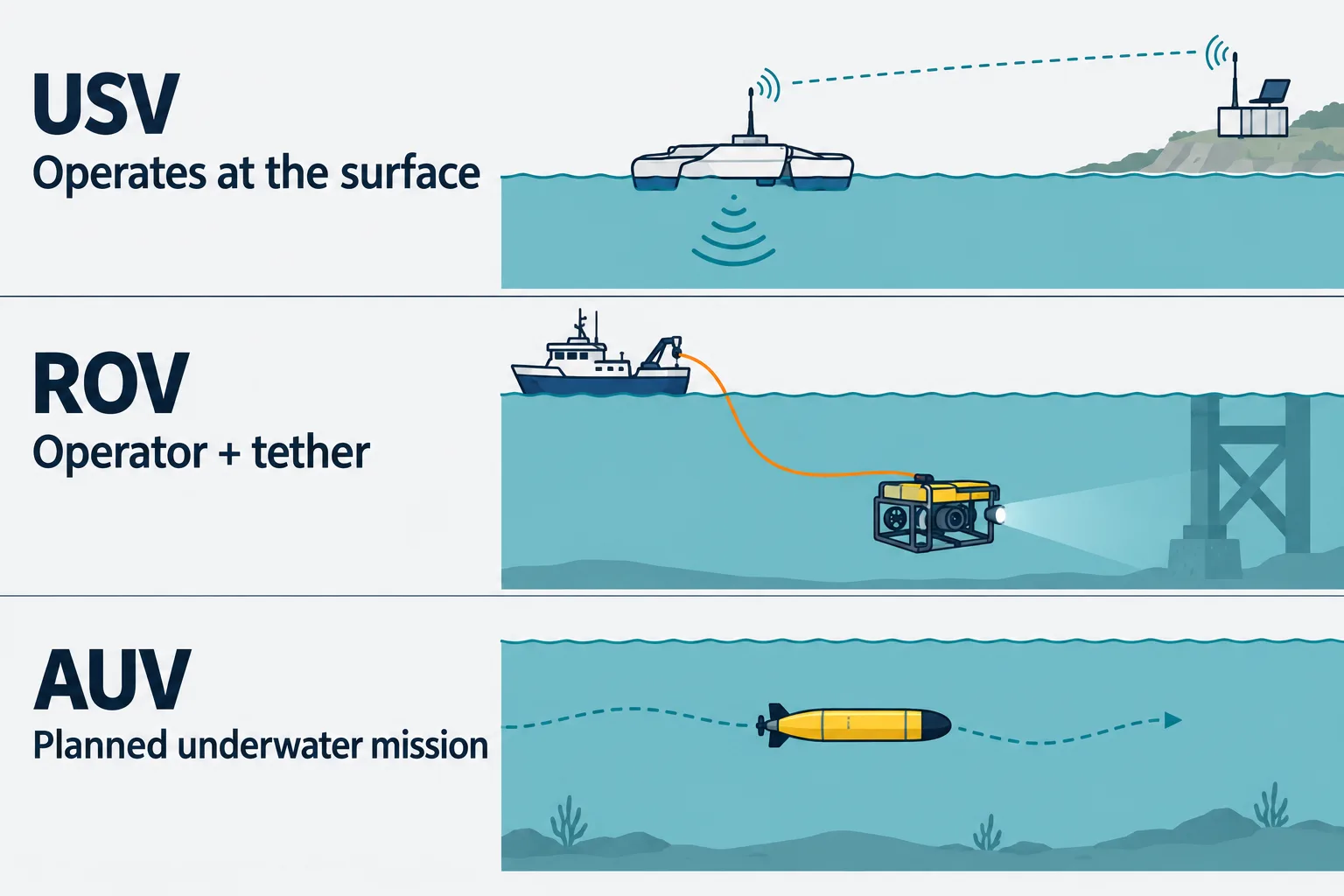
The middle panel makes the ROV's tether visible: the operator link reaches the underwater vehicle by cable. Sensors, tools and power arrangements still depend on the system. AI-generated illustration; generic vehicles, not actual products or field evidence. Not to scale.
View full-size diagram (opens in a new tab)What the term means
An ROV is an unoccupied underwater vehicle controlled by an operator through a tether. NOAA describes cables that transmit command and control signals, allowing the operator to navigate the vehicle remotely. A camera, lights, sonar or a manipulator may be fitted, depending on the system.
The tether distinguishes a conventional ROV from an untethered AUV. It provides an operating link; it does not establish that every ROV has the same sensors, tools or source of power.
Mission context
An inspection ROV gives an operator a way to observe submerged structures or investigate an object while directing the vehicle. NOAA identifies vessel-hull inspection and submerged-hazard identification as hydrographic uses.
The required record matters as much as seeing an image. An observation task may need a view of a feature; a repeat inspection may also need a way to associate that view with a location and revisit it. Those data requirements must be checked against the configured system rather than inferred from the vehicle label.
A common confusion
An ROV depth rating is not a statement of image quality, positioning capability or suitability for every inspection. Likewise, a video stream does not make an inspection vehicle a cleaning system. Cleaning requires the appropriate tools and supporting equipment; recording observations and acting on a surface are separate task requirements.
What this means for equipment selection
Selecting an ROV prioritises operator-directed observation through a tether. That link makes cable handling and deployment part of the equipment decision, alongside the depth and observation task. If the task requires acting on a surface rather than observing it, the tool and supporting equipment must be considered separately.
On Aqua Robot Supply's ROV equipment page, compare the observation, tool and deployment arrangements of the configured system rather than choosing by depth rating alone.