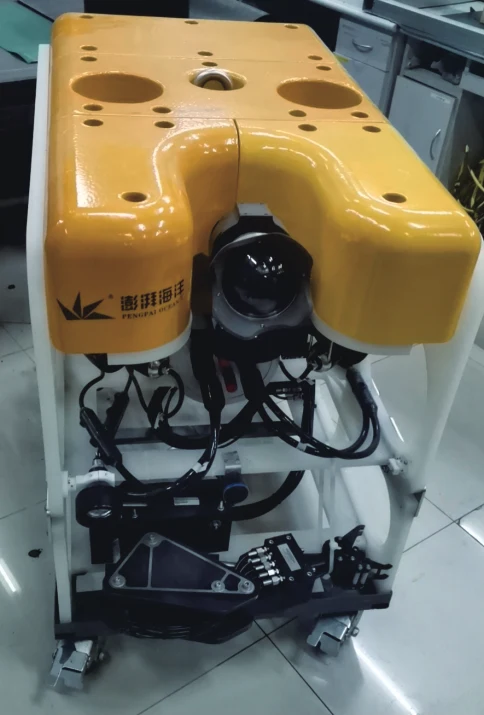
Inspection task
Identify the structure or area, inspection depth, available access and intended record: photographs, video, sonar output or a tool-assisted task. State any reporting or positioning requirements. Describe known visibility and current conditions rather than selecting only from vehicle weight or maximum speed.
An inspection ROV is not automatically a net-cleaning system. For aquaculture cleaning, use the separate net-cleaning equipment section and confirm net and site compatibility.
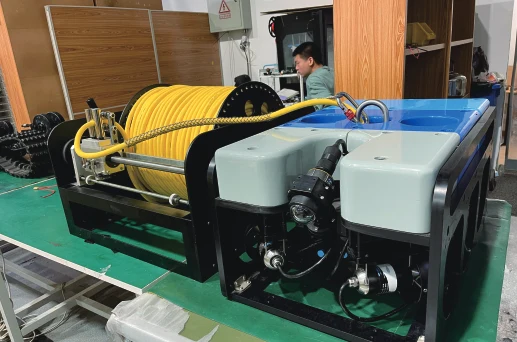
Manufacturer deployment-equipment reference only. Exact model matching and the included winch are unconfirmed; this is not Aqua Robot Supply's facility or an inspection case.
Working depth and tether
Compare the selected vehicle's working-depth rating with the planned task, and ask for the tether, handling and deployment arrangement to be identified separately. Tether length is not a working-depth rating or a guaranteed horizontal operating radius.
Pengpai Ocean lists 0–300 m working depth and a 300 m umbilical for both PX-050ROV and PX-100ROV. For PX-180ARV, the brochure lists a 200 m working depth and different optional ROV-mode cables, including an optical-fiber cable up to 1,000 m. The longer cable does not make this a 1,000 m-depth vehicle.
Describe likely tether routes, obstructions, launch location and the proposed shore or deck arrangement so the configuration can be checked with the manufacturer.
Camera, sonar and tools
Provide the camera output, lighting, sonar or tooling requirements. If a third-party instrument or manipulator is specified, supply its model, dimensions, mass, electrical demand and interfaces. Ask which parts are included and which require integration or an optional configuration.
Pengpai lists camera and lighting systems, manipulators, forward-looking sonar and inertial navigation among the expandable equipment for PX-050ROV and PX-100ROV. The list does not mean every item is delivered as standard. Published camera specifications also do not establish performance at a particular site's visibility.
Load and operating conditions
Keep vehicle mass separate from payload. Pengpai lists PX-050ROV at 50 kg vehicle weight with a 15 kg payload, and PX-100ROV at 150 kg vehicle weight with a 30 kg payload. Confirm the scope of the installed tools and accessories against the quoted configuration.
Both brochures list 0–3 kn velocity ranges. Those are vehicle-speed records, not verified current-resistance ratings. Ask about task-specific handling and station-holding conditions rather than converting speed into an allowable current. Site suitability, imaging conditions and tool performance need configuration-specific confirmation.
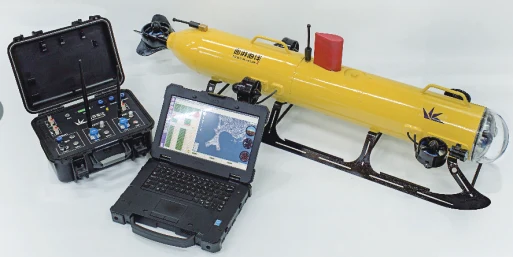
A hybrid-platform system reference, not a PX-050ROV or PX-100ROV standard kit. Pictured accessories do not establish the power, tool or deployment scope for the quoted model.
Power and deployment
PX-050ROV and PX-100ROV use cable power. Discuss the available shore or vessel power, deck control equipment, winch, guide arrangement and launch/recovery provision. Cable power does not establish unlimited continuous operation, and the brochure does not provide an endurance-hours figure for these two models.
Battery-operated equipment needs a separate endurance discussion. For example, Pengpai lists a maximum 3.5-hour battery life for PX-MiniROV with its stated 200 Wh battery; full test conditions are not provided. Do not assume that figure applies simultaneously at maximum speed with every light or optional sensor running.
Quotation checklist
Ask the quotation to identify the vehicle version, tether, controller, power or charging equipment, cameras, lights, sonar, tools, winch and deployment scope. Confirm interfaces, applicable compliance documents and the actual delivery, warranty and support terms before ordering. Manufacturer brochure statements are not a substitute for project-specific documentation.
Send the structure, country, working depth, known current and visibility, intended output, required tools and available deployment facilities to sales@aquarobotsupply.com. You can also start from the underwater inspection application page or the Request a Quote direct-contact options.
Source note
The examples come from Pengpai Ocean's PX-series brochure, particularly PX-MiniROV, PX-050ROV, PX-100ROV and PX-180ARV. They are manufacturer records, not Aqua Robot Supply tests, cases or manufacturing capabilities. Use the linked product pages for configuration notes and confirm final equipment scope with the quotation.