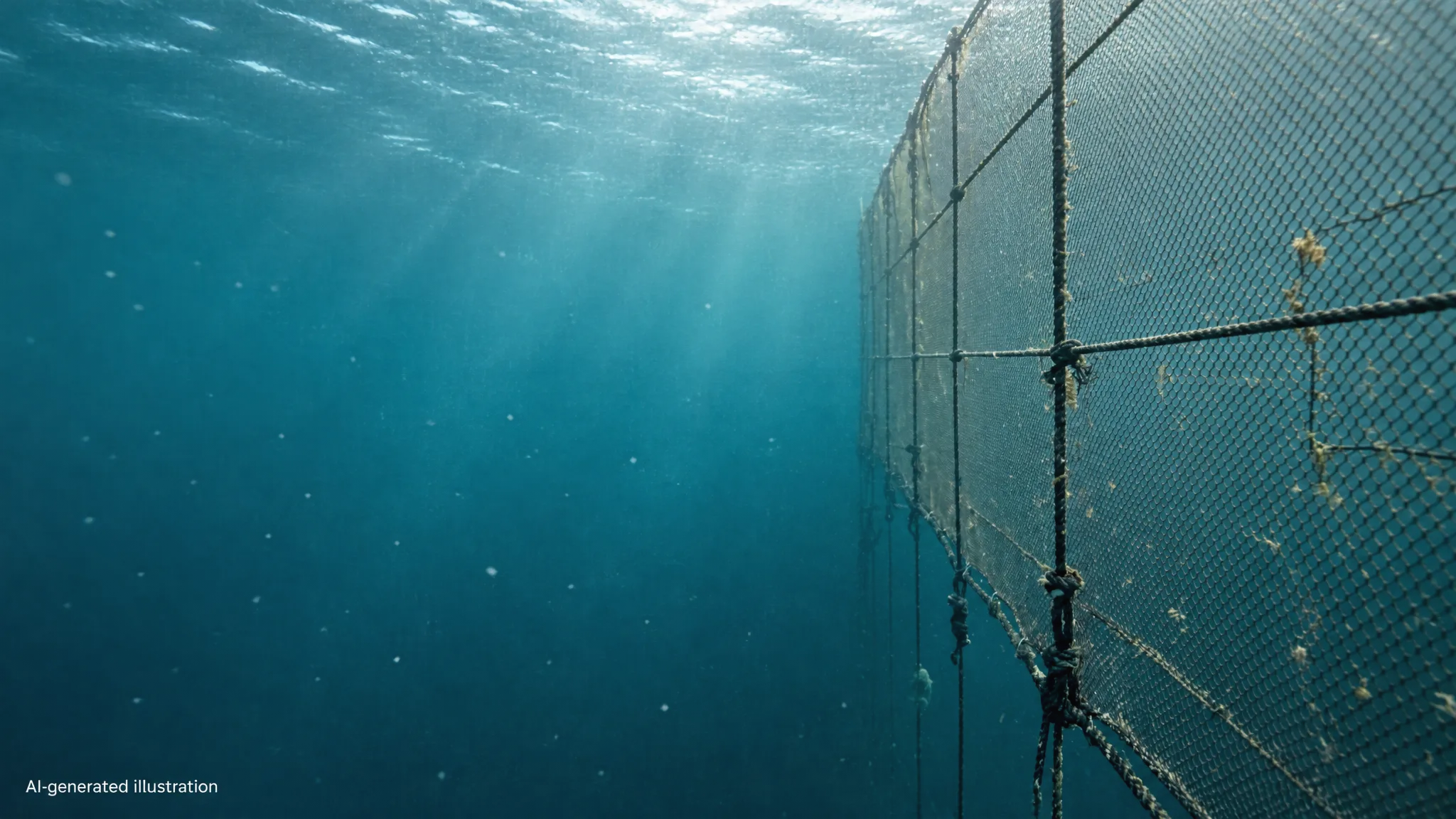
How do fish cage inspection and net cleaning differ?
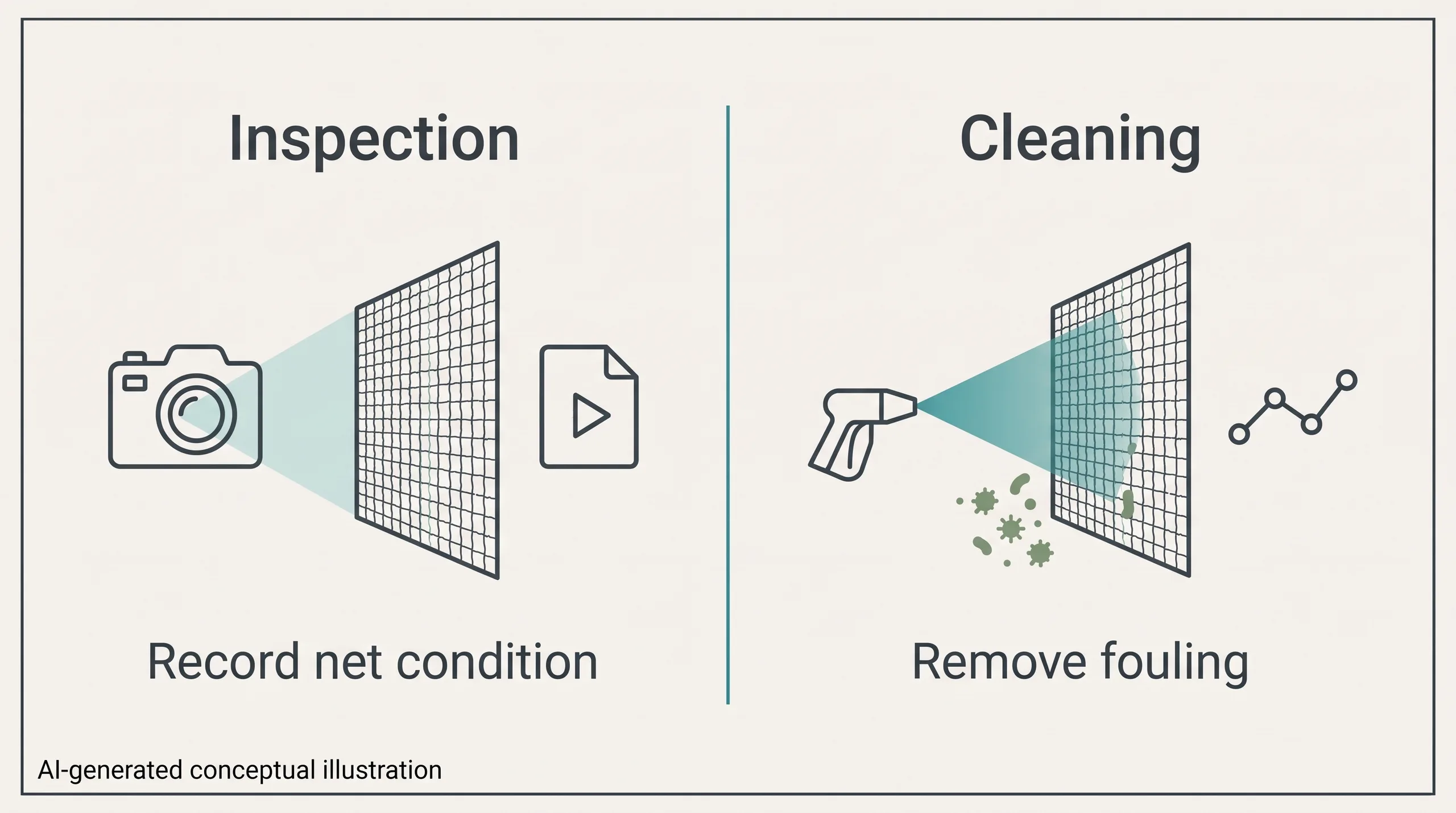
Fish cage inspection and net cleaning answer different questions: what condition is the net in, and what fouling needs to be removed? We recommend specifying the inspection record separately from the cleaning work—even when both use underwater cameras.
The useful distinction is not simply “a small ROV versus a larger ROV.” It is the difference between observing the net and acting on it. Cameras on a cleaning vehicle help an operator monitor the work, but the inspection requirement still needs its own definition.
Pengpai Ocean's cage-cleaning system makes that distinction particularly clear. Its camera and lighting arrangement supports visual monitoring and marking points of interest for later inspection. Its console also displays desired and actual paths, together with a three-dimensional representation of the robot's posture and position in the cage. Those are useful cleaning-monitoring functions. They should not be treated as interchangeable with a record of net condition.
| Question to specify | Inspection task | Cleaning task |
|---|---|---|
| What is the job? | Observe and document the requested areas of netting or cage infrastructure. | Remove fouling from the agreed net surfaces. |
| What record do you need? | Identifiable video or images, with the location and observations required by your team. | The agreed record of the cleaning work and areas covered. |
| What should the configuration discussion resolve? | Viewing access, visibility, camera or sonar requirements, and how observations will be located. | Net compatibility, cleaning hardware, work paths, utilities and deployment arrangements. |
What does a point marked during cleaning tell you?
A marked point tells you where something deserves another look; specify what happens to that point afterward. Pengpai describes points of interest as available for later inspection, rather than presenting every cleaning observation as a completed assessment.
For a buyer, that opens a practical discussion: can the operator find the same location again, retrieve the relevant recording and pass the observation to the person responsible for assessing the net? Ask for a demonstration using the proposed console and recording arrangement. Do not assume that a screen marker automatically becomes an exported inspection report.
Define the handoff in plain terms. You might request a location reference, the associated video and a description of what the operator observed. These are requirements to agree with the manufacturer, not a claim that a particular reporting package is included.
Keep an observation separate from a conclusion. A place flagged for closer examination is not, by itself, a confirmed defect or a completed repair. If your project needs defect classification or a formal inspection report, name that output explicitly.
Does a cleaning path show that the net was inspected?
A cleaning path shows the vehicle's route; it does not describe the condition of every part of the net along that route. Pengpai's desired-versus-actual path display and three-dimensional posture view give the operator information about vehicle motion during the cleaning task.
Use that display to discuss the proposed work record. Ask what path information can be retained, how it relates to the cage layout, and which accompanying camera recordings would be available. A display function and a downloadable deliverable are different requirements.
Then ask a separate question about inspection coverage: what must be visible in the resulting footage for your team to assess the requested areas? Specify how locations will be identified and how areas that could not be assessed will be recorded. That prevents a cleaning-track image from being accepted in place of the inspection evidence you actually requested.
The distinction also applies in the other direction. Video showing a net surface does not, on its own, demonstrate that the agreed cleaning work was completed. Decide what evidence you require for each task before discussing a combined package.
Does automatic cleaning include automatic damage detection?
Do not infer damage detection from automatic movement or cleaning. Pengpai describes automatic depth setting, path planning and net-washing functions for its cleaning system. If you need automatic identification of holes or other defects, ask for that capability and its supporting evidence separately.
The difference between controlling a vehicle and interpreting its images also appears in research. In a 2022 study published in Sensors, researchers developed camera-based relative positioning and control so an ROV could traverse a net plane. That work illustrates a navigation problem; it is not evidence that the same functionality is included in Pengpai's system.
When reviewing an “automatic” function, ask what is being automated: vehicle motion, the cleaning action, image capture, defect identification or report preparation. Keep those answers separate in the equipment scope. A feature name should lead to a specific demonstration, not an assumption about all the other functions.
What changes in the surface equipment?
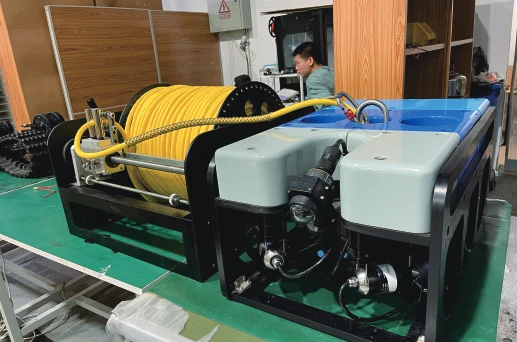
Cleaning introduces a water-delivery system as well as the vehicle and its controls. Pengpai's dedicated system uses seawater-jet cleaning components and a high-pressure feed hose. Our cage-cleaning equipment overview sets out the system requirements to discuss with the manufacturer.
An inspection configuration has its own surface-equipment scope. For Pengpai's cable-powered inspection ROVs, the manufacturer describes deck controls, an umbilical, a winch and a guide arrangement. Do not transfer that equipment list to the cleaning system, or assume that inspection accessories provide cleaning capability.
For either task, review the complete arrangement:
- Access and handling: where the equipment will be launched, recovered and handled on the vessel or shore.
- Connections and utilities: which power, control, hose and cable arrangements belong to the quoted system.
- Recording and handoff: which displays, recordings and exported information the operator will actually receive.
Have the manufacturer and your site's qualified technical personnel review the proposed power, pressure-system and handling arrangements. This is a configuration discussion, not a basis for choosing operating settings from a generic article.
How should you describe a project that needs both tasks?
Write two task requirements within the same inquiry, rather than asking for a robot that “does inspection and cleaning.” We suggest this order:
- Define the inspection output. Identify the cage areas, observations, location references and records your team needs to review.
- Define the cleaning scope. Describe the net material, mesh, coating, fouling, cage geometry and surfaces to be cleaned.
- Define the connection between them. State whether observations made during cleaning need to be marked, revisited or included in a separate inspection record. Ask which functions and exports the proposed configuration provides.
As an equipment supplier coordinating with manufacturing partners, we use those requirements to discuss the equipment scope—not to substitute a cleaning video for an inspection conclusion.
Send your cage layout, net details, site utilities and the two task requirements through our project inquiry page. That gives the configuration discussion a clearer starting point: what must be cleaned, what must be observed, and what evidence you need to receive afterward.
Filed under ROVs
Back to Blog