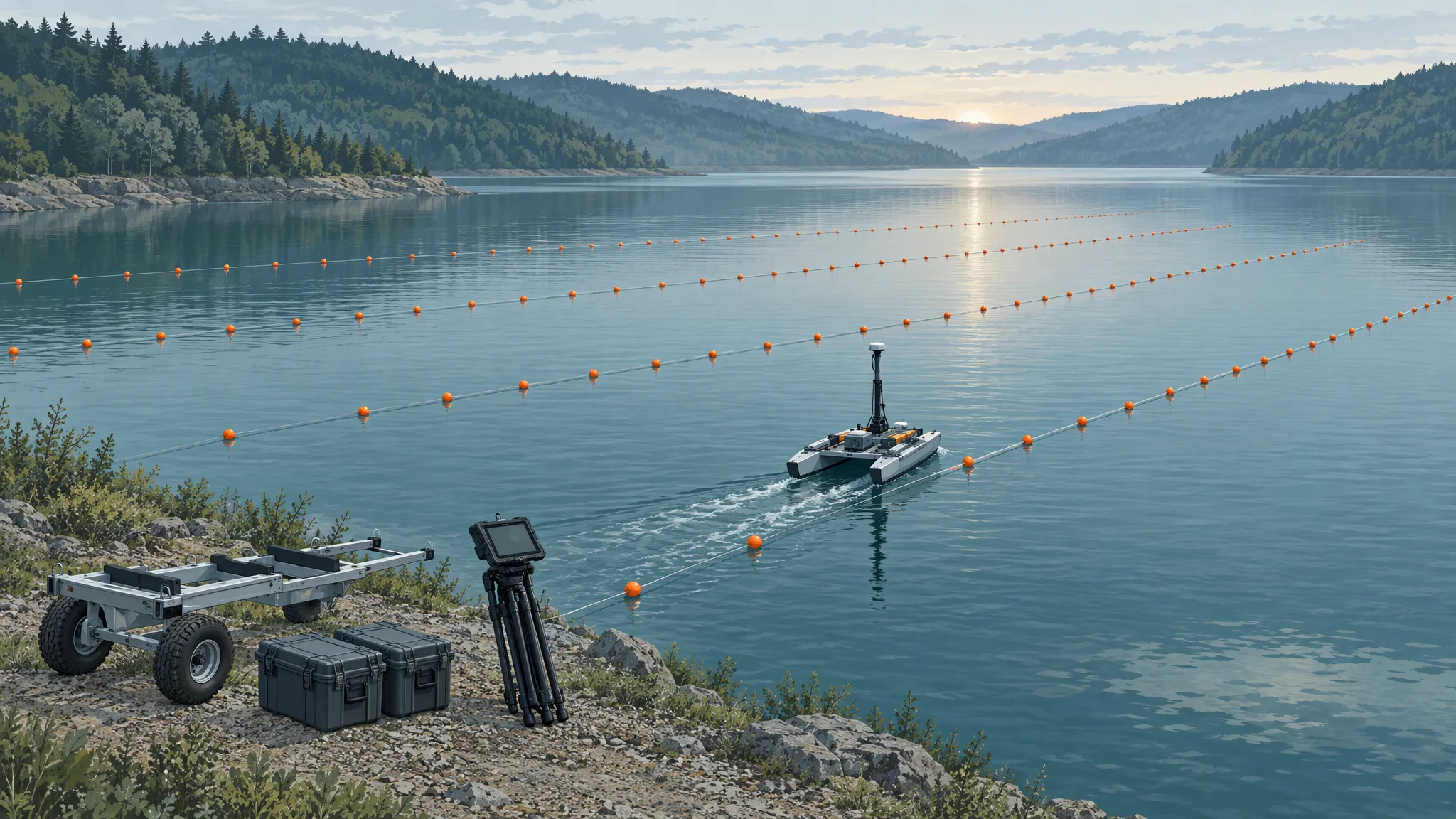
The USV survey brief that lands on this desk usually looks the same: a block of water on a chart, a delivery date, and three hulls shortlisted with an endurance figure each — 5 hours, 20 hours, 24 hours. None of those figures says how much of the block can be surveyed in a day. Compared as they are printed, they rank the hulls by the size of their batteries.
Endurance is a power figure. A day's area is a distance multiplied by a spacing, and the arithmetic that connects the two fits in one line:
area in a working day ≈ speed over ground × sailing hours the day gives you × line spacing
Every input in that line is arguable, which is the point. The speed you can hold on the line, the hours the day actually hands over, and the spacing your deliverable owes are three separate arguments, and the endurance column speaks to the middle one only where a speed is printed beside it. Put numbers in and the shortlist usually comes back in a different order.
Why is a USV survey day not the endurance figure?
Because an endurance figure is energy, and the day is a distance.
A hull that holds 1.5 m/s for five hours logs 27 km of line. The same hull at its published 6 m/s maximum is quoted at one to two hours: go four times faster for one hour and you log 22 km, less than the 27 km the same boat logs at 1.5 m/s in five. Speed and hours move against each other, so the pair is the figure, not either half of it, and a data sheet that prints one number has printed half of one.
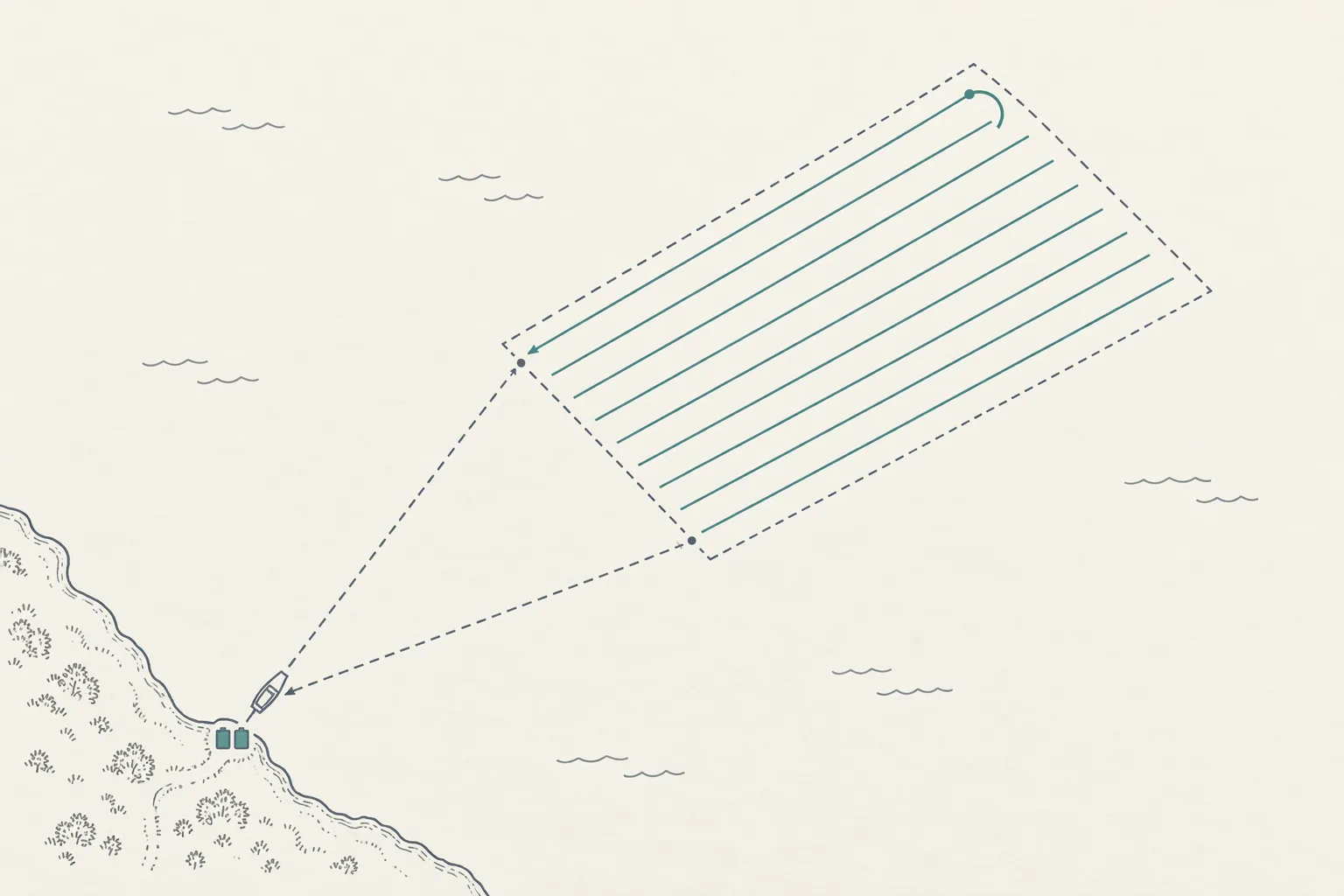
The second thing the endurance column hides is everything a day contains that logs no line: the run out to the first line, the run home from the last one, a turn and a run-in at the end of every pass, the sound-speed cast, and the sortie change — a battery exchange at the bank or a recovery, depending on the hull. On a small block those minutes are not a rounding error. Even where the launch point is a short run from the first line, they decide whether the last two passes happen.
Then the spacing, which is not the hull's business at all. Halve it and the day doubles, whatever is towing the sonar. The spacing your deliverable can defend is settled before any model is compared, and this article takes it as given.
So the question to put to a data sheet is not how many hours it prints, but hours at what speed — and how many of those survive the transit, the turns and the change.
Which endurance figure should a USV survey use?
The one with a speed printed beside it, and where a document prints several, the one whose condition matches the speed you will hold on the line. Here is what four of the platforms we supply publish, read from the manufacturer data we hold.
| Hull | Hours as printed | Speed printed with the hours | Range as printed | What the figures convert to |
|---|---|---|---|---|
| KOI | 3 h cruising capacity; 5 h at working speed; 5 h on the maximum-speed row | 1.5 m/s on the working-speed row; the maximum-speed row carries no speed | — | 27 km of line from the 5 h at 1.5 m/s; the other two hours convert to nothing until a speed is named |
| HUNTER | 8 h cruising capacity; 5 h at working speed; 1–2 h at maximum speed | 1.5 m/s and 6 m/s | — | 27 km at working speed; 22–43 km at maximum speed; the 8 h figure has no condition attached |
| Seeker | 24 h | cruising speed 4 kn | 150 nmi | 96 nmi of passage inside the rated hours at cruise; the range implies a 6.25 kn average |
| MANTA | 20 h operational endurance | operating band 5–30 kn; maximum 40 kn | 230 nmi | 100 nmi at the low end of the band inside the rated hours; the range implies an 11.5 kn average |
Read the rows top to bottom and the difference is not the length of the hours; it is how much of each row can be converted. Seeker and MANTA each print an endurance figure, a cruise speed and a range, so each row turns into a distance. KOI prints three figures and attaches a speed to only one of them: the 3 h cruising capacity and the maximum-speed 5 h convert to nothing until someone names the speed behind them. HUNTER prints three as well, and the largest — 8 hours of cruising capacity — is the one its document gives no condition for.
We supply these platforms; the declared figures are the manufacturers', and so are the conditions behind them. Ask for the speed and the payload behind the figure you intend to use, and keep the answer with the quotation. That answer is the difference between a day you can plan and a day you hope for.
The same trap waits below the surface: an AUV's endurance at 3 knots becomes a distance only once the knots are named.
What does a square kilometre take from a small hull?
About 3.7 hours of sailing at 1.5 m/s before anything else — most of a five-hour rating, and why a small hull's day is decided by the overhead rather than by the rating.
A square kilometre at 50 m spacing is 20 km of main line. Divide by 5.4 km/h and 3.7 hours of sailing comes out. Add the run out and back, the turns, a cast and one sortie change, and five hours stops looking generous. Seeker's 4 kn cruise covers the same 20 km in 2.7 hours; the bottom of MANTA's operating band, 5 kn, takes 2.2. Between a hull that sails the block at 1.5 m/s and one that sails it at 4 kn the sailing time differs by an hour; at 5 kn, by 1.5 — not by the nineteen hours that separate the two ratings.
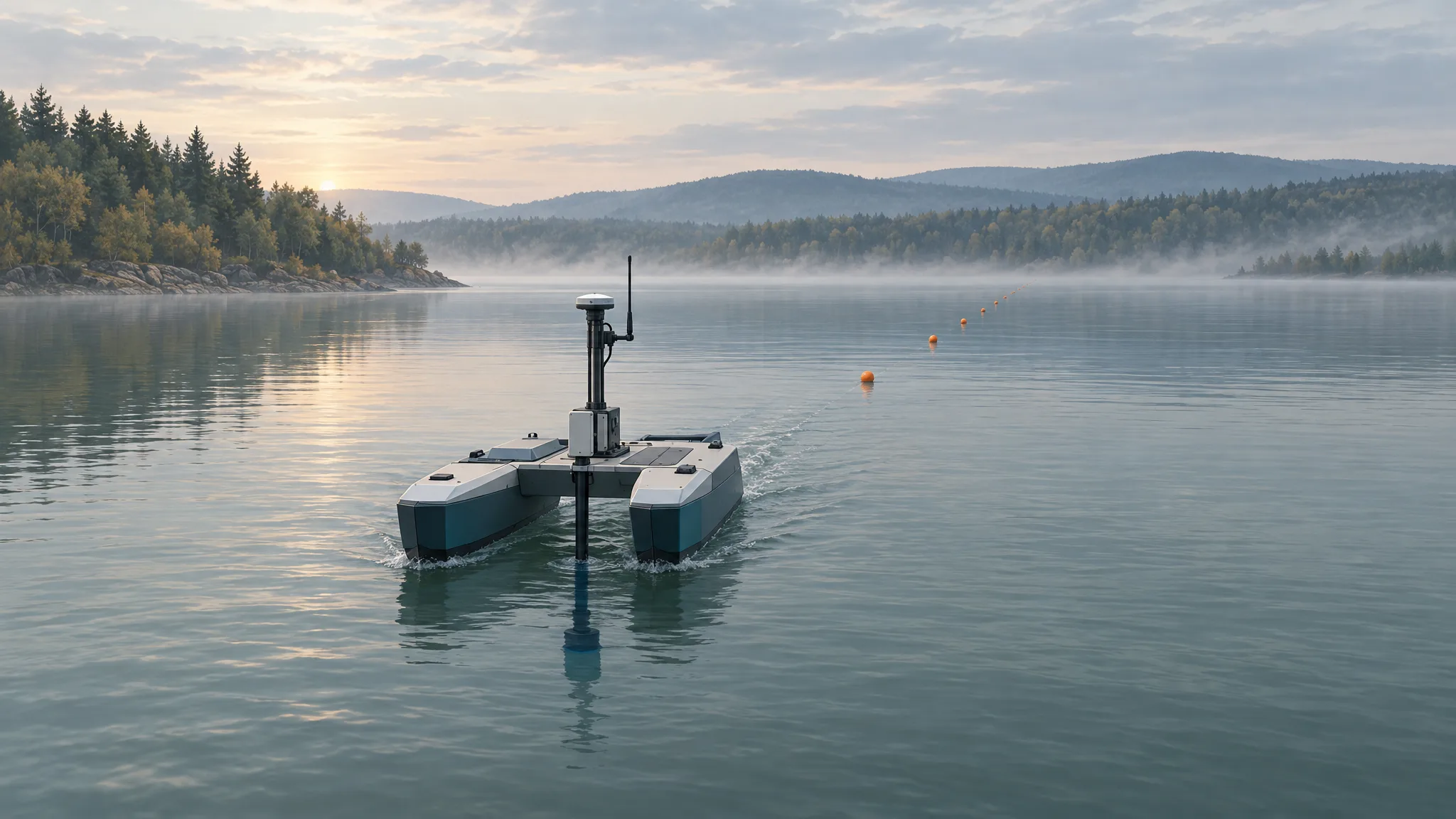
Turn the same arithmetic around and the answer to "how big an area can one hull finish in a day" appears without a model comparison: area ≈ speed × sailing hours × spacing. Fill the sailing hours with what the day gives you rather than what the battery holds, and a small hull at 50 m spacing lands near a square kilometre — because its rating's own best case, five hours at 1.5 m/s, is 27 km of line, which is 1.35 km² with nothing left for a turn, a transit or a second cast.
Ten square kilometres is a different argument. At 50 m spacing it is 200 km of line: 37 hours of sailing at 1.5 m/s, 27 at 4 kn, 21.6 at 5 kn. On a block that size the rating finally separates the hulls, because the block no longer fits inside one charge on any of them: the small hull needs at least eight five-hour sorties, each with its run out, recovery and relaunch, while Seeker at 24 hours and MANTA at 20 need two, the second a short one. What endurance buys on that block is sorties saved — and once the sortie count is written down, the rest of the choice turns on draft, mounting and launch access, which the hulls side by side sets out.
Why do the long-endurance hulls publish a range that disagrees with their hours?
Because hours and nautical miles imply a speed, and on both of these hulls that speed is not the cruising speed printed beside them.
Seeker publishes 24 hours, a 4 kn cruising speed and a 150 nmi maximum range. At 4 kn, 24 hours is 96 nmi; to reach 150 nmi inside 24 hours the average has to be 6.25 kn. MANTA publishes 20 hours of operational endurance and 230 nmi: at the bottom of its 5–30 kn band, 20 hours is 100 nmi, and 230 nmi in 20 hours needs 11.5 kn. Both documents hold together only if the range was measured at a speed other than the one on the cruise line, and neither says which.
That is a question for the manufacturer, not a defect to argue around, because the answer decides which of the two numbers your day rests on. What the range figure is for is worth keeping straight. On a reservoir or a canal reach it never binds; the hours do. On an offshore block where the run out and back is a serious part of the day, the transit is where a long-endurance hull earns its price — and the working day is still bounded by people. NOAA's Office of Coast Survey, which has been investigating uncrewed survey systems since 2004, divides its own fleet the same way: small, portable battery-powered systems with an operational endurance of up to eight hours, and large diesel-powered systems able to operate for several days, all of them under the continuous supervision of qualified operators. A 24-hour rating does not give you a 24-hour working day unless you staff the night.
How many sorties does the area need?
Divide the sailing hours by the hours one sortie really gives you, round up, and cost the answer. That number, not the endurance rating, is what the day is made of.
sorties = sailing hours ÷ usable hours per sortie, rounded up
day = sailing hours + sorties × (run out + run back + change + run-in per turn + cast)
The published rating is not the usable hours. The last part of it belongs to the reserve and the way home, which is what the operating note on our USV selection guide means by agreeing the reserve and return arrangements for the mission instead of treating the full rating as measurement time. How much is left over is a configuration question: an instrument package that draws more shortens the working window, and the manufacturer's figure was measured with something aboard that may not be your something.
The change itself is worth settling before the shortlist is cut. KOI publishes 12 kg including the battery and HUNTER 45 kg including the battery, so the change is plausibly a pack and a light hull; HUNTER-X publishes 50 kg with the battery and 35 kg without, and ORCALINK-X 230 kg with the battery and 170 kg without. The data sheets give the masses. Whether your bank, trailer and crew turn that into a pack exchange or a full recovery is a configuration question for the manufacturer, and it belongs in the sortie count, not in the small print after it.
The time calculator we publish does the two divisions honestly — area ÷ spacing for main-line length, length ÷ speed over ground for sailing time — and it states what it does not do: no endurance or battery model, no route geometry, no turn count, no line count, and no claim that its answer is a validated schedule. Its added-minutes field takes the whole job's turns, changes and other time, so the sortie arithmetic above goes in by hand. That is deliberate. A calculator that guessed your sortie count would be inventing the one number this article is about.
What has to be written down before the models are compared?
Six lines on one page. Without them the comparison is a table of battery sizes.
- The area, and the unit it was measured in.
- The line spacing, and where it came from — usable swath, overlap and deliverable.
- The speed you will hold on the line, in whatever unit the data sheet uses.
- The endurance figure you are using, the speed printed beside it, and the manufacturer's confirmation of its condition and payload.
- The sortie count, with the per-sortie overhead itemised.
- The reserve and the return arrangement, agreed for the mission rather than assumed from the rating.
Anyone holding that page can re-run the arithmetic, which is the whole of its value. What it is not: a schedule, a safety plan, or an acceptance. Whether the data meets the specification your client set turns on the sonar, the processing and the survey specification; our side is the platform, its draft, its payload and the day its configuration can hold, and we confirm the configuration with the manufacturers rather than certify a survey.
Send the area and the spacing, the speed you expect to hold, the depth range and the deliverable, and we will put the platform side of the arithmetic beside the models. If the spacing is still open, start from the survey application page; if it is settled, tell us the area and the deliverable and we will come back with which hull, at which speed, over how many sorties — and where a manufacturer's figure has to arrive before a day can be quoted.
Filed under Hydrographic Survey
Back to Blog