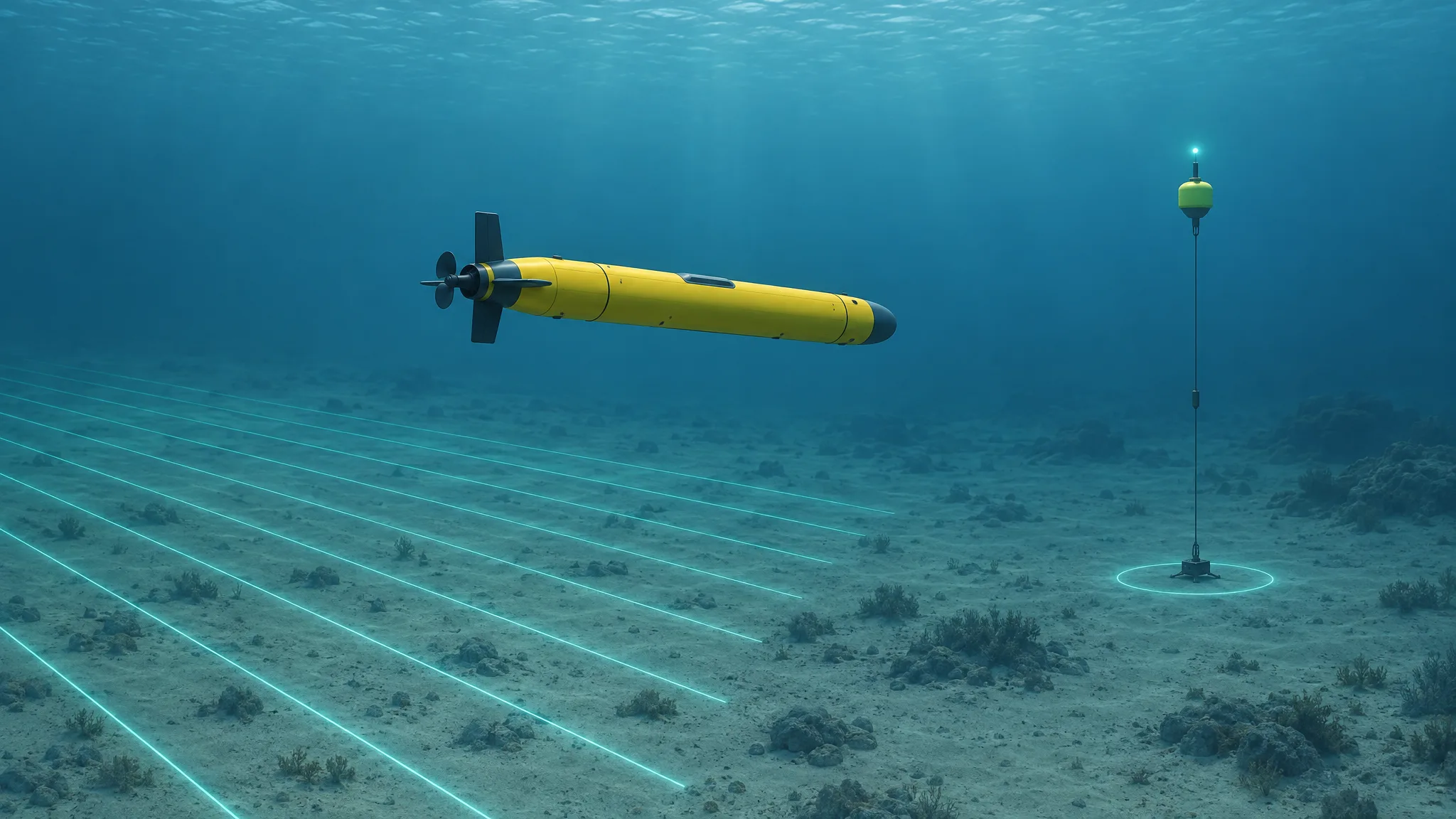
An AUV endurance figure is one number: one speed, one configuration, one unit. The PX-series tables state their ratings at 3 kn and hand the longer option over as a second row, so PX-324 reads at least 20 h basic against 50 h extended, and PX-533 and PX-900 at least 90 h against 180 h and 270 h. Reading the two rows as one figure with a bigger battery is where a mission plan starts to drift. This is how we would read them before a quotation.
What does an AUV endurance figure fix, and what does it leave open?
It fixes the speed and the configuration written beside it. Sensor load, turning, hovering, current, battery age and the speed you will actually fly stay open.
Every PX-series endurance rating on our AUV family page carries a speed condition: PX-324 at 20 h or more in its basic configuration, PX-533 and PX-900 at 90 h or more, the smaller models as one figure or a pair of variant figures, all at 3 kn. The exception on that page is the hybrid PX-180ARV, listed as a 4 h maximum without the condition. Three knots is a cruise reference rather than the vehicle’s ceiling — the same three large models are rated across 1–6 kn. What the tables do not give is the endurance at 5 or 6 kn, and that number has to come from the manufacturer for your configuration.
Instrument load moves the figure on a vehicle of this class. Teledyne Marine’s Gavia page lists 7–8 hours at 3 knots per rechargeable battery module in a typical defence or scientific configuration, and 5–6 hours at the same speed with all sensors including swath bathymetry — a fall of roughly a quarter to a third from instrumentation alone, before the vehicle carries up to three battery modules.
So use the printed figure to compare models, use the configuration to plan a mission, and do not carry one across to a payload set or a speed other than the one it was printed for.
Hours or kilometres — which one does your mission spend?
Whichever the mission consumes. At 3 knots the hour and kilometre figures are one statement in two units, which is why the tables pair them.
A knot is one nautical mile per hour, 1.852 km/h, so 3 kn is about 5.56 km/h. Run that through the extended ratings and the kilometre figures come out of the hour figures, within rounding:
| Model | Basic, at 3 kn | Extended, at 3 kn | Extended range as listed | The same endurance as distance |
|---|---|---|---|---|
| PX-324 | ≥20 h | 50 h | 300 km | 50 h ≈ 278 km |
| PX-533 | ≥90 h | 180 h | 1,000 km | 180 h ≈ 1,000 km |
| PX-900 | ≥90 h | 270 h | 1,500 km | 270 h ≈ 1,500 km |
Fifty hours at 3 kn works out to about 278 km, so the 300 km listed beside PX-324 is the same endurance within rounding rather than a second and larger capability; only the manufacturer can confirm what its 300 km figure is measured against. The distinction matters because an area survey is planned in kilometres of line, while a fixed station, a plume or a repeated transect is planned in hours on site. Only one of those is the number your task spends.
Time without distance deserves its own line. MBARI’s long-range AUV is described as able to wait in a low-power configuration for biological events to occur, with high-power sensors operated intermittently so that they do not sacrifice endurance. There the hours and the kilometres come apart, because waiting is time the vehicle spends without covering ground: a figure quoted to you as a range says less about a mission built on patience than the hour figure does.
What neither figure tells you is whether the transit to the survey area sits inside it. Ask. A range that includes a two-way transit and a range that starts at the first survey line are different missions for the same vehicle. If the task is observation rather than coverage, the observation question comes first, and AUV environmental monitoring sets out why the sensor set decides what the record can answer.
Why is the extended figure not the basic figure plus 30–50%?
Because the percentage and the extended row describe different things. Pengpai Ocean’s PX-series description says an optional battery-compartment extension can increase endurance by 30%–50%. The model tables then list extended ratings that go well past that.
| Model | Basic, at 3 kn | +30–50% would give | Extended rating listed | Increase over basic |
|---|---|---|---|---|
| PX-324 | ≥20 h | 26–30 h | 50 h | +150% |
| PX-533 | ≥90 h | 117–135 h | 180 h | +100% |
| PX-900 | ≥90 h | 207–225 h | 270 h | +200% |
Those two statements cannot be the same measure of the same change. That is not a reason to distrust either; it is a reason not to compute with them. A plan built by adding 30–50% to a basic rating will understate what the extended rows list, and a quotation built from the percentage alone will not describe the vehicle in the extended row.
Treat the extended row as its own configuration. When you weigh PX-324 against PX-533 for a long mission, compare basic with basic and extended with extended, and ask what else is fitted in the extended version — the depth option, payload, propulsion and energy arrangement are the candidates, and only the manufacturer’s configuration answers it.
The tables also show where the question stops. PX-150, PX-160, PX-210 and PX-260 list a single rating at 3 kn and no extended row; whether the battery-compartment extension is available for them is a quotation question, not something to infer from the series text.
What else does the extended pack change?
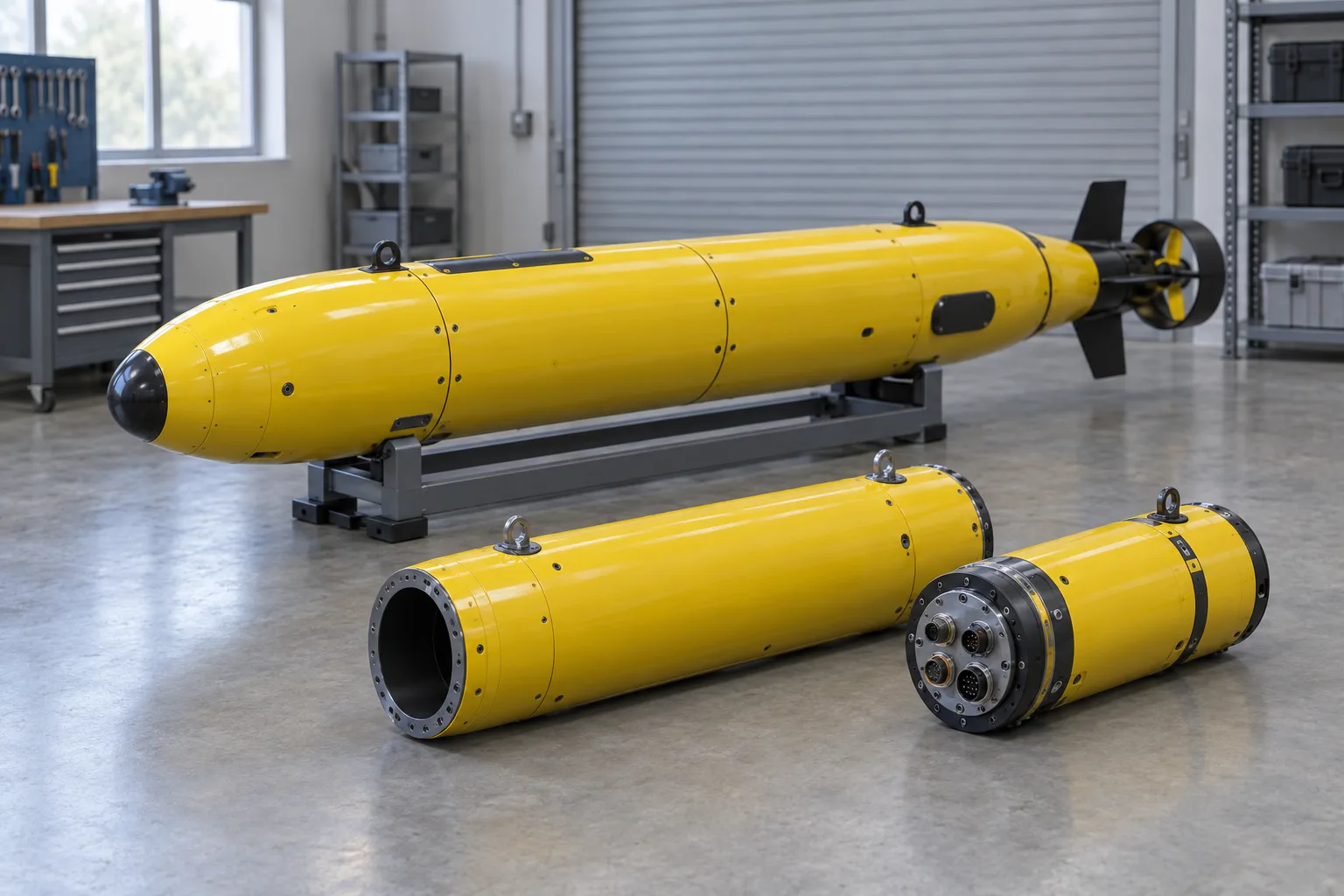
Mass, length and the way the vehicle is handled on deck. The battery compartment is a physical section with weight of its own, so an extended vehicle is not its standard weight plus a number in a table.
The published standard weights are 300 kg for PX-324, 1,200 kg for PX-533 and 2,000 kg for PX-900. Those figures belong to the standard configuration. If your proposal is the extended vehicle, request its handling mass, overall length and centre of gravity, because they decide whether the crane, cradle and deck space still work: the handling review in our AUV launch and recovery planning article applies to the vehicle as configured. Pengpai Ocean’s launch and recovery system is specified for AUV diameters of Ø324 to Ø900 mm, and diameter is not length — a longer vehicle reaches the deck question from a direction that specification does not cover.
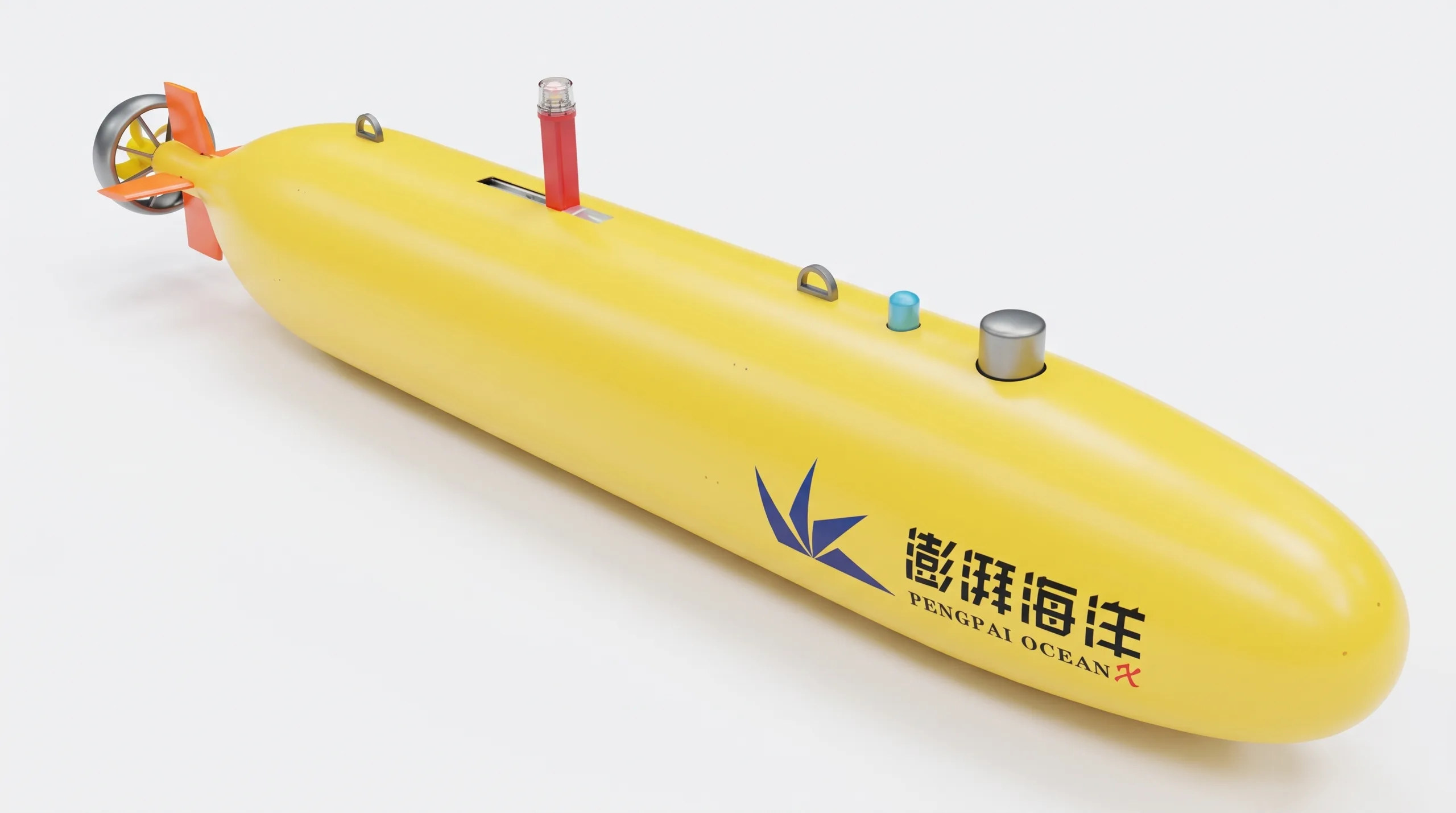
A longer campaign can also be bought without a longer hull. Pengpai Ocean lists a deep-sea pressure-resistant battery placed directly in seawater rather than in a pressure-resistant chamber, with a battery management system in each unit forming an independent power supply and the unit replaceable at any time. The manufacturer describes that arrangement as reducing the vessel time lost while equipment is charged, and as reducing electromagnetic interference from the high-current path to the control system to a certain extent. Whether a given extended configuration uses those units, and how many it carries, is a question for the quotation.
What should the quotation state?
Five things, written down: the configuration by name, the speed the rating belongs to, the payload fitted when it was measured, the range basis and the energy arrangement. An endurance figure without them is a number you cannot plan against.
- The configuration by name — depth option, basic or extended, and any propulsion option that changes consumption.
- The speed the figure is quoted at, plus the endurance at the speed you will fly. Three knots is a reference; a 6 kn transit and a 3 kn line speed draw differently.
- The payload and instruments fitted for the quoted figure, since instrumentation is what turns eight hours into six on a comparable vehicle.
- The range basis — whether the kilometres include the transit out and back, and at what speed.
- The battery arrangement — how many units, whether they are swappable in the field, and what the manufacturer says about endurance as the packs age.
We put these into the configuration discussion with the manufacturer, because the rating belongs to the configuration and not to the model name.
What do you send us to get an AUV endurance quoted?
Send the mission rather than the wish: the vehicle is chosen against how much energy your task spends, and in which unit.
Our survey time calculator turns area, line spacing and speed into line length and sailing hours, and it is deliberately a time estimate — it holds no endurance, battery or current model — so its answer is the workload you compare against a rating, not the rating itself. Bring that, the transit distance, the hours you need on station, the site depth and the number of deployment days to our project equipment inquiry, and we will coordinate the configuration and the endurance basis with the manufacturer.
Filed under AUVs
Back to Blog