Pengpai Ocean / PX-533
PX-533 Deep-Sea Survey AUV
Review Pengpai Ocean's PX-533 for deep-sea and marine-engineering survey. Aqua Robot Supply coordinates configuration and quotations. Select 2,000 m or 6,000 m depth, a 150 kg mission payload and a launch/recovery arrangement; basic and extended endurance are recorded separately at 3 kn.
- Manufacturer:
- Pengpai Ocean
- Equipment supplier:
- Aqua Robot Supply
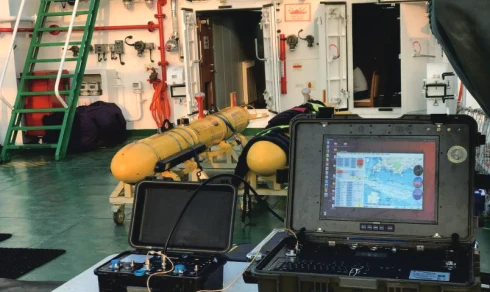
PX-533 · Configuration summary
Ratings apply to the named configuration and stated operating conditions. Maximum speed, depth, payload and endurance are not one simultaneous operating point.
- PX-533 · Working-depth configurations
2,000 m or 6,000 m (approx. 6,562 ft or 19,685 ft)
Separate depth options; the 6,000 m rating is not the default for every configuration. The title's 2/6 km refers to these options.
- PX-533 · Basic endurance at 3 kn
At least 90 h at 3 kn (approx. 1.54 m/s)
Basic manufacturer configuration.
- PX-533 · Payload
150 kg (approx. 330.7 lb)
Confirm usable instrument mass, dimensions, payload bay, power, mounting and data interfaces.
Manufacturer series reference.
Specify the required instruments, control equipment and accessories in your quotation request.
Technical data
Model specifications
Compare dimensions, payload and operating limits for your configuration. Endurance figures apply at the stated speed and conditions.
| Parameter | Specification |
|---|---|
| Dimensions | Ø533 mm × 5000 mm long (approx. Ø20.98 in × 16.40 ft) |
| Standard vehicle weight | 1,200 kg (approx. 2,646 lb) Configuration notesStandard vehicle weight, not payload or total shipping-system weight. Final configuration, handling mass, ground control and LARS must be accounted for separately. |
| Payload | 150 kg (approx. 330.7 lb) Configuration notesConfirm usable instrument mass, dimensions, payload bay, power, mounting and data interfaces. |
| Working-depth configurations | 2,000 m or 6,000 m (approx. 6,562 ft or 19,685 ft) Configuration notesSeparate depth options; the 6,000 m rating is not the default for every configuration. The title's 2/6 km refers to these options. |
| Velocity range | 1–6 kn (approx. 0.51–3.09 m/s) Configuration notesManufacturer table range, not rated current resistance. Maximum velocity is not the condition for the endurance records. |
| Standard propulsion and control | Tail propeller propulsion with cross/X-rudder control Configuration notesConfirm actual propulsion hardware and control limits. The auxiliary propulsion option is not assumed included. |
| Optional vertical propulsion | Vertical auxiliary propeller for vertical diving/ascent and dynamic positioning Configuration notesManufacturer option; these functions depend on the selected arrangement, sensors and control scope, not every standard configuration. |
| Basic endurance at 3 kn | At least 90 h at 3 kn (approx. 1.54 m/s) Configuration notesBasic manufacturer configuration. |
| Extended endurance at 3 kn | 180 h at 3 kn (approx. 1.54 m/s) Configuration notesExtended configuration, not basic endurance. Confirm energy system, weight, dimensions and mission conditions. |
| Extended range | 1,000 km (approx. 540 nmi) Configuration notesSeparate extended-range record, not basic range or a simultaneous guarantee with maximum depth, speed and every mission payload. |
| Navigation and accuracy | INS + DVL + GNSS + USBL; manufacturer table precision 0.3% of range Configuration notesAgree the actual navigation package, calibration, mission distance and test conditions. This is not unconditional accuracy or fixed centimetre-level error; SLAM does not independently guarantee improved precision. |
| Communications | UHF, Wi-Fi, 4G, satellite and underwater acoustic communication listed Configuration notesManufacturer configuration scope; confirm hardware, services and link conditions. Surface wireless links do not imply arbitrary-depth live wireless video or unlimited coverage. |
| Control software | Manufacturer visual control interface; secondary development, post-mission processing/analysis, SLAM and data-driven capabilities described Configuration notesCollaborative networking and data-driven functions can be customized. Versions, licenses, outputs and maintenance scope require agreement, not a supplier development or service-time promise. |
| Ground control | Integrated ground control station Configuration notesDocumented ancillary equipment; actual components, batteries and communication devices must be specified in the final delivery list. |
| Launch, recovery and deck scope | Dedicated LARS and integrated deck container described Configuration notesManufacturer system description; confirm inclusions, lifting method, deck space, power and vessel interfaces. Generic LARS operating ratings do not constitute verified PX-533 compatibility or standard shipment. |
| Expandable sensor scope | Underwater CCD, CTD, altimeter, obstacle-avoidance sonar, side-scan sonar, multibeam sonar, shallow-profile sonar, USBL and hydrophone Configuration notesMission-integration scope, not all included as standard or guaranteed compatible with arbitrary third-party instruments. |
Operating conditions
- Select the 2,000 m or 6,000 m depth configuration. 1,200 kg is standard vehicle weight; 150 kg is the separate payload record.
- Basic ≥90 h and extended 180 h are at 3 kn. The 1,000 km range is extended scope; maximum depth, speed, endurance and payload are not guaranteed together.
- Manufacturer metric figures are authoritative; conversions are approximate. Low-power emergency communication is not mission endurance.
Task and integration scope
Applications and configuration
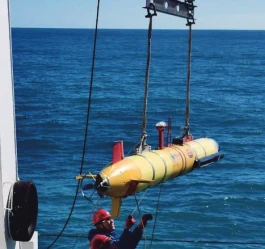
Application scope
Deep-sea exploration
For deep-sea prospecting, compare the payload and mission configuration. Define survey depth, sonar/measurement payload, route, navigation and recovery needs before selecting the configuration.
Marine-engineering survey
Marine-engineering and physical marine-operation surveys are listed. Specify seabed data, sensor interfaces and output requirements; no survey result, delivered instrument suite or supplier survey service is implied.
Ecological survey
For ecological surveys, select the instruments and mission configuration. Confirm the measurements, sampling/observation equipment, endurance conditions and mission plan; vehicle capability does not establish a verified monitoring outcome.
Configuration requirements
Compare PX-533 when deep-sea depth options and a larger payload bay are required. The 1,200 kg standard vehicle requires a vessel/deck and launch/recovery plan; it is not a portable hand-launch platform. For a smaller 30 kg payload platform compare PX-324, and for tethered live inspection review ROVs.
Vehicle equipment
Large modular platform
A 533 mm-diameter, 5 m vehicle with 150 kg payload, tail propeller and cross/X-rudder control. Select the depth and energy configuration and confirm its actual mass.
Navigation and mission control
INS/DVL/GNSS/USBL and a visual control interface are documented.
Deck and recovery system
Deployment options include a dedicated LARS, integrated deck container and ground control station. Confirm which items are supplied and their vessel, space, lifting and power interfaces.
Optional equipment and integration
Extended endurance configuration
180 h at 3 kn or 1,000 km is extended scope, not basic performance. Confirm the energy system, vehicle dimensions, weight and test conditions.
Vertical auxiliary propulsion
The optional auxiliary propeller supports vertical diving/ascent and dynamic positioning when configured. Agree the arrangement, sensors and control functions.
Mission payloads
Camera, CTD, altitude sensing, obstacle-avoidance and survey sonars, USBL and hydrophone are expandable scope. Confirm instrument model, mass, mounting, power, protocols and output software.
Communications and software
Specify surface, satellite and acoustic equipment, services and link behavior. Collaborative networking and data-driven functions are manufacturer customization scope; they are not automatically a supplied multi-vehicle system or supplier engineering service.
Integration requirements
Provide instrument model, dimensions, mass, voltage/power, connectors, protocols and required data outputs. Confirm navigation calibration and acceptance conditions, deck space, lifting capacity, power and recovery method separately.
Confirm the selected instruments, controller and accessories in the quotation before ordering.
Request a Quote
Discuss your equipment requirements
Share your task, site conditions and required tools for a model-specific quotation.
Selected model: PX-533
Drawings and spec sheets can be emailed to sales@aquarobotsupply.com. Please do not include sensitive information in your project brief.
Inquiry Privacy Notice