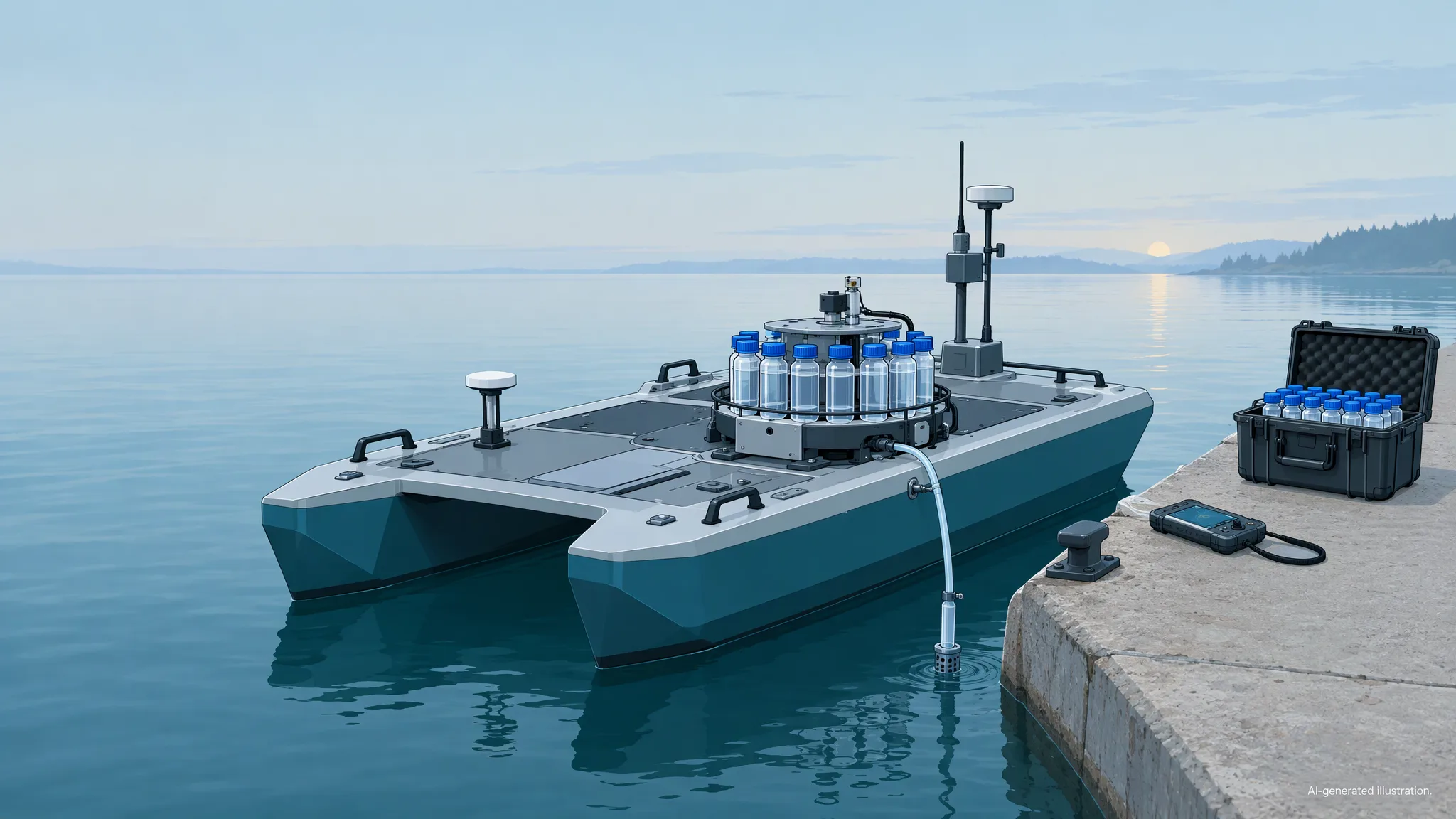
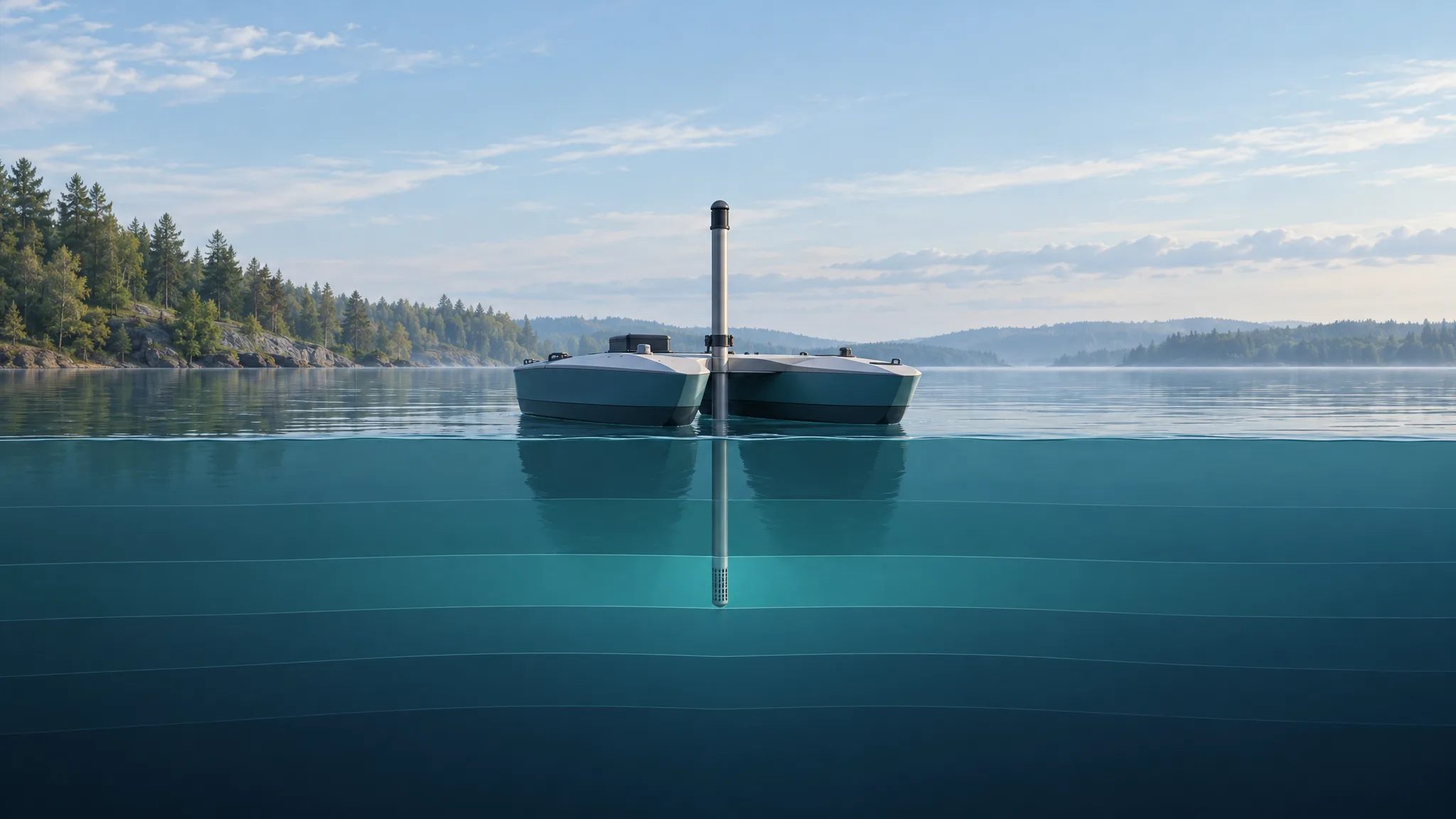
What should a water sampling programme decide before it compares equipment?
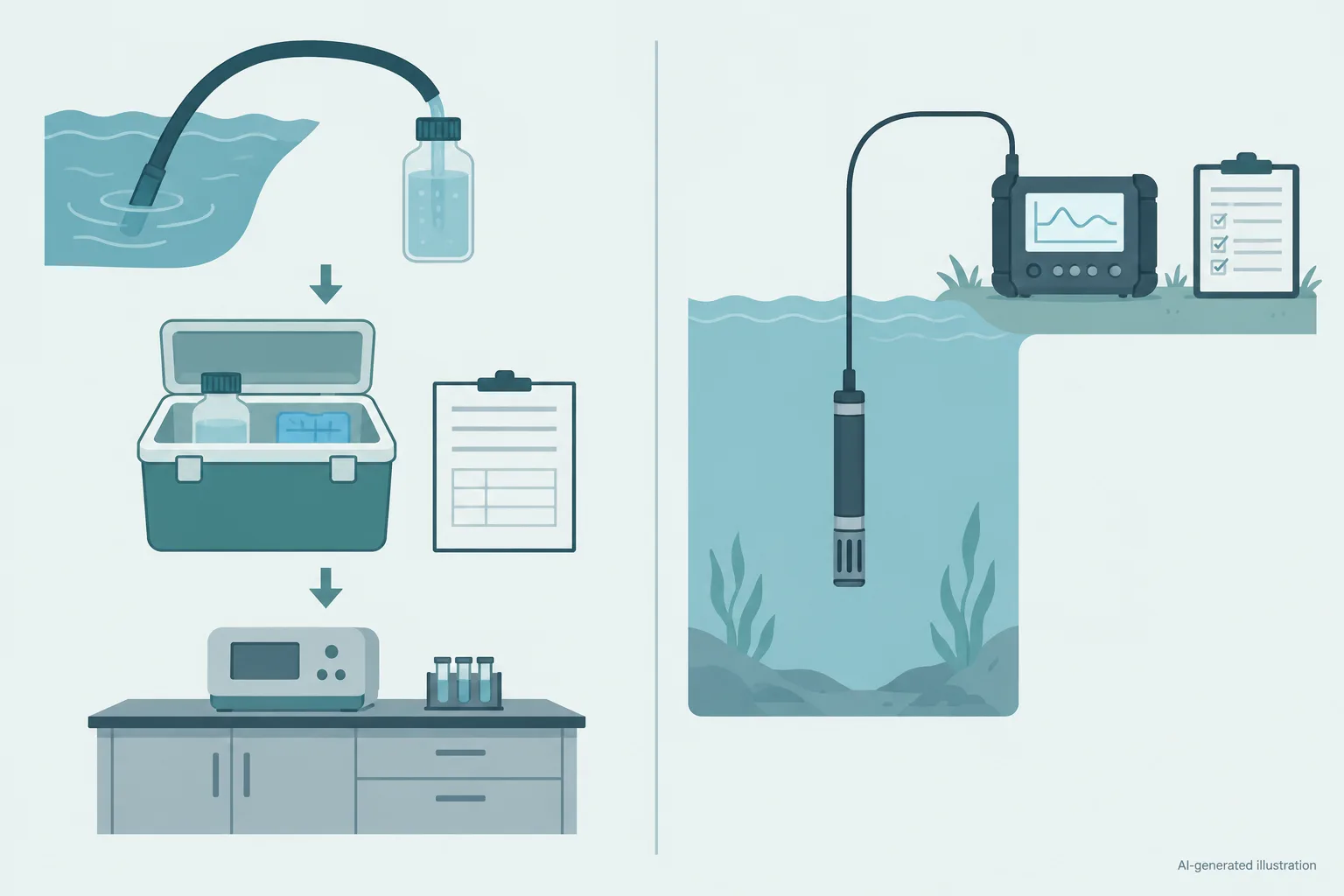
Name the deliverable first. A water sampling programme that ends with a bottle in a cool box and one that ends with a logged reading are different projects sharing a boat and a launch point: the first produces an aliquot that a named laboratory method will analyse, the second produces a value for a named variable under a stated condition, and a programme that needs both has to join them with a record that lets one check the other. Decide that in the other order — instruments first, deliverable afterwards — and the configuration conversation starts from a model name instead of from what the data has to prove.
The distinction is not ours to invent; it is how field work is already organised. The U.S. Geological Survey's guide to water quality sampling techniques notes that physical measurements and streamflow are almost always taken on its stream work, but that water samples are often still needed for chemical analyses — the two are collected alongside each other rather than one instead of the other. Read in that light, water sampling and water-quality monitoring are two outputs of one visit, not two names for one task.
What does a physical sample answer that a reading cannot?
An analytical result for a named analyte, by a named method, on a known volume — and one that can be re-checked later within the limits the method sets, because the laboratory can return to an aliquot it has not yet consumed. A reading cannot be re-examined in the same way: a stored sensor record can be revisited, but not analysed for an analyte the sensor does not measure.
The word "sample" hides a design decision, and the design belongs to the deliverable. The same USGS guidance separates a single grab from a small, well-mixed stream — taken by moving the bottle through the vertical column — from samples taken at set increments across a larger river, where a separate bottle for each vertical section and a single bottle for the whole stream are both legitimate and do not mean the same thing. In the Iowa DNR's reference of sample collection methods, a beach grab collected at a single point sits beside a composite made from water collected at nine sites, three transects and three depths. Which of those a programme needs is settled on the sampling plan, before anyone asks what the boat can carry.
A sample also carries a clock. One field training guide — ICBA's sampling-methods material hosted by FAO — describes a handling route that runs from calibrated electrodes and a rinse with sample water, through filtration to 0.45 µm and acidification of the filtered sample for cations, to labelled bottles with a chain-of-custody form, packed on ice and carried to the laboratory within 24 hours of sampling. Which container, which reagent and how long a sample keeps are set by the analytical method a laboratory works to, not by a catalogue — but the consequence for the platform is fixed: the sample's usable life begins when it leaves the water, and the day's route has to fit inside that life rather than inside the battery.
What does a field reading answer that a bottle cannot?
Continuity, in time and at a density bottles cannot match. A sonde lowered through the column returns a profile in one pass; an instrument running while the boat moves returns a track across an area. Neither is available from a bottle array without stopping at every metre, and some questions — where a layer sits, whether a value is drifting, where a signal begins — are answered by the shape of that record rather than by any single number.
A reading, though, arrives with conditions attached. The ICBA guide asks for calibrated electrodes, a rinse with the sample water and a wait until the reading stabilises before it is recorded; the Iowa DNR lake procedure navigates to the deepest point, anchors the boat, lowers a sonde slowly through the column and only then decides where samples go. "Stabilised", "anchored" and "lowered slowly" are operating requirements, and they belong to the mission rather than to a footnote. A platform that cannot hold station, or whose probe sits in the wash of its own propulsion, still records something — the open question is whether what it recorded is the water body.
The parameter list is the other half of the same question. The published option lists for these hulls name parameters; chlorophyll, ammonia nitrogen, total phosphorus, pH, dissolved oxygen and chemical oxygen demand appear among the examples for one monitoring configuration. A list is not a method: it does not say which values are measured directly, which are derived from another reading, or what has to be true of the water and the boat before a number is logged. Ask for the instrument's own documentation and read it beside the method your programme reports against. Our water sampling and monitoring application page draws the same boundary: the instruments are configuration options, and the bare platform does not measure those parameters.
Where does the platform decide whether the programme is possible?
In two places: the mass it must carry back, and the water its instruments are allowed to touch. Everything else about a hull — length, communication range, sea-state reference — matters second. The platform in question is an uncrewed surface vessel — a USV — whose instruments work from the surface rather than being carried underwater.
A bottle array is the only part of a payload that grows during the mission. The bottles leave the shore empty and come back full, and what fills them is water: the payload grows by the mass of the sample itself, which no published figure on these sheets reserves. Now read those figures on the basis they were stated: one hull separates a 20 kg equipment-only payload from a 50 kg battery-plus-equipment allowance, another publishes 50–60 kg without stating the basis, and a third publishes 100–150 kg as "Standard and Ultimate" load capacity without saying which value belongs to which configuration. Three accounting conventions, and none of them states a filled bottle array as part of the figure. The first arithmetic in a sampling configuration is therefore done by hand, and each basis has to be honoured on its own terms: bottles full, sampler, brackets and cables count against an equipment allowance, while the battery-plus-equipment limit is checked separately — an equipment-only figure reserves nothing for the battery, and a combined figure does not say what remains once the battery is aboard.
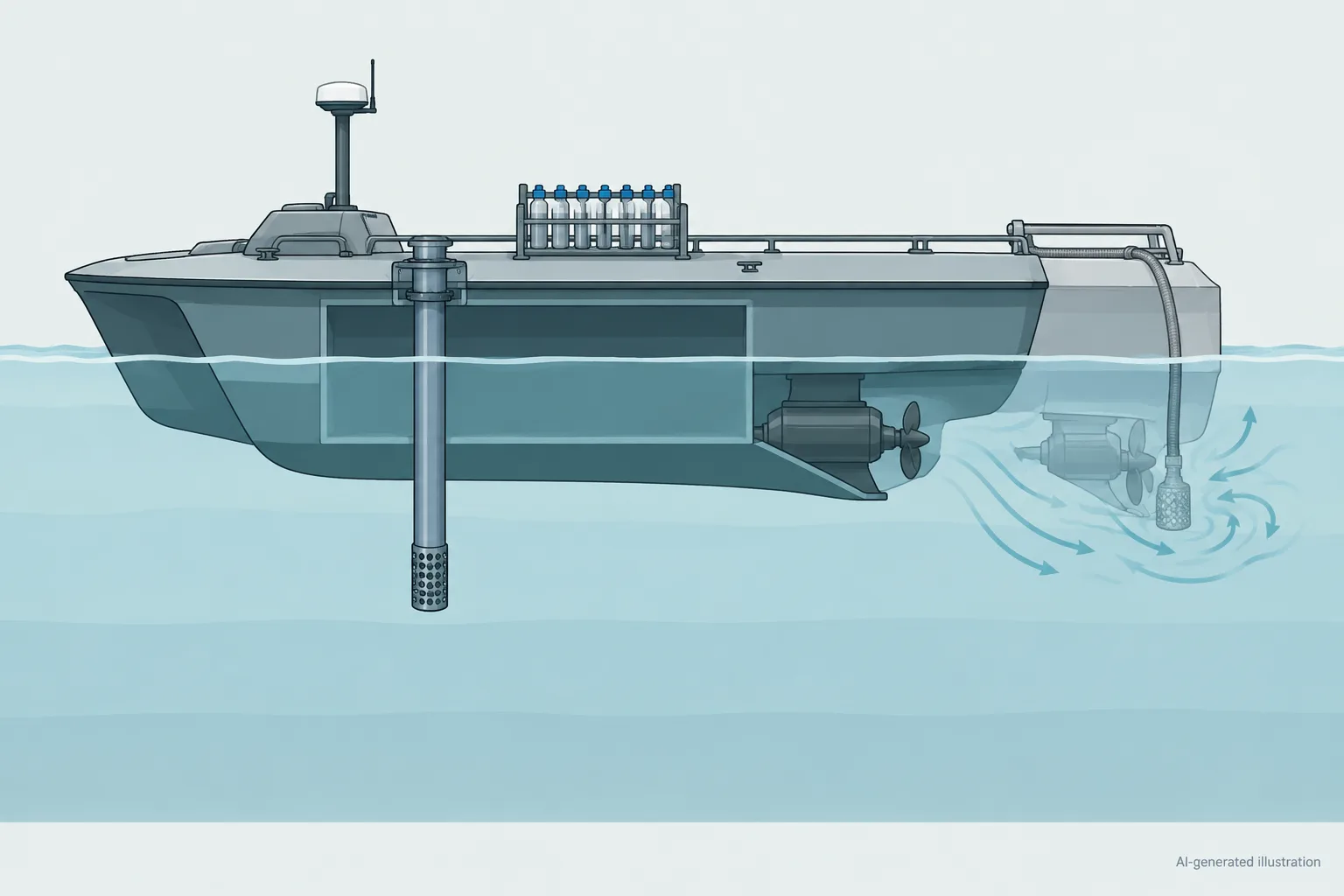
The second place is contact with the water. Published draft tells you where the hull floats — 28 cm on the smaller platform, 30 cm on the HUNTER, 35 cm on the Orcalink — not where the intake opens or how far below the surface it sits, and the two arrangements available are not interchangeable. On one platform a 250 mm through-hull moon pool accepts mainstream ADCPs, CTDs, analysers and samplers, and the rear hatch you order decides whether that opening is available at all: the full-coverage hatch seals the moon pool and the rear compartment, while the simplified hatch leaves it open for sampling or a vertical instrument. The larger platform takes a different route, listing an automatic sampling system that fills a bottle at specified target points, and a separate stratified sampling system for depth work, with winches for equipment such as a temperature chain and layered-water harvesting.
Intake position relative to the boat itself is the part no sheet states. A boat is a disturbance in the water it is sampling, and the U.S. Geological Survey's sampling-techniques guidance — stand downstream of the sampling point so disturbed sediment does not reach the bottle — has a direct platform equivalent: the distance between the intake and the hull and propulsors decides how much of the sampled water the boat has just moved. Ask where the intake sits, whether sampling happens with propulsion stopped, and how the line is flushed between points.
What do the published platform figures settle, and what do they leave open?
They settle draft, handling and the shape of the working day, provided each figure is read with its condition. Three platforms we offer, as published by their manufacturer:
| Platform | Draft | Payload as published | Endurance as published | Sampling-relevant arrangement |
|---|---|---|---|---|
| Orcalink | 35 cm | 100–150 kg, "Standard and Ultimate"; the record does not map values to configurations | 8 h cruising capacity; working speed 1.5 m/s and maximum 5 m/s listed separately | Multiparameter monitor, COD instrument, automatic sampling at target points including one mixed bottle, separate stratified sampling system with winch |
| KOI TURBO | 28 cm | 20 kg equipment only; 50 kg battery plus equipment | 6 h, not tied to the listed 1.0 m/s cruising or 7.0 m/s maximum speed | 250 mm through-hull moon pool; simplified hatch for sampling or vertical instruments, full-coverage hatch sealing it |
| HUNTER | 30 cm standard | 50–60 kg; basis not stated | Cruising capacity 8 h; 5 h at 1.5 m/s; 1–2 h at 6 m/s | Automatic sampling listed as an option, with online monitoring, COD, oil-content and flow-injection modules |
What the table leaves open is exactly what a sampling programme asks. None of the three states bottle volume, the number of independent samples the sampler holds, intake depth, whether a reading may be taken on passage or must wait for the boat to hold still, or what calibration and cleaning a monitoring season demands. A sampling run is not a cruising run in any case: it stops, holds, repeats and returns heavier, so an hour figure belongs next to its speed and its condition — and the question "what does stopping do to that figure" is one for the quotation, not for a comparison table.
How do you keep the sample and the reading comparable?
Give both the same four coordinates — time, position, depth, and the state of the instrument — and put them on the record when the water is taken, not reconstructed from memory afterwards. When a programme uses a reading to decide its sampling, that link is already being made: in the Iowa DNR lake procedure above, the sonde profile establishes whether a thermocline is present, and if it is, the samples are taken above it in 0.5 m increments. The reading chose where the bottles went; the bottles then have to say which reading they belong to.
That is harder from a moving platform than from an anchored boat, and it is where two datasets quietly become two programmes. A bottle labelled with a time, a position, a depth and a bottle number, logged beside a reading carrying its own time, position, depth and calibration state, can be joined and argued about. A bottle labelled "site 4" cannot. If the fields cannot be joined, the comparison the programme intends is not there, however good each half is.
What should a request for a configuration state?
Send the answers, not the model name. Eight items decide most of the configuration:
- The analyte list and its method. What the laboratory will determine, and the container, preservation and holding time its method sheet requires.
- The sampling design. Points, depth, and whether each point gets its own bottle or several points share a mixed one — plus the volume each analysis needs.
- The reading set. Each parameter, and whether the instrument must be stationary, stabilised or fed a flow, or can run while the boat moves.
- The intake and probe arrangement. Through-hull or over the side, its depth, its distance from the propulsors, and how it is flushed between points.
- The mass audit. Bottles full, sampler, instruments, brackets and cables, with the equipment-only and battery-plus-equipment allowances checked separately rather than substituted for each other.
- The handling route on board. Labelling, shading, cooling and how long the samples may stay aboard before they leave for the laboratory.
- The record. Which fields travel with every sample and every reading, and in what format they are exported.
- Site and day. Launch point, route, current and wave conditions, and whether the platform must hold station at each point.
If some of that is still undecided, our free project brief generator turns what you do know about the task and the site into a written brief with the missing items flagged; it runs in the browser, needs no email address, and recommends no model.
Where do we fit in a sampling programme?
We supply the surface platform and coordinate its configuration with Aqua Helpers, the manufacturer of the hulls named above. We do not take the samples, run the laboratory analysis or certify a method. What we can do is hold the requirement and the configuration to each other: a method that needs a bottle changed at every point, or an instrument that must hang vertically through the deck, becomes a hatch choice and a mounting question before it becomes an order.
Start from the analyte list and the sampling design. That is what turns into a configuration, and it is what a project equipment quotation can be written against. If your work goes below the surface instead of at it, the comparison of surface and underwater platforms is in USV versus ROV versus AUV, and the underwater side of monitoring is covered in AUV environmental monitoring.