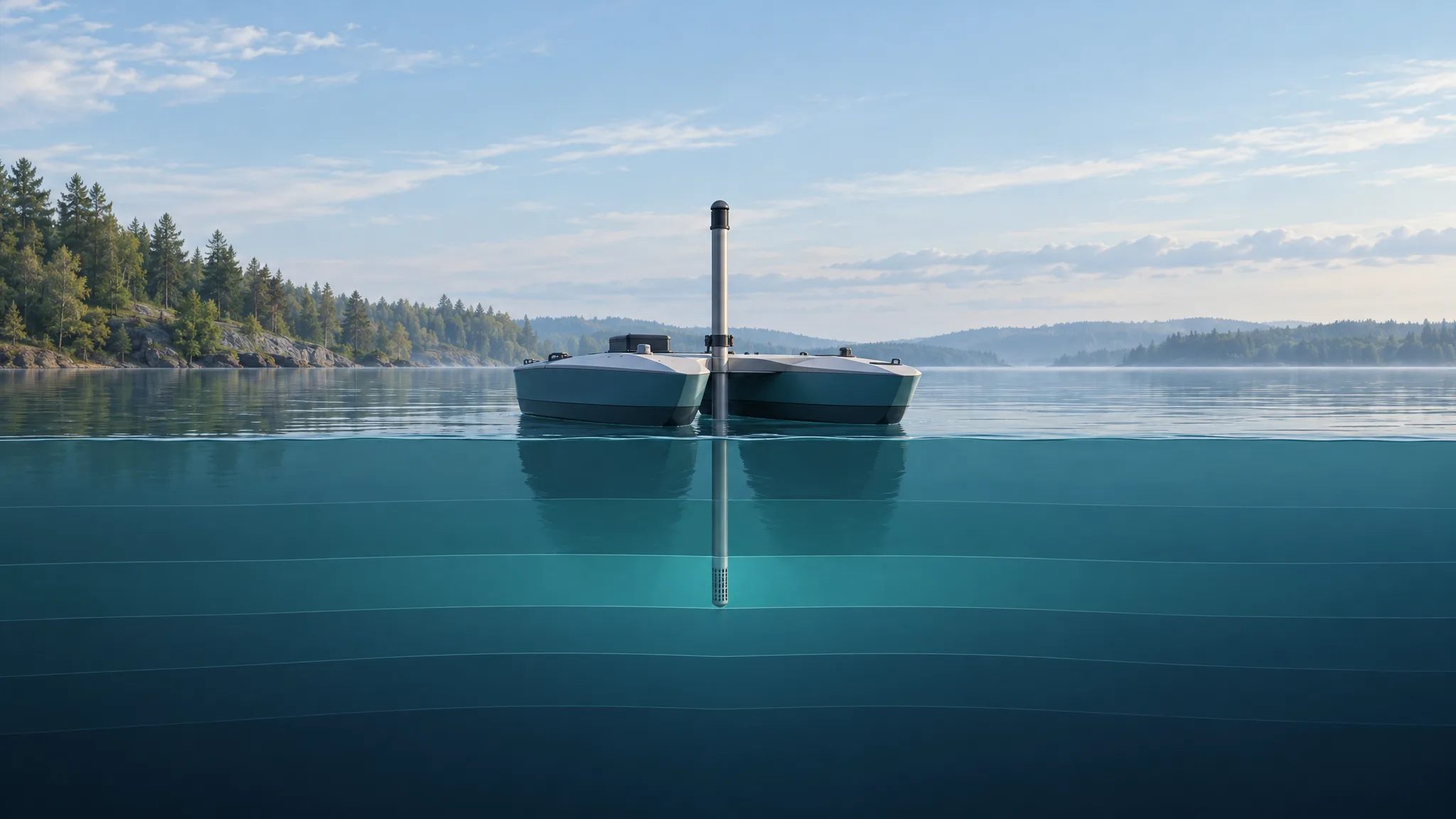
A sampling plan that asks for a surface sample has already made a decision about depth. Often it has just not written the number down. From a bank or a bridge you reach the bottle into the top 20 cm yourself and the question answers itself. From a boat, the depth is set by where the sampler's intake sits against a waterline that moves with load, speed and chop — and on the shallow-draft surface vehicles we supply, that waterline is only 15 to 40 cm above the lowest point of the hull.
Draught is a hull figure. It tells you which layer the boat occupies; it does not tell you which layer the water in the bottle came from. Water sampling depth is a mounting and operating condition, and it is better settled in the quotation than discovered in the first field report.
What does a sampling plan mean by "surface"?
It means a number, and the number is usually a short one. In the US EPA's sample-collection appendix to its beach guidance, a surface grab is taken 15 to 30 cm (6 to 12 in) below the water surface, with the bottle mouth plunged downward to avoid surface scum and kept away from the side of the sampling platform or boat.
Depth also decides which water mass you have sampled. Where a thermocline separates the layers, a sample from above it, inside it or below it answers a different question, and the sampling guidance published by GMBL recommends 2 m in the middle of a lake when only one sample can be taken. The same guidance notes that a sampler such as a Ruttner bottle is usually needed for a sample from a specific depth, because a bottle on a stick will not get you there.
Where a permit, a method standard or a client's specification fixes the depth or the method, that document governs. What follows is technique: how to make a plan's stated depth true from a small unmanned surface vehicle.
Where does the intake sit on the platforms we supply?
Draught is measured to the lowest point of the hull, never to the sampler's intake, so the specification table cannot answer the question on its own. What the manufacturer's documentation does show is how the sampling gets into the water:
| Model | Published draught | Sampling arrangement in the manufacturer's documentation |
|---|---|---|
| KOI | 15 cm, listed as a safe range | automatic water-harvesting systems listed as options |
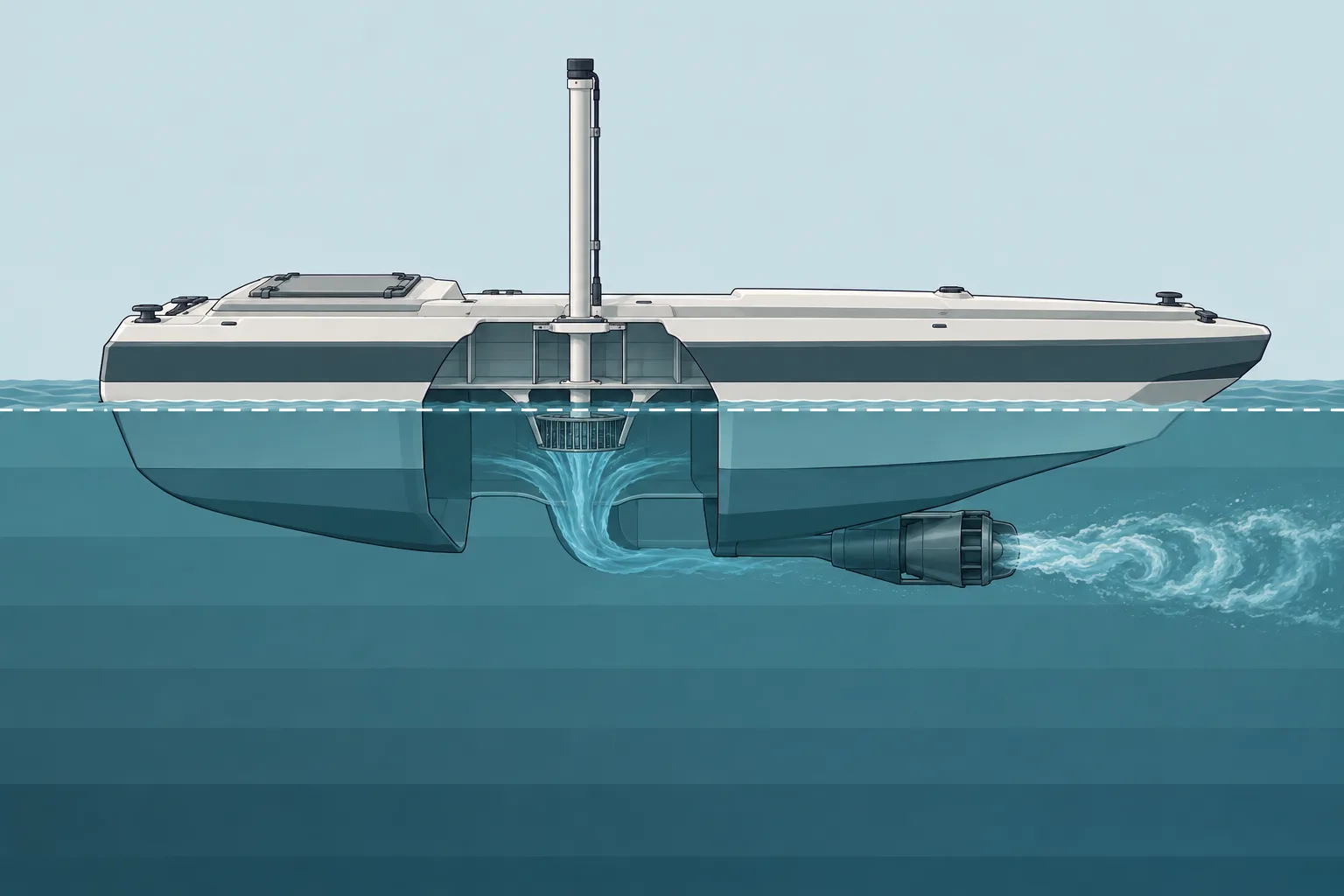
| KOI TURBO | 28 cm | 250 mm through-hull moon pool; a simplified rear hatch left open for sampling or vertical instruments |
| HUNTER | 30 cm standard | automated water-harvesting system listed as an option |
| Orcalink | 35 cm | automatic sampling at specified points; a stratified water-sampling system and a winch listed as separate options |
| Seeker | 400 mm | dual moon pools and rail-mounted payload |
Two things follow.
The arrangements differ in kind, not only in number. A through-hull moon pool draws from the water the hull is sitting in. A line led over the side or through an open rear hatch can be set lower — at the cost of sitting in the wash along the hull. A 15 cm hull and a 40 cm hull are not the same starting point for either.
And the offset is a configuration figure. It is confirmed with the manufacturer against the sampler you choose, together with the bracket, the tube route and the power it needs. Sample volume and depth are treated the same way on a sampling enquiry, rather than inferred from the hull's payload rating or from the winch visible on the deck. Our sampling and monitoring configuration page sets out what has to be specified alongside them.
Is the water sampling depth set by the hull or by the sampler?
Both — and the hull limits what the sampler can reach.
Take a 28 cm draught hull against that 15 to 30 cm band. The hull's body spans the band. Whatever is drawn through a through-hull moon pool comes from the column the hull is displacing, and a tube led below the hull bottom draws from deeper than 28 cm, which puts it outside the band rather than inside it. On a 40 cm hull the arithmetic runs the same way: the shallowest water a fixed through-hull intake can reach already lies below where many plans define a surface sample.
So two boats with the same draught can deliver samples from different depths, and one model can do it two ways. The KOI TURBO lists a full-coverage hatch that seals the moon pool and a simplified hatch that leaves it open for sampling or vertical instruments; which one is quoted changes where the intake sits.
What we would do with a plan in hand: write down the depth it requires, ask for the intake position in writing for the configuration being quoted, and check the two agree before the order rather than after the first report.
What changes the depth once the boat is working?
Three things: load, attitude and the surface itself.
Load. KOI TURBO separates a 20 kg equipment allowance from a 50 kg battery-plus-equipment figure; HUNTER weighs 45 kg including battery; Orcalink 85 ± 1 kg including battery. A sampler, its bottles and a full set of filled bottles are mass, and they sit where they are mounted. Whether that moves the intake relative to the surface, and by how much, depends on the hull and on where the mass is placed — worth asking per configuration rather than assuming it away on a boat this size.
Attitude and wash. A pump-jet or a brushless thruster discharges below the waterline, aft of the hull. Sampling while the boat drifts is a different proposition from sampling at speed: cruising speed is 1.0 m/s on KOI TURBO and working speed 1.5 m/s on HUNTER and Orcalink. A tube led below the hull sits in the discharge's path.
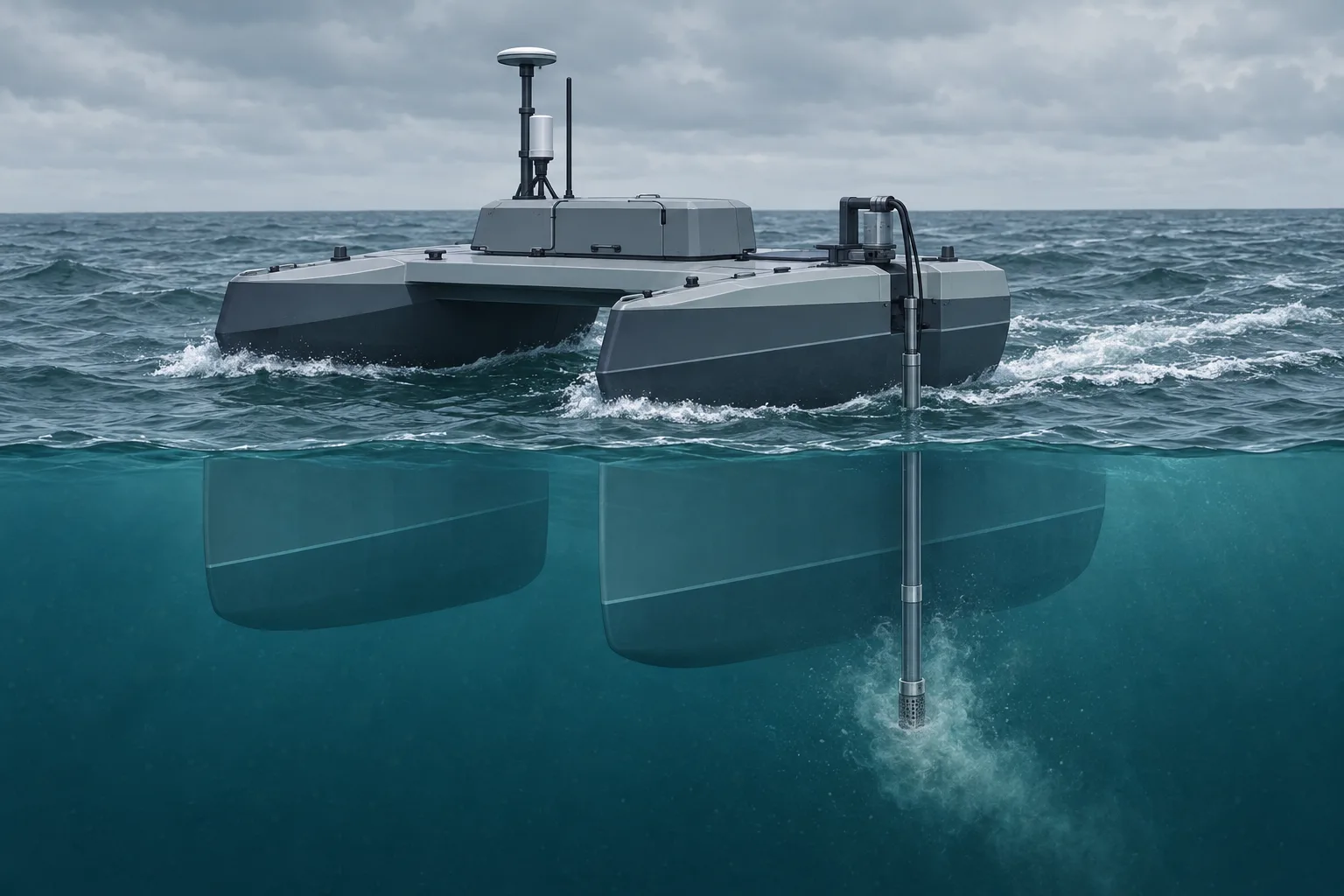
The surface. Published wind-and-wave references put these platforms at Beaufort 3 with 0.5 m waves (KOI TURBO), 1 m waves (Orcalink) and 1.5 m waves (HUNTER). A 0.5 m wave height lifts and drops the water surface by about a quarter of a metre at a fixed point, wider than the whole 15 to 30 cm band. A depth written without a sea state and a tolerance attached describes a moment, not a method. Our piece on monitoring a water column rather than a single point takes that difference further.
What should the plan record, and what should the quotation confirm?
Record in the field:
- the depth definition the plan uses, and whether the sample met it;
- whether the boat was drifting or holding station, and at what speed;
- which hatch or mounting was in use;
- whether the intake sat forward of or behind the propulsor;
- time, position and bottle number for each sample;
- anything that made the sample unrepresentative.
That is close to what the EPA appendix asks of a field record and chain-of-custody form: the sampling method and equipment, the sample's identification, and any deviation from the plan.
Confirm in the quotation:
- The intake offset below the waterline for the quoted configuration, at the load and trim you will operate.
- Whether that offset is fixed or adjustable, and what adjusts it.
- Whether sampling happens stopped and drifting or at a stated speed, and what the mounting allows.
- Whether the line and bottle are rinsed with sample water before the bottle fills, and where the rinse goes.
- Whether one point at two depths uses one line lowered twice or a separate stratified system — Orcalink's option list names a stratified water-sampling system apart from its automatic sampling system, so treat them as two configurations until the manufacturer says otherwise.
- What the sampler records by itself: time, position, bottle number and depth.
- Whether the bottles suit the analysis and the holding time your laboratory works to.
Items 1 to 3 change the number that ends up in the report. Items 4 to 7 decide whether a sample taken at the right depth is still worth analysing.
What we need before we can confirm a depth
The model is the last thing we need; the depth is the first.
Send the sampling points, the depth each one needs and the tolerance around it, the volumes and bottle types, whether the boat may stop to sample, and the water conditions you expect — wind, wave, current, weed. We coordinate the sampler, brackets and mounting with the manufacturer, confirm the intake position for that configuration, and quote the platform that carries it. If your plan already names a method standard, send it too, so the configuration is checked against the document that will be audited. Send the depth with the rest of the project details and we will quote against it.
Filed under Water Sampling and Monitoring
Back to Blog