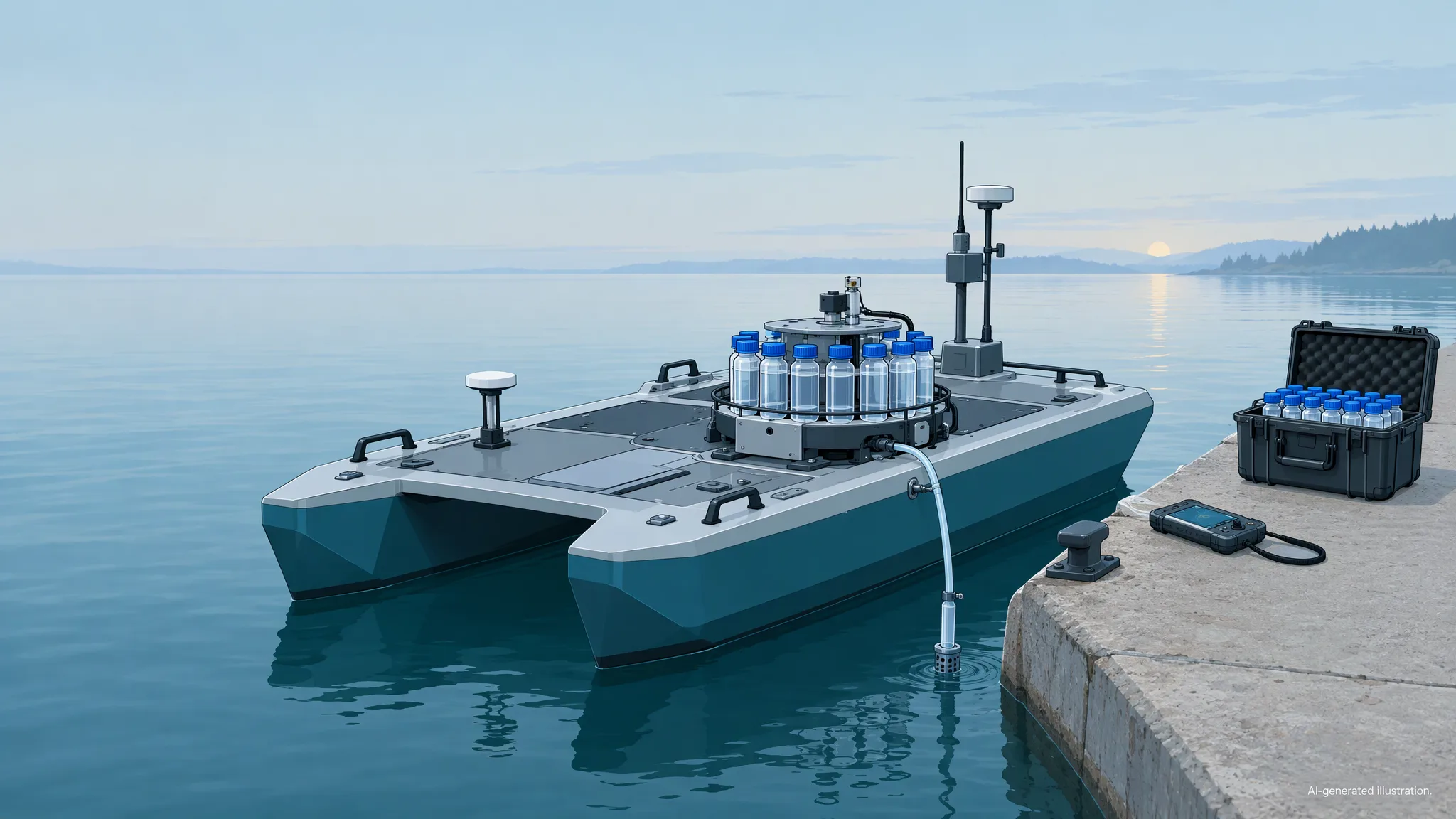
The automatic water sampling system we offer on three survey platforms is listed with capacities of 2, 6 and 10. None of the descriptions behind those labels states the volume of one bottle or how many independent samples a trip can return, and only one of the three says whether a bottle may serve more than one sampling point. Those three questions, not the number, decide what comes back from an outing.
What does the number in an automatic water sampling system name?
It names the capacity of the option you order, and on its own it settles neither sample count nor sample volume.
| Platform | Option as offered | What the description adds | Published weight including battery |
|---|---|---|---|
| 0.99 m hull | Automatic 2 and automatic 6 water harvesting systems | nothing on bottle volume or sample count | 12 kg |
| 1.6 m catamaran | Automated 10-water harvesting system | nothing on bottle volume or sample count | 45 kg |
| 2.5 m catamaran | Automated 10-water harvesting system | sampling at specified target points, with several points able to share one bottle | 85 ± 1 kg |
Read the three lists together and two useful conclusions follow. The smallest hull is offered in two capacities while the two larger hulls carry a single capacity, so the figure is a decision taken at order rather than a property of the boat. And each list stops at the name.
The sampler also shares its deck with other water instruments: a full-spectrum COD detector and an online water-quality monitor on all three platforms, an oil-content analyser on the larger two, a phosphorus and ammonia module on the 1.6 m catamaran. Nothing in the lists says that the sampler and those instruments draw from the same point, or that they can be installed and operated at the same time. Ask for that in writing rather than assuming it.
How many samples can one outing return?
As many as the point-to-bottle assignment allows, which is not the same question as how many bottles the option provides. On the 2.5 m catamaran, samples are collected at specified target points using the intelligent handheld ground station, and different target points can be assigned to the same sampling bottle for mixed sampling. One unit can therefore return a set of discrete samples from separate points, or a single bottle built from several of them.
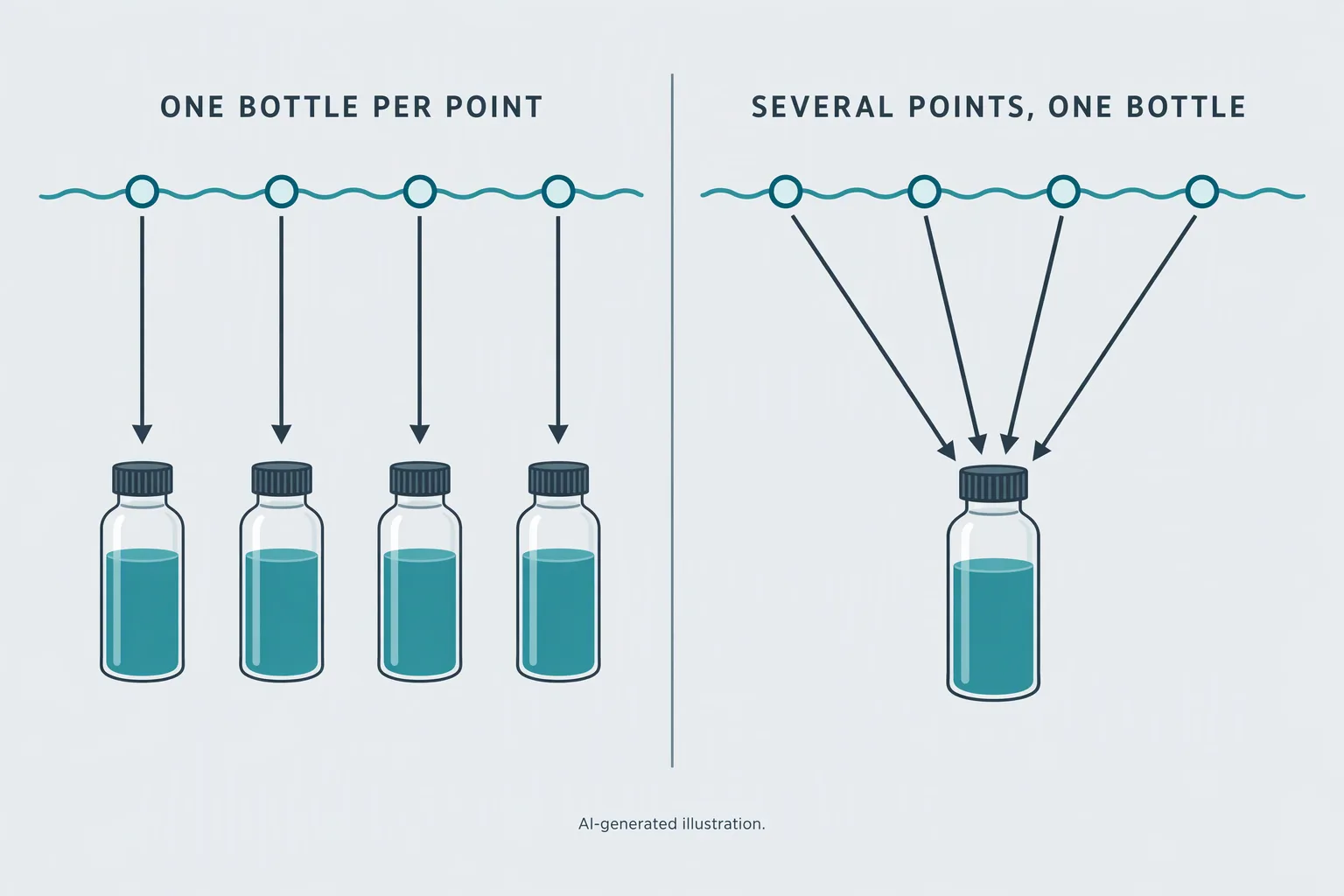
Keep three quantities apart when you specify a job:
| Quantity | What it actually decides |
|---|---|
| Bottle position | how many fills the unit can sequence |
| Independent sample | how many results you can report separately |
| Sampling point | how much of the water body one result describes |
A composite is a real result rather than a shortcut. The U.S. Geological Survey's 2024 guidelines for automatic samplers describe a sampler collecting a prescribed volume, an aliquot, and mixing several aliquots into a flow- or time-weighted composite that represents the "average" chemistry of the sampled water body. What a composite cannot do is tie a concentration to one point. If your monitoring plan, permit condition or internal protocol needs a result per point, write that down and ask how points map onto bottles before the order.
How much water must each bottle hold?
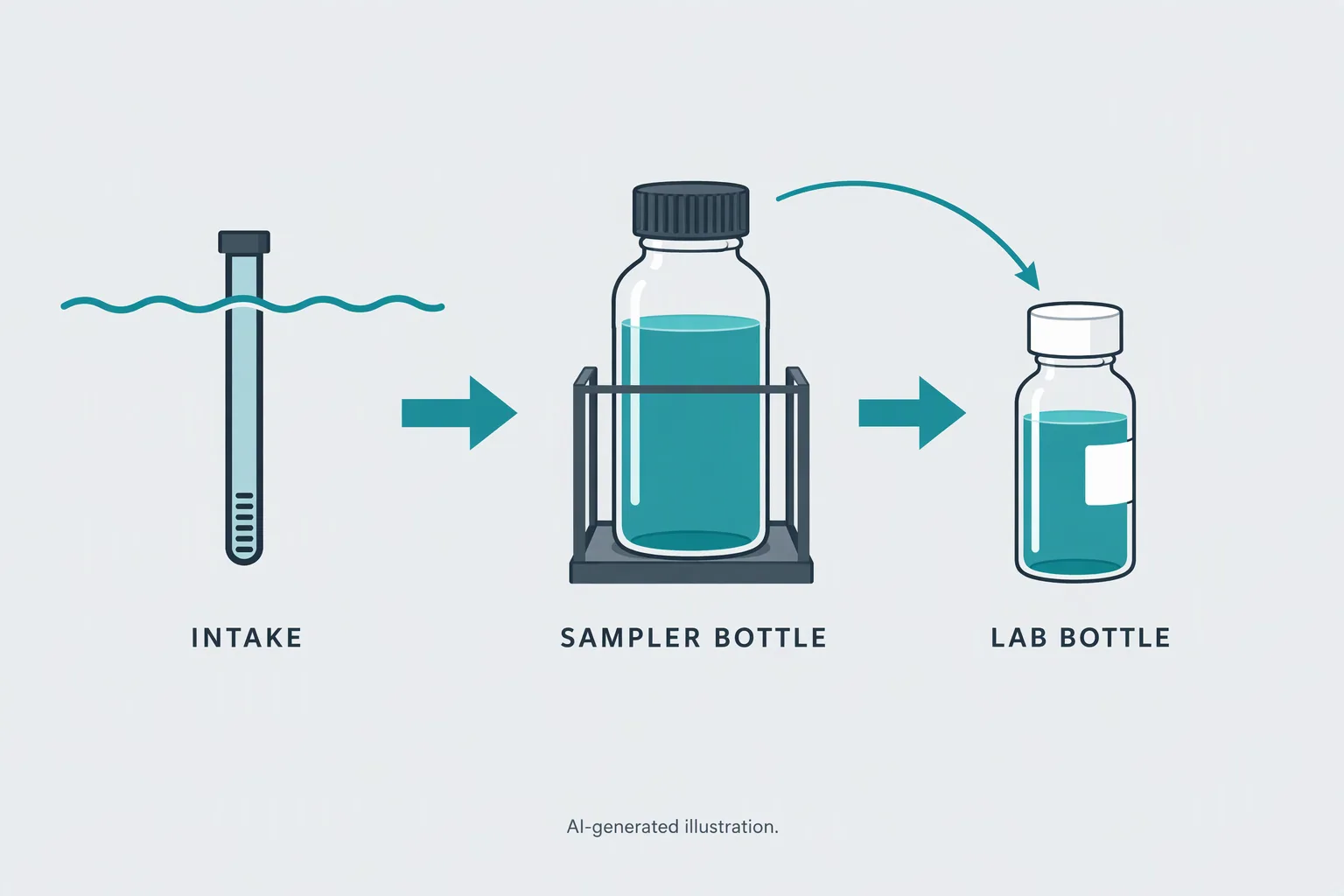
More than the laboratory needs, because the sampler bottle is often not the bottle the laboratory receives. Queensland's departmental guidance on water quality sampling with automated sampling equipment (Physical and chemical assessment, February 2018) treats the sampler bottle as an intermediate container: the sample is decanted into laboratory-supplied bottles, rinsed there where the method calls for it, and where enough sample remains, further analyses may be drawn from the same sampler bottle. Volume per bottle has to cover the analyses, the rinses and the laboratory bottle, and the laboratory — not the boat — sets the container, any preservative and the holding time.
Delivered volume is a tolerance as well as a target. Frontier Precision, in a comparison of automatic sampler types, sets out the pre-sample purge and rinse sequence, volume determined by pump revolutions together with the suction line's internal volume and a liquid detector, and a volume accuracy of roughly ±5 ml for vacuum samplers against roughly ±10 ml for peristaltic ones. A small sample and a long intake line are both harder to deliver exactly, which is why the line's length and bore belong in the same part of the quotation as the bottle volume.
What does a full set weigh, and where does the intake sit?
Filled bottles are mass carried above the hull, and the vehicle weight on a specification table is not the load available for equipment. The published weight including battery is 12 kg on the 0.99 m hull, 45 kg on the 1.6 m catamaran and 85 ± 1 kg on the 2.5 m catamaran. One sentence in the quotation settles the arithmetic: whether the battery and accessories sit inside the quoted load figure, and whether the bottle set is quoted empty or full.
Position matters at least as much as mass. A tube lowered over the side draws water the hull and thrusters have already stirred, and how much that matters depends on where the intake sits and how deep it goes — the subject of our article on sampling depth. A bottle count agreed without that answer is a count of containers, not of usable samples.
Which bottle, and what happens after it leaves the water?
The analyte decides the bottle. Queensland's guidance specifies polypropylene or glass sampler bottles according to the parameters monitored, requires each bottle to be labelled in the order it is filled, and requires the distributor arm to restart at bottle one once the set is changed. The last point is a record requirement as much as a mechanical one: a bottle number that does not correspond to the point it was filled at is not a sample you can report. On a boat, that record is made twice — by the operator at the point, and by whatever the ground station logs — so ask what the log holds for each fill: time, position, bottle number, or none of the three.
Storage is the part of the chain a boat makes hardest. That guidance keeps samples chilled and dispatches them within the analytical holding times, and the USGS guidelines store samples chilled in a closed container until they can be retrieved, while noting that preparing, calibrating and maintaining an autosampler still takes considerable human effort. Ask us whether a given configuration includes chilling, light protection or neither before you plan a long day. Neither the bottle count nor the hull size answers that question.
What belongs in a quotation for an automatic water sampling system?
Ten lines, each answered separately:
- Bottle count, bottle volume, and the fill volume you expect per sample.
- Bottle material, and whether the sampler bottle is also the container the laboratory receives.
- Discrete or mixed sampling, with the number of points allowed per bottle.
- How a fill is triggered — by hand, at a point, on an interval — and what the record carries.
- Intake line length and bore, and whether the line is purged and rinsed before each fill.
- Cleaning and cross-contamination steps between points, and whether field blanks can be run with the set.
- Chilling or light protection, or a plain statement that neither is included.
- Load with the bottle set full, and the basis of the quoted load figure.
- Which items the option contains: the bottle set, the intake line, the cleaning items. The capacity label does not say.
- Stratified sampling, if you need depth-separated samples, named as its own configuration.
Line ten matters on the 2.5 m catamaran, where a stratified water-sampling system is listed separately from the automatic sampling option: the same hull, a different system, and a different set of questions about depth and winch.
Send the sampling plan with the request
Points per trip, volume per bottle, discrete or composite, the laboratory's bottle and method, the hours on the water: those decide the configuration, and each of them is settled before a quotation is written. Write the day out — where you stop, what you take at each stop, which bottles it fills — and send it with your quotation request. We coordinate the configuration with the manufacturer and confirm in the answer what the option includes, what is quoted separately, and what the load figure already covers. The water sampling and monitoring configuration page sets out the four requirement groups a project is checked against.
Filed under Water Sampling and Monitoring
Back to Blog