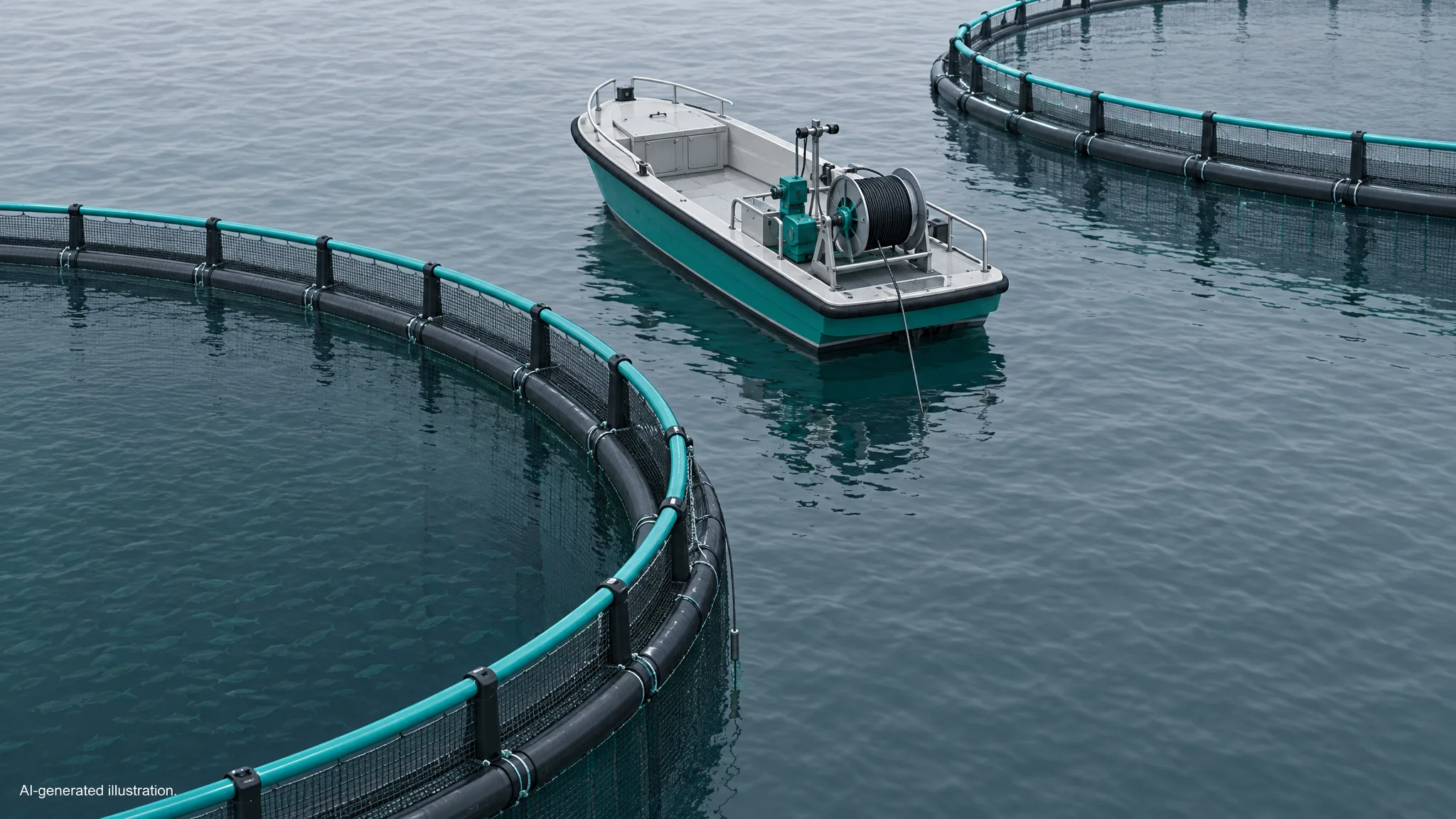
What does an aquaculture net cleaning programme have to settle first?
Four things sit under an aquaculture net cleaning programme, and they hold each other up: what fouling is doing to the cage, when that becomes unacceptable, how much force the net can take, and what the farm will be able to show once the pass is over. This page spends most of its length on the last of the four, because it is the one that decides whether the next interval can be argued at all.
The discussion starts with the interval — the number of days between passes — and the useful question about any interval is where the number came from. The interval, the force and the record are one decision wearing three hats: fouling is load on the mooring and closure of the mesh; the pass that clears it is also force applied to the twine and material released into the water the fish are breathing; and only a record that separates what the machine did from what the net is lets a farm tell whether any of it worked.
We supply cage-cleaning equipment and coordinate its configuration with Pengpai Ocean, the manufacturer. We do not run farms, assess net condition for anyone or certify a cleaning result. What follows is how those four fit together, and what to ask for at each.
What does fouling change before anyone cleans?
Two things the budget feels: open area and load. A 2014 panel study in the International Journal of Molecular Sciences recorded mesh openings reduced by 28% on uncoated net after 148 days of static immersion, against 10% on copper-coated and 12% on silicone-coated net. It also reports earlier work finding that a few months of immersion can increase netting weight as much as two-hundred-fold and drag five-fold, with that added weight and drag having collapsed large commercial structures, and it puts the direct cost of controlling biofouling at 5–10% of production cost.
The same closure works on the water rather than the structure. The 2023 study in Frontiers in Aquaculture describes net occlusion limiting water exchange, lowering oxygen saturation and inhibiting waste removal, and adds that a fouled net's extra weight and the deformation it causes can lead to net damage.
Load is where cleaning stops being housekeeping. Marine Scotland's 2015 technical standard for Scottish finfish aquaculture requires mooring design to assume that 50% of a seawater pen's net surface is solid with respect to drag, from twine area plus worst-case fouling. A mooring is therefore sized for a fouled net; the farm's job is to stay inside that assumption rather than meet it in a winter storm.
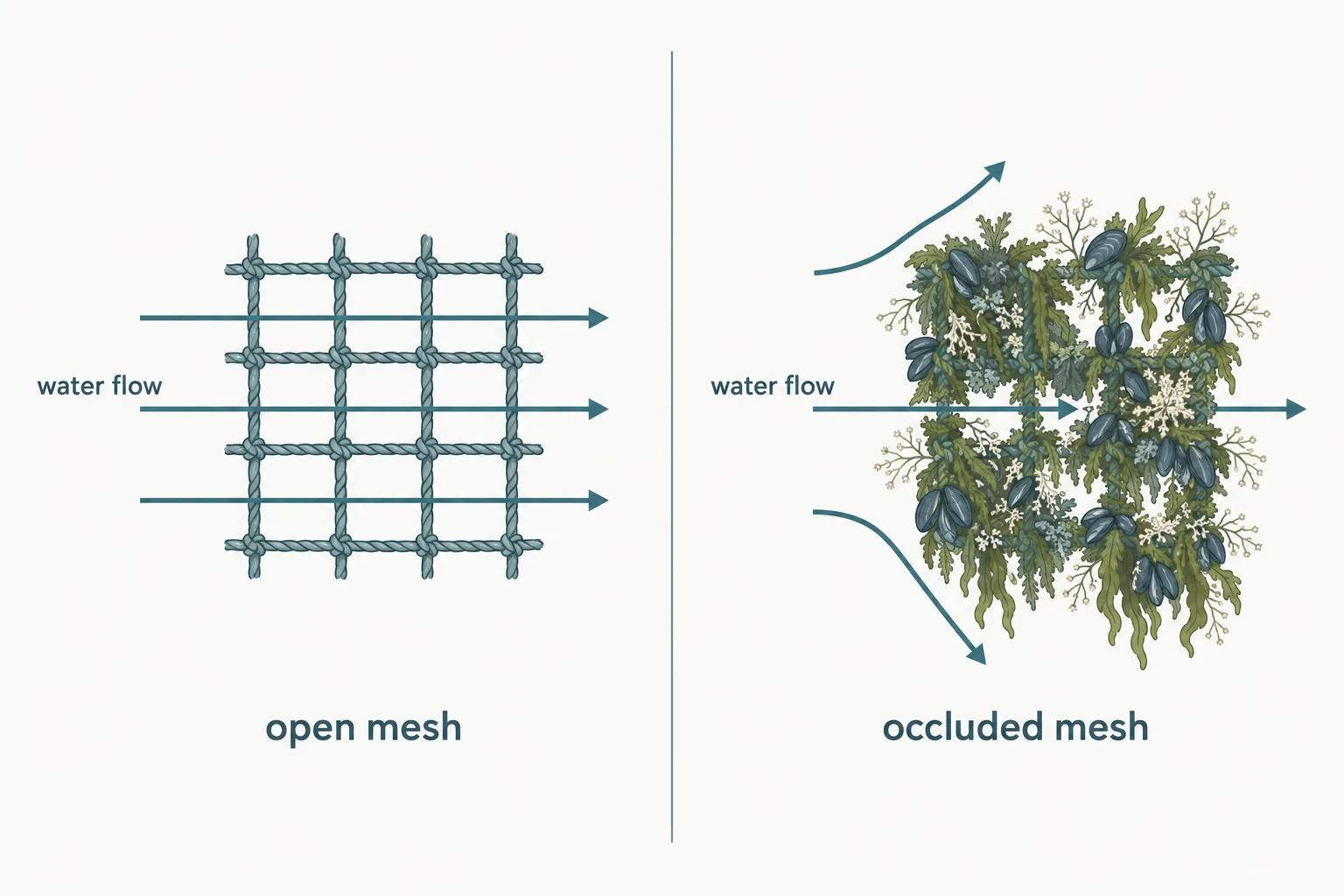
AI-generated illustration: a concept of mesh closure, not a measurement from any farm.
Should the interval follow the calendar or the cage?
The cage, with the calendar as a check on it. The 2023 study sets out what the frequency actually depends on — how fast fouling accumulates at the site, what the cultured species needs, and what the net is coated with — and records that cleaning rates have risen in Scotland and Norway, reaching "every two weeks or more" on high-growth sites. Its field trials on three commercial farms in western Norway worked between 60 and 175 bar, took two to five hours per net pen, and ran on a fortnightly cycle from May to November.
Two consequences follow. A fortnight is not a wrong interval; it is an interval someone chose on a site with a growth rate and a species, and it means nothing on a site with different ones. And the coating ages out from under the schedule: the same paper records that copper-based coatings lose effect through the seawater phase, with fouling possible within 8 to 12 weeks of immersion, so the interval a new net needs in its first month is not the one it needs in its sixth.
What we would ask a farm to write down, then, is not a number of days but the two inputs that produce one — the growth observed on each cage, and the time a pass actually takes there. A supplier's cleaning rate and a neighbouring site's routine are starting guesses, not the interval.
How much force should reach the net?
Enough to remove the growth and little enough to leave the twine alone, and that amount differs by net treatment — which is why a single pressure is a system setting, not a specification. The 2023 study describes commercial cleaning rigs pushing water through nozzles at 50 to 300 bar. The 2014 panel study found the pressure needed to clear fouling differed by treatment: copper-coated net gave up most of it at around 30 psi (0.207 MPa), silicone-coated net below that, and uncoated net needed the highest pressure of all and still kept algae, hydroids and ascidians attached above 100 psi (0.689 MPa). Its authors also note that frequent cleaning and net replacement stress the animals and damage the nets — the trade, in one sentence.
The system we coordinate with Pengpai Ocean is listed at 80 bar and 100 L/min through 1.2–2.0 mm nozzles, with a 160 cm cleaning width, 0–1.5 m/s of travel and a 100 m working depth, and the manufacturer describes pressure reduction intended to hold cleaning performance while limiting wear on the cage. Read those as settings to be matched to your net, not as a recommendation for it, and read them beside our published limits for the system, which state the boundary: no universal wear or cleaning-rate guarantee, and cleaning settings to be confirmed against the cage you intend to clean.
A pass is not only mechanical. The same field study measured turbidity and dissolved oxygen changing in the pen while cleaning was under way, and found a large shift in the salmon gill microbiome afterwards, with a moderate change in inflammatory and antigen-presentation activity and little change in pathogen diversity. None of that argues against cleaning; it argues for knowing when a pass is worth the disturbance.
Whether the tool in the water is a jet or a brush decides where the force lands; what decides the outcome is how much of it reaches the twine and how much of the panel the pass covers. Net material, coating, mesh size, repairs and the fouling community all change what is safe, and none of it can be settled from a general article.
What does a pass record show, and what does it not?
It shows where the vehicle went and what its cameras saw; it does not show the condition of the net. Those are different outputs from the same dive, and a farm needs both to decide anything about the next one.
What the console shows and records is substantial: four Ethernet IP cameras, four LED lamps listed at 3000 lux, four 4K monitors and four video recording channels, an on-screen display carrying date, time, depth and sensor values, and a graphic view of the desired path, the actual path, the vehicle's posture and its three-dimensional position in the cage. The manufacturer also describes marking points of interest from the cameras so they can be revisited later. What the documentation does not say is whether those path and posture views are retained or exported; if they have to become part of a file, that is a question for the quotation.
As far as it goes, that is a good account of work done — where, when, how deep, and which places deserved a second look — provided someone captures it. It is not a condition record, because a camera following a cleaning path frames the mesh the cleaning needs, at the distance and angle the cleaning needs, for as long as the pass takes. A condition record answers a different question — what is the state of this panel at this place — and it needs its own framing, its own lighting and an agreed answer to what counts as an observation and what counts as a conclusion. Marking a point is the beginning of that record, not the record.
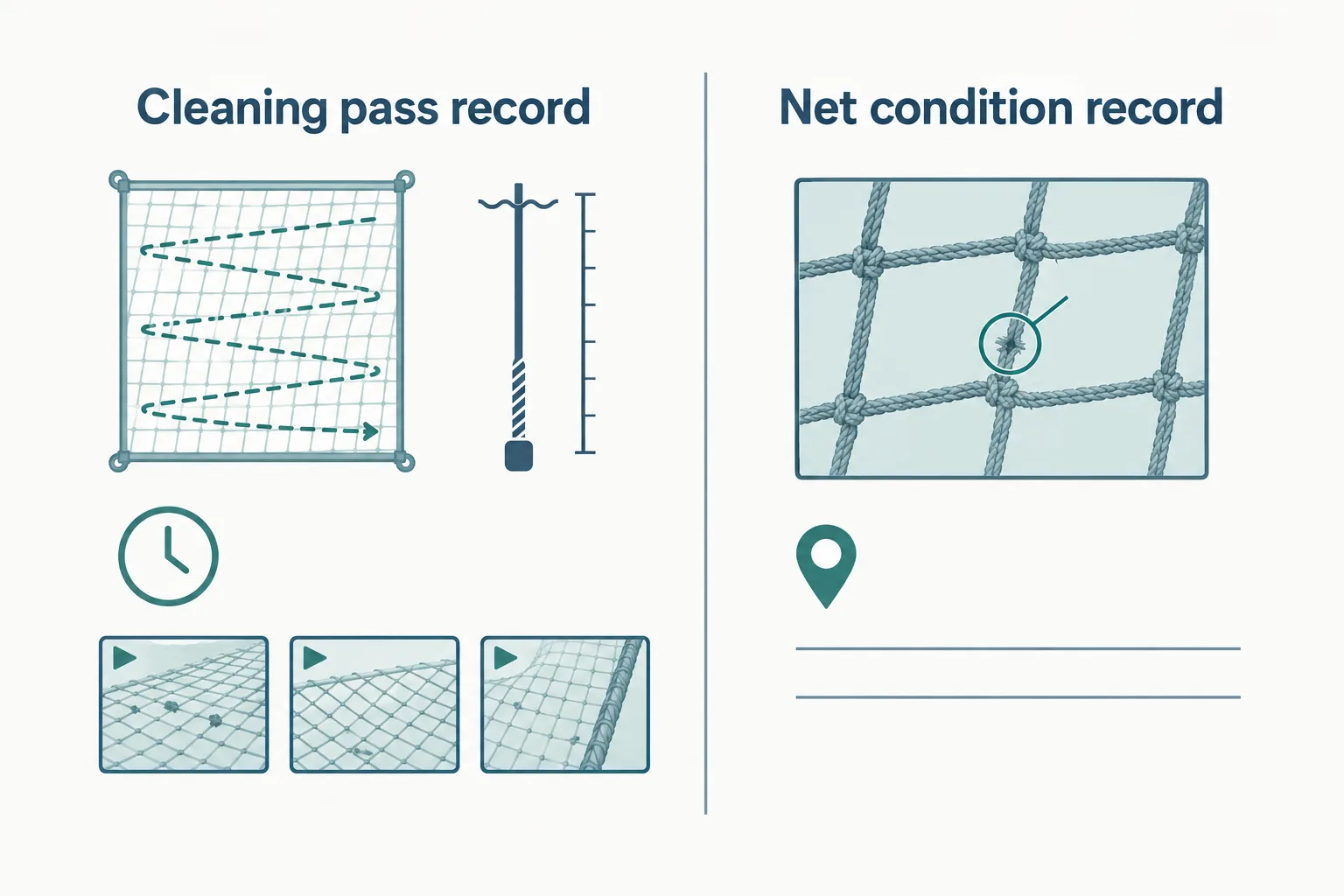
AI-generated illustration: what a cleaning console shows beside what a condition record has to add.
The two outputs are worth separating on paper before the season starts. Marine Scotland's standard sets out what that paper can look like: it requires adequate documentary evidence of compliance with its mandatory provisions to be available for inspection, and treats the numbered elements of a site operating procedures manual as mandatory and auditable. Whether and how it applies to a given site is a question for that farm's regulator and compliance people, not for an equipment supplier.
What else should be inspected while the vehicle is down?
The mooring, the collar, the buoys and the bottom. Fouling shows up on the mooring as load, and the same standard requires certificates for connectors whose strength is documented by test or calculation, checked and held — paperwork no camera can produce. The 100 m rating and the high-pressure hose belong to the panels and the cage bottom, not to an anchor line running into deeper water. A mooring check asks for a tether long enough for the site, a vehicle that can hold station in current and a way to record what was seen at a known place: the same discipline as a net inspection, on different hardware. If the vehicle families are new to you, the glossary entry on the remotely operated vehicle fixes the terms fastest.
Dead fish recovery and predator monitoring are separate tasks, with their own equipment and their own configuration questions. A cleaning pass does neither.
What does the farm need at the water to run the system?
Power, a hose route and a way to handle 105 kg. The listed input is 230 VAC, 10 kW, three-phase at 50–60 Hz, with an 80 bar high-pressure feed hose, a shore-based power supply and control station, and a mobile console with four monitors; the vehicle itself is 150 × 80 × 60 cm at 105 kg air weight. Which parts of that package come with the equipment and which belong to the pontoon or the service boat is exactly what a quotation should state, together with the protection your local supply requires and who signs off the installation.
Commissioning a high-pressure system is not something an article should teach; the manufacturer and the qualified people on your site own that step. What we can do is make sure the configuration conversation starts with the right facts instead of a model name. Nothing here replaces that review: the power, hose and handling arrangements, the cleaning settings and anything your own regulator requires of the site are signed off by qualified people on the ground, not by a page on the internet.
What should a configuration request state?
Eight items, and a farm that has them gets a useful answer faster than one that asks for a price:
- The net. Material, coating or alloy, mesh size, age, and any repairs.
- The cage. Shape and dimensions, depth, bottom type, obstructions inside it.
- The fouling. Which organisms, at what season, and how fast it returned after the last pass.
- The water. Current, wave exposure, and how visibility changes through the year.
- The interval you want, and why — including the observation that would make you shorten it.
- The record. What you must be able to show, to whom, and in what form.
- The utilities. Supply available, hose route, lifting, where the console will stand.
- The people. Who assesses an observation, and who signs the record.
If some of those are still open, a written brief of what you already know will carry the gaps forward with the rest, and it runs in the browser with no email address. How we keep observation, cleaning and feeding apart on a farm, and why each needs its own configuration, is set out on our aquaculture equipment page.
Where do we fit?
Our side of this is configuration. A net that needs a gentler setting, a cage whose geometry changes the pass, a record that has to be produced for someone — each is a question to settle before an order rather than after delivery, and each is answered with the manufacturer in the conversation, not by a catalogue page.
Start with the net, the interval you are trying to hold and the record you owe. Those three become a specification; the vehicle and its settings follow from them. When you have them, send the project requirements through and we will work the configuration from there.