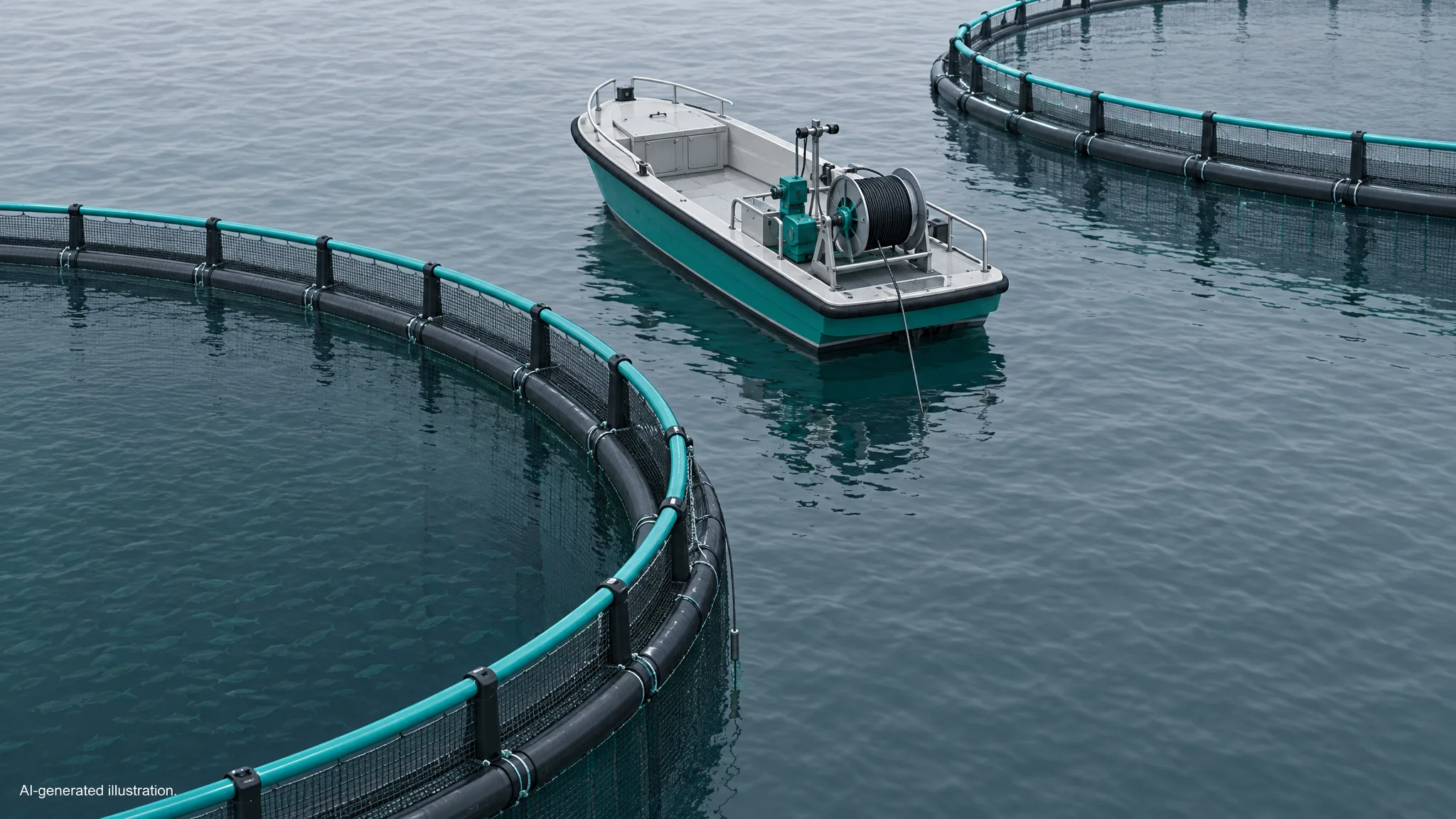
Why does the boat decide before the depth rating does?
A fish cage inspection ROV is usually chosen on depth, and at a working cage depth is the last thing that separates the candidates. Every tethered platform we coordinate with Pengpai Ocean reaches further than a cage is deep: the PX-MiniROV is rated 0–100 m, the PX-180ARV 0–200 m, and the PX-050ROV and PX-100ROV 0–300 m. SepcoTech, which distributes five aquaculture ROV brands and publishes its own depth guidance by task, puts 100–300 m as more than sufficient for most aquaculture work and says there is no advantage in paying for depth you will not use.
What is left to decide is the site. Three conditions on a cage farm sort these platforms faster than any rating: where the remotely operated vehicle's tether can run between the net and the mooring lines, what electrical supply the boat can give it, and whether the deck has room for a winch and a person standing at a control unit. Depth says all four can work. These three say which one will.
We supply the platforms and coordinate their configuration with Pengpai Ocean, the manufacturer; we do not run farms or operate vehicles for anyone. What follows is what each platform asks of the boat, and what to have ready before the configuration conversation.
Where does the tether go between the net and the mooring lines?
Out of the water and around the outside of the net, through whatever else occupies that band. The vehicle cannot widen the band, and the operator cannot invent a route the cable will not take: the cable's own construction and the hardware that guides it set the options.
Three details of that hardware decide more than the cable length printed beside it.
- Buoyancy. The PX-MiniROV's control cable is listed as zero-buoyancy with Kevlar reinforcement. A cable that neither floats nor sinks stays in the water column between the vehicle and the boat instead of arcing across the surface or lying slack over a collar — in a gap where the surface is already taken by a boat, a feed barge or a walkway, that is the difference between a route and an obstruction.
- Tensile resistance. The same cable lists 80 kg. Read it beside the manufacturer's own caveat: that figure is a cable property, not a safe working load and not permission to lift the vehicle by its cable. It tells you when the cable parts; it does not tell you what you may pull with it.
- The guide. The PX-050ROV and PX-100ROV come on a retracting system listed with an electric-control winch, a guide device and a 300 m umbilical. The listing names the guide but does not describe it, and it sits between the winch and the water: ask what it consists of, how it mounts to your deck and what it weighs, and put the answer in the quotation rather than in an assumption.
Cable length is not reach. A 100 m cable on a 100 m-rated vehicle is two separate limits, and a route that goes round the far side of a cage spends cable the depth rating does not count. The same water holds the mooring lines, which are a different job on longer tethers and heavier hardware, and the collar itself, which is where the vehicle goes in and the cable comes out.
Does the boat have the power for a cable-powered ROV, or only a battery's worth of time?
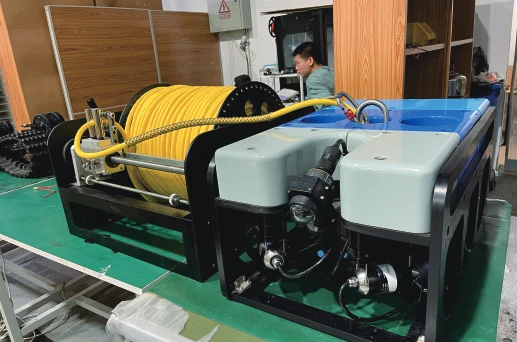
Cable power trades the battery clock for a deck supply; a battery vehicle trades the deck supply for a working window. Which of the two your boat can give is the question, and it is a different question from which vehicle can reach the net.
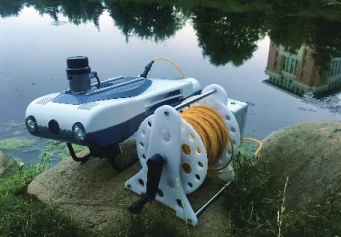
The PX-MiniROV carries a 200 Wh lithium battery with a listed maximum battery life of 3.5 h and a charging time of 1.5 h; a high-endurance pack is an option. That 3.5 h is a maximum tied to that pack, so treat it as the ceiling on a day's first dive rather than a shift. Two cages in a morning means planning around a charge or a second battery, and whether a second pack can be carried and swapped on your boat is a quotation question, not a given.
The PX-050ROV and PX-100ROV take power down the umbilical. Pengpai Ocean describes cable power as supporting long-duration operation where supporting facilities are limited — a fair description of a service boat, because the facility that limits it is the boat's own supply. The published listings do not state the deck supply these two systems expect, so ask for it in the quotation and measure it against what your boat can give where the winch will sit.
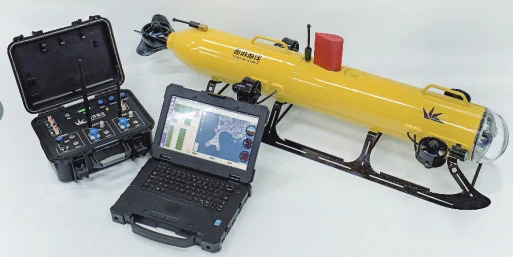
The PX-180ARV sits between the two: a 1 kWh battery with a 4 h maximum and a 5 h charge, plus optional control cables — a power-carrier cable to 200 m or a fiber-optic cable to 1,000 m — that leave its 200 m depth rating where it was. Carry that distinction into any request, because a long cable is the kind of number that quietly gets read as capability.
A boat's electrical installation, its protection and the fixing of a winch to a deck belong to whoever operates that vessel and to a qualified electrician on your side. This page does not set out how to arrange them, and a quotation is not a substitute for that sign-off.
Which fish cage inspection ROV fits the boat you actually have?
The one whose deck equipment your boat can carry and whose cable route fits the gap — which is why the table below is about what arrives on deck, not about what the vehicle can do once it is down there.
| Platform | Vehicle weight and size | Working depth | Cable as listed | Deck-side equipment |
|---|---|---|---|---|
| PX-MiniROV | 3.2 kg; 420 × 220 × 100 mm | 0–100 m | 100 m zero-buoyancy, Kevlar-reinforced; 80 kg listed tensile resistance | Integrated reel-winch transport arrangement; optional special reel winch and fiber-optic cable; 200 Wh battery, 3.5 h maximum, 1.5 h charge |
| PX-050ROV | 50 kg; 700 × 450 × 364 mm | 0–300 m | 300 m umbilical | Electric-control winch and guide device, deck control unit; cable power; 15 kg payload |
| PX-100ROV | 150 kg; 1,000 × 640 × 828 mm | 0–300 m | 300 m umbilical | Same retracting system and deck control unit; cable power; 30 kg payload |
| PX-180ARV | 30 kg; 1,200 × 380 × 400 mm | 0–200 m | Optional 200 m power-carrier or 1,000 m fiber-optic control cable | 1 kWh battery, 4 h maximum, 5 h charge; optional reel winch and shore control box; AUV and ROV modes |
Two columns do more work than the rest. Vehicle weight is what you handle, and on these platforms it is not the payload: 50 kg of vehicle against a 15 kg payload on the PX-050ROV, 150 kg against 30 kg on the PX-100ROV. Why those two numbers are never interchangeable is set out in our note on the three numbers behind an ROV's limits, and it is worth clearing up before the table becomes a lifting plan — because dividing a vehicle weight by the number of people aboard is not one.
The other column is the operator count, and only one platform here has a stated figure: Pengpai Ocean says the PX-180ARV can be deployed and recovered by one or two operators. For the other three, how many people it takes to put the vehicle in the water and get it back is a question for the quotation and for the boat's operator, not something to infer from its weight.
The published limits for all four are on our ROV range page, together with our own warning that tether length does not establish permitted depth, current capability or reach around structures.
Does the task decide the camera, the sonar and the tools?
Yes, and it decides them before the platform, because the answer changes what the boat carries too. A live-feed inspection with a reference for each observation is a camera, lighting and recording question. A search for a hole, a tear or a lost feed bag in poor visibility may want forward-looking sonar, which is a configuration choice on the PX-MiniROV and on the two larger cable-powered platforms. A tool task is another platform again.
What the farm has to be able to show afterwards is the part that gets skipped. A pass that shows where a vehicle went is not the same output as a record of what the net looks like, and settling the difference before a vehicle is chosen saves a configuration change later. We set the two outputs side by side in keeping a cleaning pass apart from a condition record. Where the inspection requirement itself still needs defining — structure, access, depth, visibility, current, cable route and the output owed — the four points on our underwater inspection page are the same ones we would ask in a first reply.
What should the request to us state?
Six things, and with them the configuration conversation starts at the boat instead of at a model.
- The boat. Deck length and free space, what lifting gear exists, where a winch could be fixed, and what supply is available at that point.
- The gap. Which side you launch from, how far the far side of the cage is from that point, and what else is in that water — mooring lines, feed pipes, buoys, a walkway.
- The depth and the water. Working depth, current, and how visibility changes through the year.
- The output. Whether you need live observation, a recording with locations, or a tool task, and who assesses what the recording shows.
- The platform. If a model is already in mind, name it; if not, say what the boat and the gap allow, and we will put the four side by side.
- The people. Who operates on the day, and whether they have run a tethered vehicle before.
Send those through our project inquiry page, and drawings or the boat's supply details can go to sales@aquarobotsupply.com. We take the same list to Pengpai Ocean, because the vehicle follows from the boat and the gap — not the other way round.
Filed under Fish Cage Inspection and Net Cleaning
Back to Blog