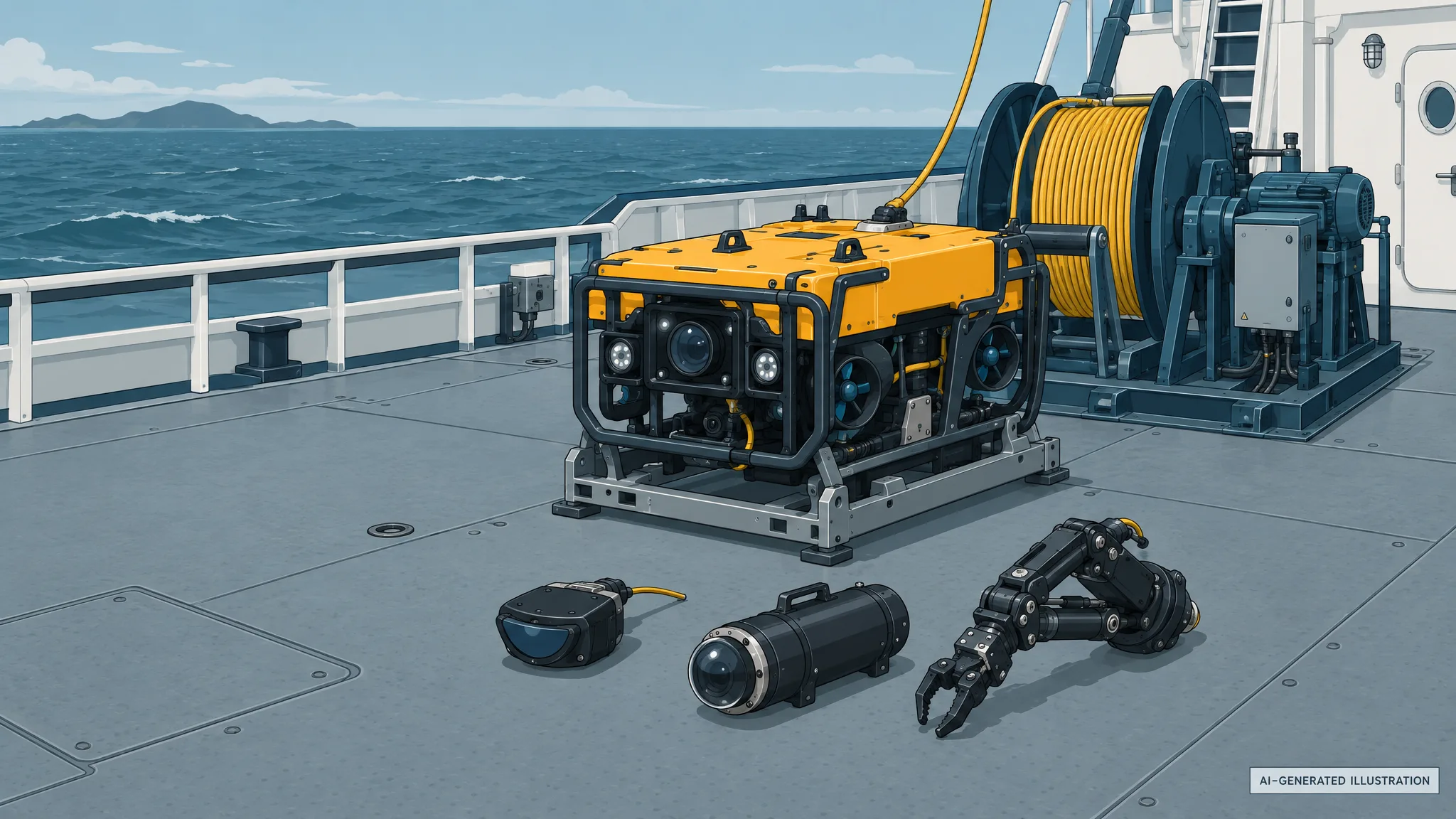
A 50 kg inspection ROV does not carry 50 kg of instruments. Our page for the PX-050ROV publishes a 15 kg payload against a 50 kg vehicle, and the PX-100ROV publishes 30 kg against 150 kg. Neither figure is an ROV buoyancy figure, and buyers often read them as if they were.
What the payload line leaves open is what the vehicle does when you fit the sonar, the camera and the manipulator, and the thrusters stop. That is the buoyancy question, and it is the one number the model tables we work from do not publish — which is why we ask for a payload list, item by item, rather than a payload total.
Why does a 50 kg ROV carry only 15 kg?
Because vehicle weight and payload describe opposite sides of the same platform. Vehicle weight is the mass Pengpai Ocean lists for the machine out of water; it decides what the deck has to lift, stow and ship. Payload is the allowance the same table gives for equipment added to that machine.
| Model | Vehicle weight | Payload | Working depth |
|---|---|---|---|
| PX-MiniROV | 3.2 kg | not stated | 0–100 m |
| PX-050ROV | 50 kg | 15 kg | 0–300 m |
| PX-100ROV | 150 kg | 30 kg | 0–300 m |
| PX-180ARV | 30 kg | not stated | 0–200 m |
Two cells are empty, and those are the ones worth reading twice. "Not stated" is neither zero nor generous. The hybrid carries a 30 kg vehicle and no published payload capacity, so an instrument list for it goes to the manufacturer as a question, not into a subtraction. The 3.2 kg portable vehicle is documented as an observation platform for the same reason: light machine, no stated allowance, nothing to calculate.
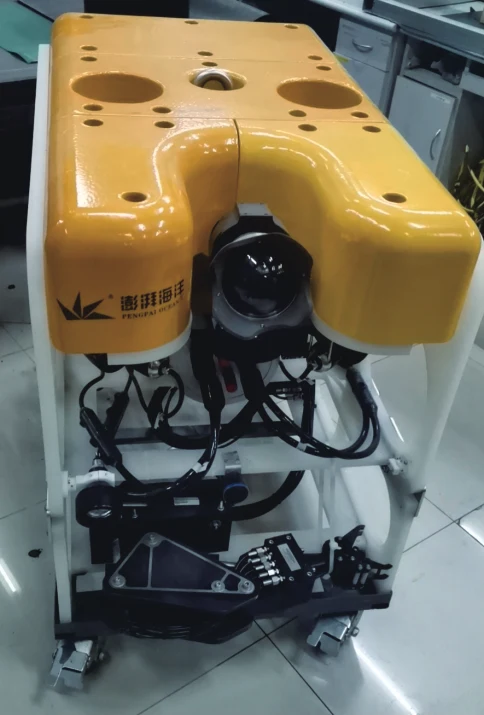
The four ROV and hybrid platforms we coordinate sort by these numbers before they sort by anything else. A buyer who has 8 kg of camera, sonar and bracket is inside the 15 kg allowance and has room to discuss a tool. A buyer who has 20 kg is not, whatever the vehicle weighs.
What does the payload figure actually limit?
It limits how much you may add to the platform, and it limits nothing else. For the two cable-powered inspection platforms, Pengpai lists camera and lighting, a manipulator, forward-looking sonar and inertial navigation among the equipment the platform can take — a list of categories, not of masses. The 15 kg and 30 kg are the ceilings the manufacturer publishes; keeping your named items under the ceiling is your job, and checking that the 25th kilogram is not hiding in a bracket is part of it.
Two consequences reach the quotation directly.
A payload figure is not a compatibility statement. A particular manipulator brings mass, mounting, reach, voltage and control questions that the payload line does not answer. Our inspection ROV checklist asks for the model, dimensions, mass, electrical demand and interfaces, and it asks for them because a payload allowance alone will not tell you whether the arm fits the frame or the deck control unit.
And a payload figure does not say where the mass sits. The same sonar head mounted low on the frame and mounted high on a bracket is the same payload and a different vehicle in the water — one change of position, one change of how the machine behaves when you let go of the controls.
Where does ROV buoyancy appear in these specifications?
Nowhere on the vehicle row, and that absence is the whole difficulty. In its plain form, buoyancy is a subtraction: the water an assembled vehicle and its instruments push aside gives an upward force, and what is left of that force after the assembled weight comes off decides whether the package rises, hangs where it was put, or keeps sinking. A vehicle trimmed slightly positive comes up if power fails. A negative one goes down. One close to neutral stays where you left it and lets the thrusters work on position instead of on weight. All three are defensible for different tasks, and none of them is in the table.
What the tables do state is buoyancy on the cables. Two of the four ROV documents mention it at all, and both times it describes the tether.
The PX-MiniROV lists a 100 m control cable described as a zero-buoyancy cable with Kevlar reinforcement, with tensile resistance given as 80 kg. Zero-buoyancy is the buoyancy statement: the cable is built not to add vertical load to a 3.2 kg vehicle. The 80 kg is a strength figure — not a lifting rating, and not permission to take the vehicle out of the water by its cable.
The PX-180ARV offers, in ROV mode, an optional fiber-optic control cable described as zero-buoyancy and up to 1,000 m. That cable adds no lift, which still leaves it adding drag, and a 1,000 m cable does not raise the 200 m working-depth limit.
The 300 m umbilicals on the two cable-powered inspection platforms are given by length alone. Length is not a working radius, and it is not a buoyancy figure.
One other line in our source material says what a mass is measured against: the net cleaning ROV table lists an "air net weight" of 105 kg. Air is the point. That is a weight out of water, and every vehicle weight in the ROV tables is the same kind of number. What none of them includes is the displacement that would let you take the difference.
None of the four model tables lists ballast, foam or a trim-adjustment provision either. If trim matters to your task — and beside a structure you have to hold in view for minutes at a time, it does — put it in the inquiry as a requirement rather than assuming it can be corrected on deck afterwards.
Does rated thrust in kilograms mean the vehicle can lift that much?
No. The PXT thruster range runs across five models rated from 12 kg to 130 kg of thrust, from 400 W to 5 kW, at working depths from 600 m to 6,000 m. A rated thrust is push at a stated voltage and speed — a horizontal shove or a vertical hold. It is not lift, not buoyancy and not a payload allowance, and those kilograms are not interchangeable with the kilograms in the vehicle row.
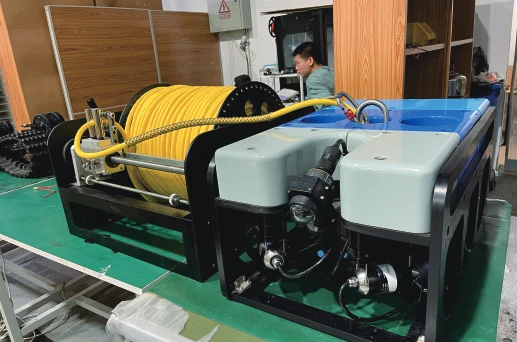
Here the ROV tables are thin in a way that matters. They say how many thrusters each platform carries — six on the two 300 m cable-powered vehicles, four in a horizontal vector layout and two vertical; three on the portable one; five on the hybrid — and they do not say which thruster model is fitted. Same count, very different thrust. Ask which unit is installed, at what rated voltage, and what rated thrust it gives. That figure is one input to station-keeping, not the answer: vehicle mass, payload, the tether's drag and how much thrust is available in the direction you need all enter it, and Pengpai Ocean holds the numbers for a named configuration.
Speed is a third quantity again. The two cable-powered platforms are listed at 0–3 kn, and a speed range is not a current rating.
What belongs on the load sheet you send with an inquiry?
Four columns for the equipment, then two more for everything that is not on the vehicle.
- Item and model. Camera, lights, sonar, manipulator, navigation, and the bracket or skid each one needs.
- Mass in air. From the instrument supplier's own datasheet, not from an estimate.
- Buoyancy or displacement, where it is published — or "unknown", which is a legitimate entry and becomes a question for the manufacturer.
- Mount, power draw, connector and data interface. A payload that fits the mass allowance can still be impossible to connect to the deck control unit.
- The tether. Length, its stated buoyancy if any, and whether the strength number beside it is a strength number.
- The deck. Winch, guide, retracting system, deck control unit and power supply — and which of those the quotation includes rather than your site provides.
That sheet is also the honest way to compare two vehicles. A 15 kg allowance on one platform and a 30 kg allowance on another are not comparable offers until each tether's buoyancy and each instrument list are known, and the difference will not show up in a depth comparison. The project equipment inquiry takes the list as it stands; we take the payload and tether questions to Pengpai Ocean with your site conditions attached.
For a heavier vehicle, the handling side belongs in the same conversation rather than after it. Lift arrangement, deck space and recovery for a 150 kg platform need the manufacturer's written system and your own qualified personnel to review them; a payload figure says nothing about any of that.
Which of the four do these numbers point to?
Start from what you must carry, then from what your deck can move.
- PX-MiniROV, 3.2 kg, no payload stated. An observation platform with a 200 Wh battery and a 100 m cable. Read it as eyes in the water, not as a light tool carrier.
- PX-050ROV, 50 kg and 15 kg. The 15 kg is the figure to test your item list against, on a 300 m umbilical with winch and deck controls.
- PX-100ROV, 150 kg and 30 kg. Twice the payload allowance of the smaller platform, and three times its vehicle mass on the deck.
- PX-180ARV, 30 kg, no payload stated. Autonomous and tethered modes on one platform, a 1 kWh battery, up to 4 h, and a choice between a 200 m power-carrier cable and a 1,000 m zero-buoyancy fiber cable.
If your list runs past the allowance on the vehicle you wanted, three routes remain: a larger platform, a shorter list, or a configuration discussion with the manufacturer. The three quantities above are what make that choice visible before an order rather than after a first deployment — and the task-based inspection guide we published earlier covers what to define before any of this starts.
Send the load sheet with your site conditions. We will come back with the payload allowance that applies to the named configuration, the tether arrangement that goes with it, and the questions only Pengpai Ocean can answer.
Filed under ROVs
Back to Blog