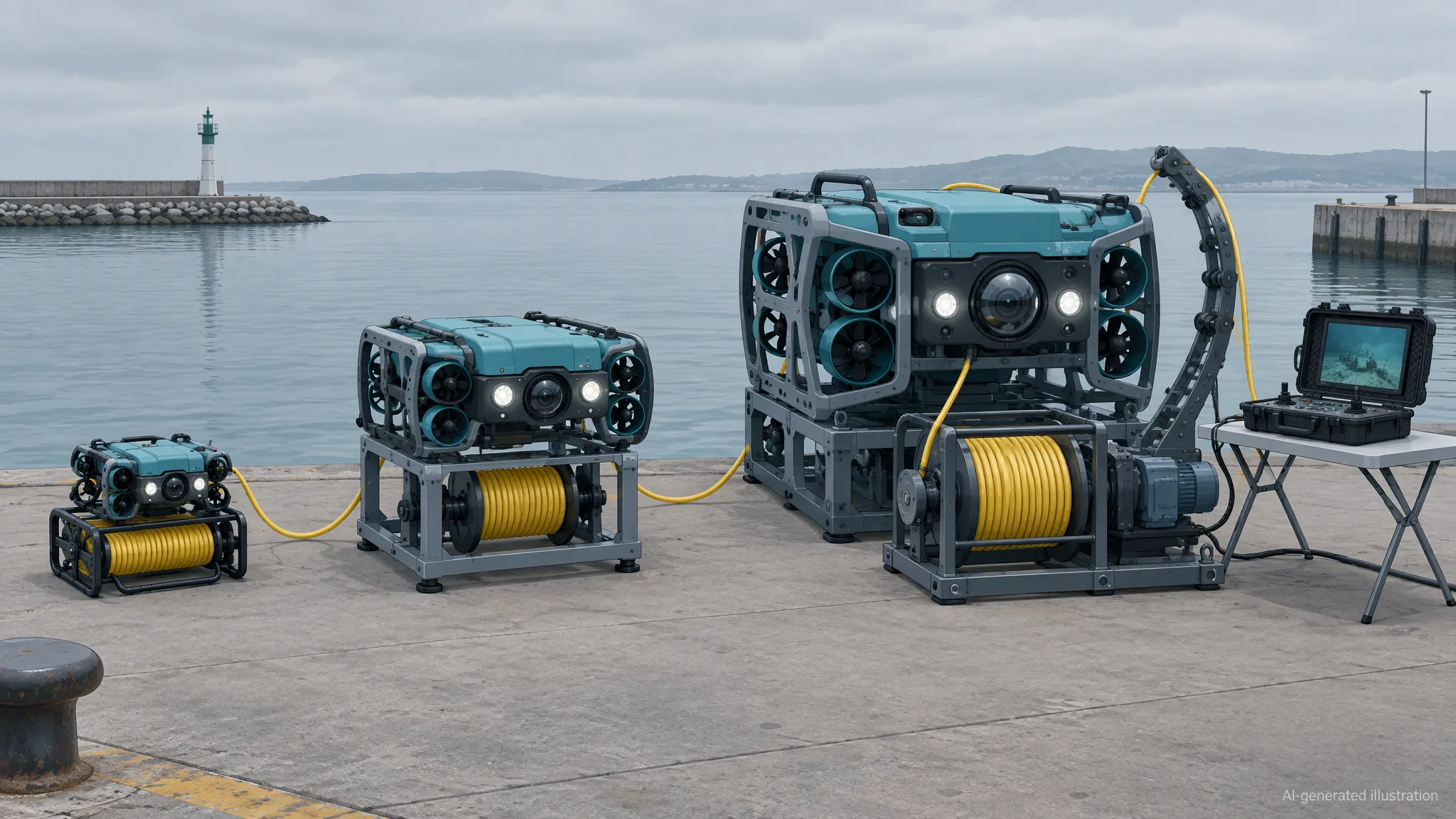
What does an ROV depth rating measure?
An ROV depth rating is the manufacturer's working-depth limit for the pressure-rated parts of the vehicle, stated for a named configuration and not for the system you will operate at the site. In the Pengpai Ocean PX series we supply, the ratings are 0–100 m for the PX-MiniROV, 0–200 m for the PX-180ARV and 0–300 m for the PX-050ROV and PX-100ROV.
Everything else you need at the site sits beside that number rather than inside it. Cable length, speed range, payload, endurance and camera package each have their own line, and none of them is bounded by the depth figure. The PX-180ARV is rated to 200 m and takes an optional zero-buoyancy fiber-optic control cable of up to 1,000 m; the cable is longer than the rating and does not raise it. The PX-MiniROV is rated to 100 m and carries a 100 m control cable, so at the bottom of its range the cable is fully paid out.
Our ROV comparison table sets depth, vehicle weight, payload, cable and deployment side by side, which is the only way the figures mean anything.
Three separate questions hide inside one specification sheet. How deep are the hull and housings rated? How much cable must you handle, and how far can the vehicle travel from where that cable enters the water? How fast can the thrusters push it? The first is the depth rating, the second is the tether and the third is the speed range. A tender that conflates them specifies a vehicle nobody can deploy from the deck that is available — the same order of questions we work through in our inspection ROV buying guide.
What changes from a 100 m vehicle to a 300 m one?
Mass, power and the equipment on deck change together, and they change more than the pressure envelope does. These are the published figures for the four tethered platforms we supply, each in the configuration it is rated for.
| PX-MiniROV | PX-180ARV, ROV mode | PX-050ROV | PX-100ROV | |
|---|---|---|---|---|
| Working depth | 0–100 m | 0–200 m | 0–300 m | 0–300 m |
| Vehicle weight | 3.2 kg | 30 kg | 50 kg | 150 kg |
| Payload | not stated | not stated | 15 kg | 30 kg |
| Dimensions | 420 × 220 × 100 mm | 1,200 × 380 × 400 mm | 700 × 450 × 364 mm | 1,000 × 640 × 828 mm |
| Propulsion | 3 thrusters | 5 thrusters, five degrees of freedom | 6 thrusters: 4 horizontal vector, 2 vertical | 6 thrusters, same layout |
| Power | 200 Wh battery, 3.5 h maximum, 1.5 h charging | 1 kWh battery, 4 h maximum, 5 h charging | Cable power, ship or shore | Cable power, ship or shore |
| Cable and handling | 100 m control cable, Kevlar-reinforced and zero-buoyancy, 80 kg listed tensile resistance | Optional 200 m power-carrier or 1,000 m fiber control cable | 300 m umbilical, electric-control winch, guide device, deck control unit | 300 m umbilical, electric-control winch, guide device, deck control unit |
The 100 m end is portable kit: a 3.2 kg vehicle and its reel, made to be carried and transported as one unit, with three thrusters and a 200 Wh battery. Pengpai lists a maximum of 3.5 hours of battery life and 1.5 hours to recharge, so the working day is built from those intervals rather than from a power supply on deck.
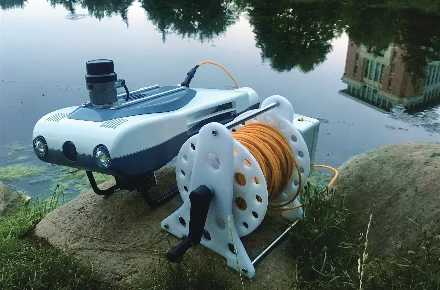
The 200 m platform in our range is not the next rung of the same ladder. The PX-180ARV is a 30 kg hybrid that works autonomously or on an optional tether, with a 1 kWh battery listed at a maximum of 4 hours and 5 hours to charge, and Pengpai describes deployment and recovery by one or two operators. Because its tether is optional, it reaches 200 m without the cable-handling package a 300 m platform brings. VideoRay draws its own line for deep work at about 150 m, which puts the 100 m portable class on one side of it and the two 300 m platforms on the other.
The 300 m pair is a different kind of purchase. Both are cable-powered from ship or shore, so there is no battery endurance figure to plan the day around: the run time belongs to the supply you bring. Both are listed with a 300 m umbilical on an electrically controlled winch, a guide device, a retracting system and a deck control unit. Depth at this level is bought with deck space, a power supply and a handling arrangement, and those are the parts of the quotation that decide whether the vehicle gets wet.
Read that way, a depth rating describes the deployment class behind it. It serves the buyer who reads it as "which of these can I actually operate" better than the one who reads it as a capability score.
Why are two vehicles with the same 300 m rating 100 kg apart?
Because payload and frame set the mass, and the pressure rating does not. The PX-050ROV is a 50 kg vehicle with a 15 kg payload in a 700 × 450 × 364 mm envelope; the PX-100ROV is a 150 kg vehicle with a 30 kg payload in 1,000 × 640 × 828 mm. They share the 0–300 m rating, the six-thruster layout with four horizontal vector thrusters and two vertical ones, the 300 m umbilical and the same deck references.
Twice the payload in a much larger envelope, at the same depth. What doubles between them is what you can mount and carry; what you take on is lifting, deck space and recovery. If your requirement is tools rather than a camera alone, the extra 100 kg is the price of the tool scope, and the depth figure plays no part in it.
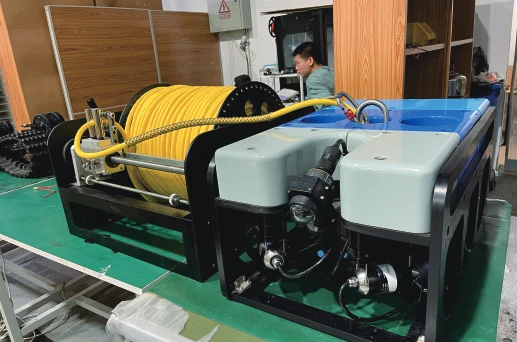
The same non-relationship runs through the rest of the catalogue. Pengpai Ocean lists its net-cleaning platform at a 100 m working depth and an air weight of 105 kg, heavier than the 50 kg vehicle rated to three times that depth. Its mass comes from the cleaning system it carries. Depth sets the pressure housings; the task sets everything you have to lift — the split we set out in vehicle weight, payload and buoyancy.
So use the depth ladder to cross vehicles off rather than to rank them. It tells you which platforms can reach the site. The survivors are then compared on payload, envelope, power and handling, and that is a different table.
What does the rating leave out?
Current, visibility and reach — the three conditions that decide whether a dive works, none of which a working-depth figure states.
Current. The 0–3 kn on the PX-050ROV and PX-100ROV and the 0–4 kn on the PX-MiniROV and PX-180ARV are vehicle speed ranges: how fast the thrusters can move the vehicle, not how much flow it can hold station in. A current figure is a different measurement, quoted as a band beside the conditions it was taken in. Ask for that band, and ask what it was measured against.
Visibility. Camera and lighting are configuration lines on all four platforms, and forward-looking sonar is an option. At 300 m there is no daylight to help: VideoRay's field guide notes that natural light fades below about 200 m and rarely offers anything even in clear water at that depth. The record you bring back is decided by the camera, the lights and whether you specified imaging sonar.
Reach. Cable length is not working radius. VideoRay's guidance is to allow 25% to 75% more tether than the vertical depth to cover the slant angle that current produces. Put that against a 300 m vehicle on a 300 m umbilical: at 300 m the cable is already fully paid out, so any horizontal offset or current-driven slant comes out of the working depth rather than being added to it. The same guide notes that a neutrally buoyant tether can compress and lose buoyancy at depth, which is why the cable's behaviour belongs in the planning and not only in the bill of materials.
Time. VideoRay puts a 300 m descent at roughly 20 to 30 minutes. That is transit before any inspection happens, and its cost lands hardest on a job where the vehicle is rated to exactly the depth you need.
How should depth go into the inquiry?
As one condition among five, written with the numbers your site actually has.
- Depth and structure. The deepest point of the work, not the deepest point of the water, and what the vehicle has to approach when it gets there.
- Current. At the working depth and through the column above it; a 300 m site can have very different flow at the top and the bottom.
- Visibility and the record you owe. Video, stills or sonar imagery, and whether the water needs imaging sonar to produce them.
- Tether route and offset. Where the vehicle enters the water, how far it has to travel horizontally, and what the cable will pass on the way.
- Deck and power. Space, lifting and recovery, and whether ship or shore power is available for a cable-powered vehicle.
Those five are what a quotation is built from. With them we can say whether the 100 m portable, the 200 m hybrid or one of the 300 m platforms is the honest starting point, and which deck items the supply has to include. If your site is 250 m deep, the depth figure has already made the shortlist: the portable class is out, and the choice is between a hybrid without a tether and a 300 m platform with its winch and deck control. Send us the five conditions and we will put the vehicle, the cable and the deck scope into one quotation.
Filed under ROVs
Back to Blog