What do water rescue robot specifications actually measure?
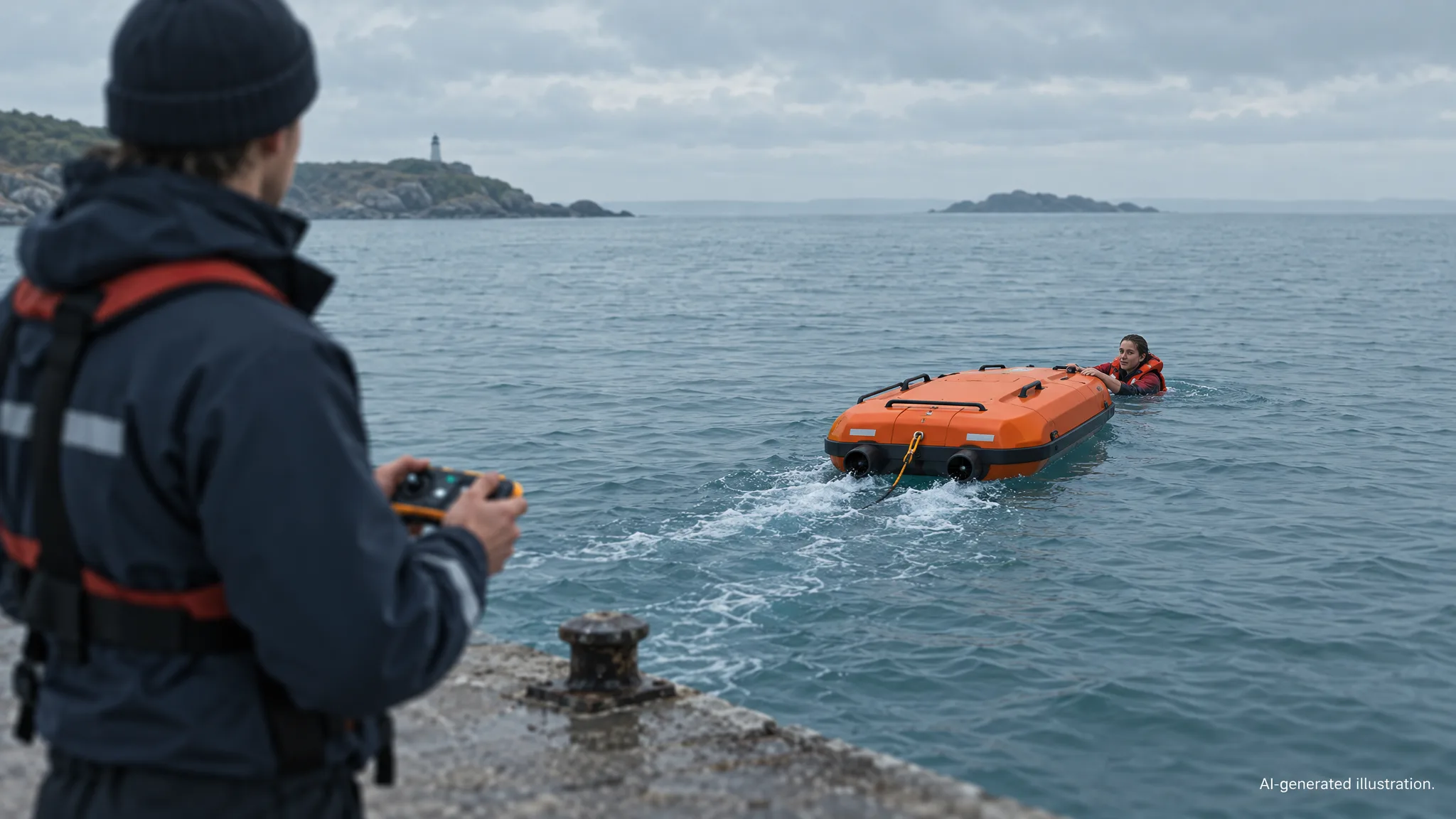
Water rescue robot specifications report three different quantities in one column: how heavy the unit is, how much lift the hull provides, and what load it is rated to tow. None of them is a version of the others, and none converts into another. On the GUARDIAN PRO specification sheet they appear as 16 kg, 80 kg and 1,000 kg, beside a 7 m/s maximum speed, an 800 m control range and one hour of endurance. A shortlist built on those numbers alone will compare the wrong pairs.
| Published figure | The question it answers | What it cannot tell you |
|---|---|---|
| Unit weight, 16 kg | Can the team carry it to the water and launch it from this bank, pier or deck? | How much it holds up once afloat |
| Effective buoyancy, 80 kg | How much lift the hull provides, expressed as a mass | How many people it can support in your water |
| Towing capacity, 1,000 kg | The load the unit is rated to tow | How that rating was measured; a tow is not a lift |
| Maximum speed, 7 m/s | The fastest it goes in the conditions it was measured in | The speed with a person holding on |
| Control range, 800 m | How far the remote link is rated | Whether the operator can still see the target |
| Endurance, 1 h | How long the battery lasts in the conditions it was measured in | Whether that hour is at full speed or at cruise |
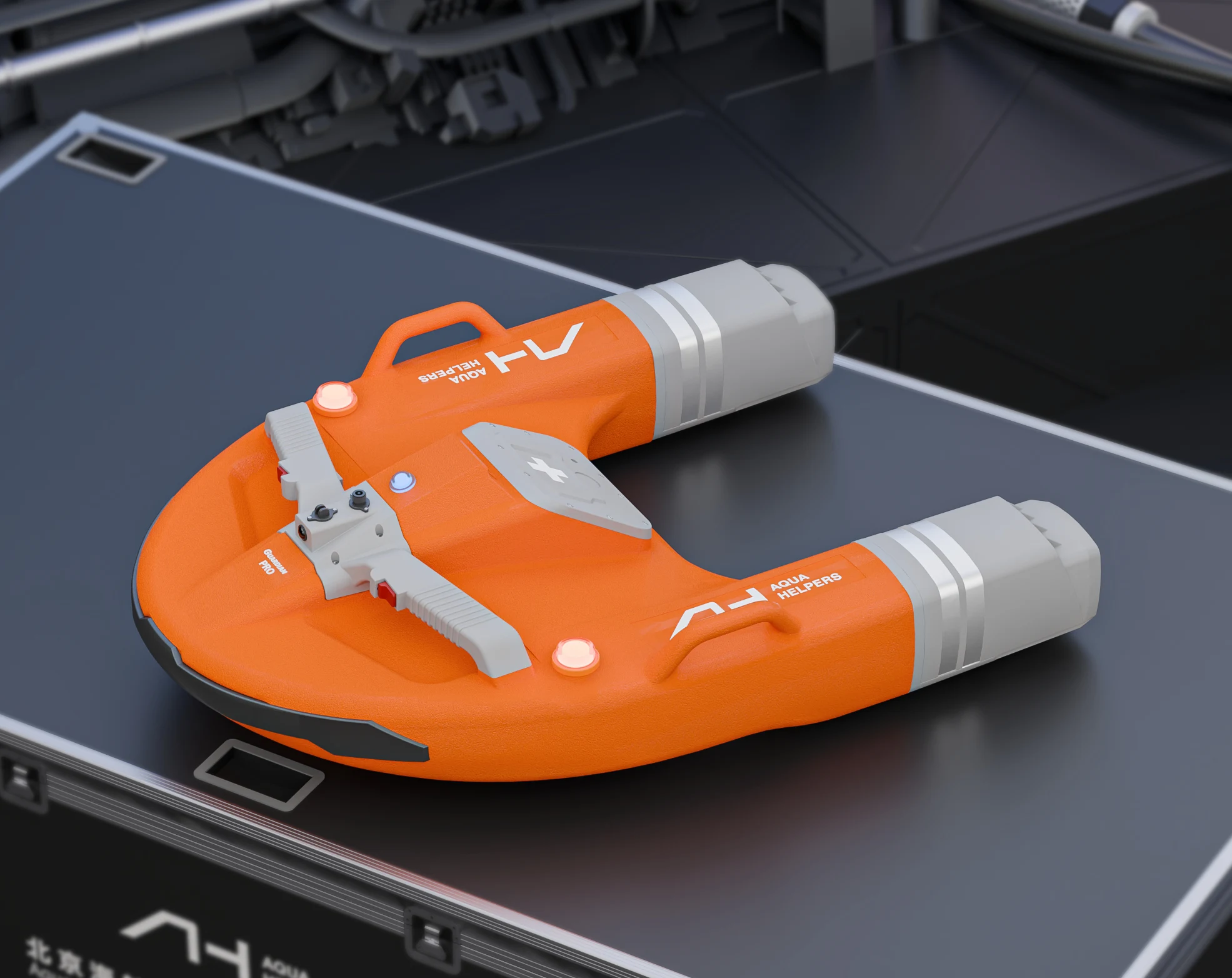
Weight is the figure your launch point cares about, and the least ambiguous of the set. JTT Rescue's R1 page lists 15 kg and an envelope of 980 × 780 × 260 mm for a device it describes as thrown into the water and driven by remote control; the sheet here lists 16 kg at 1,000 × 720 × 270 mm. What the figure settles is whether your access — a bank, a pier, a ladder, a boat deck — can take that weight and that envelope. It does not scale with what the unit is rated to tow: the same sheet that says 16 kg also says 1,000 kg.
Why can't 80 kg of buoyancy be turned into a number of people?
Because buoyancy is a force and a headcount is a claim about an outcome. The market does not even agree on the unit. The R1 page publishes 750 N and glosses it as "equivalent to four swim rings"; another page we compared gives a load capacity of up to 250 kg and describes it as flotation support for up to two adults. At standard gravity, 750 N of buoyant force is about 76 kg, and 80 kg of buoyant mass is about 785 N. Two figures that look an order of magnitude apart on a comparison sheet are within a few per cent of each other.
What decides whether a person stays with the device is not that figure on its own. It is how much of the hull remains above the surface with a person's weight in your water, and what there is to hold. Both change with the load, the chop and how the person sits on the hull. A vendor's "up to two adults" describes their hull in conditions they have not stated; it does not travel to a different one.
Ask every supplier, us included, what water, what load and what measurement produced the buoyancy figure. A number without those belongs on a shortlist, not in a deployment plan.
Does a 1,000 kg towing capacity mean it can carry that?
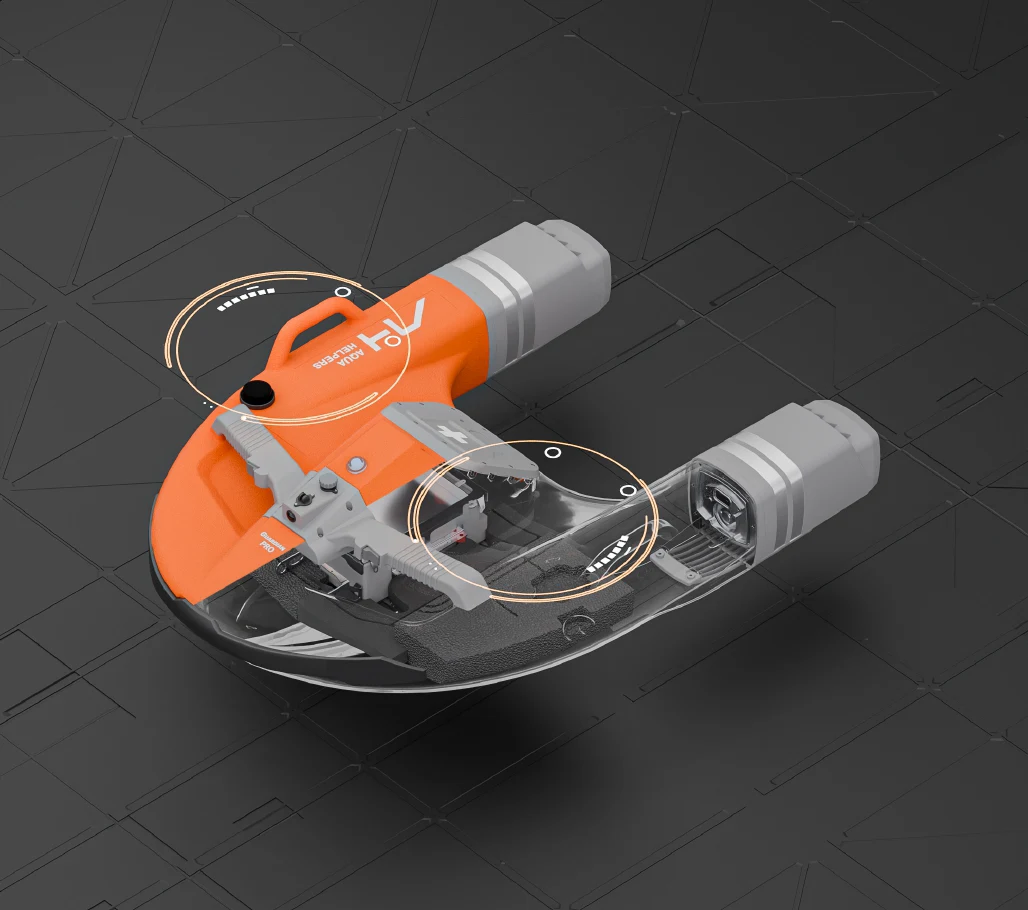
No. Towing capacity is a pull, not a lift. Whatever is being towed carries its own weight in the water; what the propulsion has to overcome is drag, current and the attachment point, and that is not the same problem as holding a body up. OceanAlpha describes a 1-ton towing capacity on its Dolphin 3 as a way to drag multiple survivors, lifeboats or debris. That is a description of intended use, not the conditions of the measurement.
Which leaves two questions for any supplier: what the figure measures — a bollard pull at zero speed, or a mass towed at some speed — and what the tow point is rated for. Our sheet publishes the 1,000 kg rating without stating the method behind it, so treat it as a figure to question before it enters a comparison, not as a capability to plan around.
Is the maximum speed the speed you will get?
Rarely. On several of the pages we read, the headline speed is the unladen one. JTT Rescue lists 7 m/s without loading and 2 m/s with 80 kg loaded; Bafang gives up to 10 knots unloaded and about 3 knots under load. The 7 m/s on this sheet carries no stated load condition, which makes the load condition the first question to put to it.
The gap matters because speed is time, and time is the point of the device. A target 800 m away is under two minutes at 7 m/s and under seven at 2 m/s. Multiply that by a search pattern, a current pushing the person away, and a return leg with someone holding on, and the two figures stop describing the same rescue.
Which limit comes first, control range or endurance?
The sheet gives one hour of endurance and 800 m of control range as two separate maxima, and separate maxima are not a promise that both hold at once. The figures alone do not establish which limit will be reached first. Do not treat the 800 m control-range rating as a safe deployment radius or assume battery reserve is sufficient for that distance. Both require confirmation under the intended operating conditions, including the return leg.
Put both questions to the supplier in the same breath. What is the one hour measured at: full speed, cruise, or holding position in current? What is the 800 m: an open-water line-of-sight figure, or shore-to-water? Neither answer is in the sheet, and the pair decides how far you can send the unit and how long it can stay out.
The return function belongs in the same conversation. OceanAlpha publishes an auto-return on its Dolphin 3 range that is triggered by loss of signal or low battery, with a battery threshold it describes as customizable. Our sheet states the trigger for this unit — low battery or signal loss, returning to the launch point — without a threshold. Ask what that threshold is, whether the return follows a straight line or the recorded track, and what the device does if a person is holding it when the return begins.
What do the safety functions actually cover?
Self-righting and automatic power-on after a capsize are structural promises, and worth reading as such: the unit comes back to a working attitude and starts again on its own. That is not the same as saying it stays with a person in rough water, and no datasheet should be read that way. Cruise control, the dual-antenna link and the return function belong to the same category of claims: functions to confirm one at a time, with what triggers them and what they assume.
Voice is the item here that is often an accessory rather than part of the machine. This unit supports an external loudspeaker and public-address module, which lets an operator talk to the person in the water, the most useful thing after flotation arrives. Confirm whether it is in the delivered kit or a separate order before comparing two quotations as if they were the same.
What should you send us before choosing?
Send the site, not the model number first. The answers that decide a configuration are the ones about water and distance:
- The water and the reach: inland lake, river, beach or harbour; typical wind and wave; the distance from the launch point to the farthest point a person could be.
- The launch point: a pier, a beach, a boat deck, a vehicle; whether one person will handle the unit or two.
- The people: how many are likely to be in the water at once, and what they will be wearing and holding.
- The operating pattern: patrol and standby, or a call-out response; whether the device sits charged on a station or travels in a vehicle.
- The rules you work under: the procedures, training and local requirements that apply where you operate.
Those five turn a table of figures into a shortlist that fits a real site. We supply water rescue equipment from manufacturing partners and coordinate the configuration discussion; send the answers through our project equipment inquiry and the first round of questions is already written.
Operational decisions stay with trained rescue personnel and the procedures that apply where you work. A specification sheet can tell you what a device weighs, lifts and is rated to tow; it cannot tell you whether your team can reach someone in time with it.